



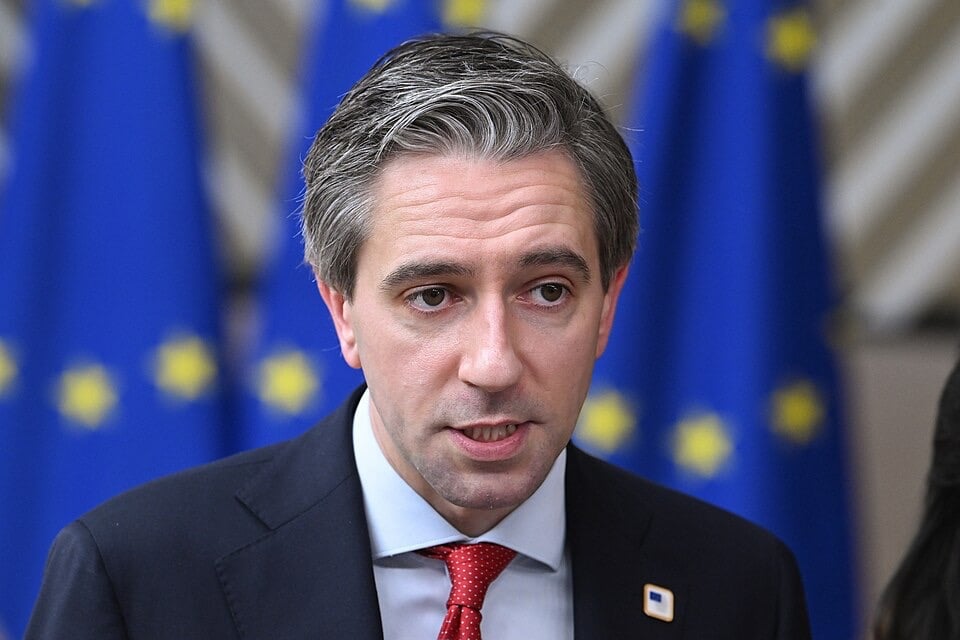
The Irish government party’s report sets out a range of scenarios for the cost of unification, from €3.2bn to €25bn in year one. It says the outcome depends heavily on the design of any united Ireland and the settlement reached with the British government.
A united Ireland could cost the Exchequer as much as €25bn in its first year, according to a “blueprint” published by Fine Gael. The report, a key part of the party’s annual Ard Fheis, also gives a more favourable first-year figure of €3.2bn, depending on how any constitutional change is designed. Under its most adverse high-cost scenario, the annual bill would reach €41.2bn by year 25. Tánaiste Simon Harris said the party wants an “honest and open conversation” on the issue.
The cost scenarios
The modelling draws on research by Professor Stephen Kinsella, who stresses that there is “no single fixed cost of unity” and that a settlement with the British government is critical to any estimate. His findings set out four designs for a unified island, each using the status quo as a baseline: “Unitary”, “Federal”, “Managed Integration” and “Higher Cost”. The projections also depend on whether the British government keeps accrued pensions and debt interest.
According to the report:
- Federal: Northern Ireland keeps a separate administration, phases pay and welfare to Irish levels over 20 years, and spends €500m a year on running two systems.
- Managed Integration: Pay and welfare reach Irish levels over 15 years, with €1.5bn a year of extra investment in the first decade and €250m a year on running two systems.
- Higher Cost: Pay and welfare reach Irish levels on day one with no extra investment, and running two systems costs €1bn a year.
The report puts the cost to the Exchequer in year one at roughly €3.2bn to €25bn, depending on the design and the deal with the British government. It says the settlement on pensions and debt is the largest policy choice in the early years, with a range of between €4bn and €24.8bn.
Over 25 years, the size of the pay and welfare gap “matters even more”, the report says. By year 25, it states, Managed Integration costs €24.1bn a year in the highest case and €4.2bn in the lowest. It describes that design as “the design closest to a planned and supported transition”, because it phases pay and welfare over 15 years with early investment in Northern Ireland.
What Fine Gael proposes
The blueprint sets out actions that can be taken immediately, preparations the party says should be made and matters that need wider agreement. Its proposals include:
- a Minister of State for North-South relations, within a Constitutional Planning Unit in the Department of the Taoiseach;
- a “Standing Constitutional Forum” to allow discussion ahead of any referendum;
- a new sovereign wealth fund, the Future Unified Island Fund, to meet transitional costs;
- doubling the budget allocation for the government’s Reconciliation Fund;
- improved all-island co-operation, stronger economic links and more investment in reconciliation; and
- further work on public services, taxation, pensions, welfare, economic transition, security and future institutional arrangements.
Some proposals need further discussion and wider agreement, the party says. They include extending voting rights in presidential elections to citizens in Northern Ireland and strengthening Northern Ireland representation in the Seanad. The Irish Times reported that Fine Gael would make greater use of the Taoiseach’s 11 Seanad appointments for this purpose, and that Ireland’s Electoral Commission could be asked to develop options on presidential voting. Any constitutional amendment would require a referendum in the Republic.
The Irish Times also reported that the party is considering combining the work of IDA Ireland, Invest Northern Ireland and InterTradeIreland, and eventually creating an enhanced North-South investment and industrial development body. No merger has been approved, and it would need agreement between Dublin and Northern Ireland’s devolved administration. According to the newspaper, such steps could be pursued separately from constitutional unification. Fine Gael intends to request meetings with political parties across the island on its recommendations, which is a proposed next step and not an agreed cross-party programme.
Ireland already has two sovereign funds, the Future Ireland Fund and the Infrastructure, Climate and Nature Fund, which had received more than €16bn in combined contributions as of January 2026, according to the National Treasury Management Agency. The proposed Future Unified Island Fund would be a separate initiative. Fine Gael has not set out how much would be paid into it each year or when it could first be used.
Planning and the unionist view
Professor Deirdre Heenan’s report, which also fed into the blueprint, argues, drawing on the experience of Brexit, that planning is not the same as support for unity and is instead good governance and risk management. She finds there is a willingness among some unionists to engage in a process, provided the outcome is not pre-determined, and says reconciliation must “remain fundamental to the process but not stall progress”. She also reports an “almost unanimous assessment” that current arrangements at Stormont are not working effectively.
The Irish Times reported that Fine Gael representatives met DUP leader Gavin Robinson and senior party figure Nigel Dodds in London as part of the engagement before publication, and that these meetings should not be taken as DUP endorsement. According to the newspaper, Traditional Unionist Voice was an exception to broad engagement from northern political groups and business representatives, and some unionist participants believed closer scrutiny of costs could reduce public support for unity.
Political reaction
Mr Harris said that those who aspire to a united Ireland must “do more than simply advocate for it”. “We must be willing to ask the difficult questions, confront the practical challenges and undertake the necessary preparations for the future,” he said. He added that “recent political developments and renewed debate about the future of Northern Ireland have brought these questions into sharper focus”, and that “recent tensions have reminded us that peace and reconciliation can never be taken for granted”.
“For Fine Gael, Irish unity cannot simply be about changing constitutional arrangements or removing an invisible border,” he said. “It must be about bringing people together, building trust and creating a shared future in which every identity, tradition and community is respected.”
Sinn Féin leader Mary Lou McDonald welcomed the report and said its proposals “deserve serious consideration”. “Ireland’s future is far too important to be confined by party political differences,” she said, urging Mr Harris to engage with opposition parties, parties in the North, civic society and the Irish diaspora.
SDLP leader Claire Hanna said there was “now real energy and momentum behind this conversation”. She said the Taoiseach’s recent announcement of a new body, alongside the blueprint, “demonstrates a welcome shift towards serious preparation”. “But unity needs unity,” she said, adding that government parties must now work together on a shared programme of preparation.
The publication follows Taoiseach and Fianna Fáil leader Micheál Martin’s suggestion that a body called the Future Studies Initiative should oversee research into future scenarios for Irish unification. Opposition parties have also pressed the government to prepare for a debate on a united Ireland.
The Irish Times reported that some Fine Gael parliamentarians had received limited information about the blueprint before publication, and that members of the party’s Northern Ireland engagement group had little involvement in writing the final document. It said the differences concerned strategy and timing and not a split over a specific referendum proposal. John Cushnahan, a former Alliance Party leader and Fine Gael MEP, told the newspaper before publication that protecting power-sharing should take priority over accelerating calls for a border poll. In August, the party’s Northern Ireland engagement group chair, Emer Currie, told The Irish News that holding a border poll without adequately preparing voters could damage the process.
How other studies compare
Earlier estimates have differed widely, and they use different assumptions and transition periods, so they are not directly comparable. A 2024 study for the Institute of International and European Affairs estimated that unification could cost about €20.5bn a year if Northern Ireland’s welfare payments, pensions and public-sector pay were aligned with those in the Republic, and about €11bn a year in its lower-cost calculation, the Irish Times reported. Sinn Féin challenged the methodology of the higher-cost study, according to ITV News.
A Dublin City University study published in July 2025 estimated an initial cost of €3bn and projected that the associated fiscal deficit could disappear after five to nine years, depending on growth. Its researchers put the transferable subvention at £1.5bn, compared with commonly cited figures of £10bn to £14bn.
Separately, Office for National Statistics data published on 26 May 2026 for the year to March 2025 show public revenue of about £12,650 and public expenditure of about £20,866 per person in Northern Ireland, implying a fiscal deficit of roughly £8,216 per resident. That is not automatically what Dublin would have to pay after unification, as the figure includes spending and accounting allocations under current UK arrangements.
How a referendum would be called
The Irish government cannot simply call a referendum on unity. Under the Northern Ireland Act 1998, the UK Secretary of State for Northern Ireland must call a border poll when it appears likely that a majority would vote for unity. A united Ireland would require majority support in both Northern Ireland and the Republic under the Good Friday Agreement. Another border poll cannot be held within seven years of a previous one. According to the House of Commons Library, there is no statutory formula for what evidence of likely majority support is needed, and the Secretary of State has considerable discretion.
