



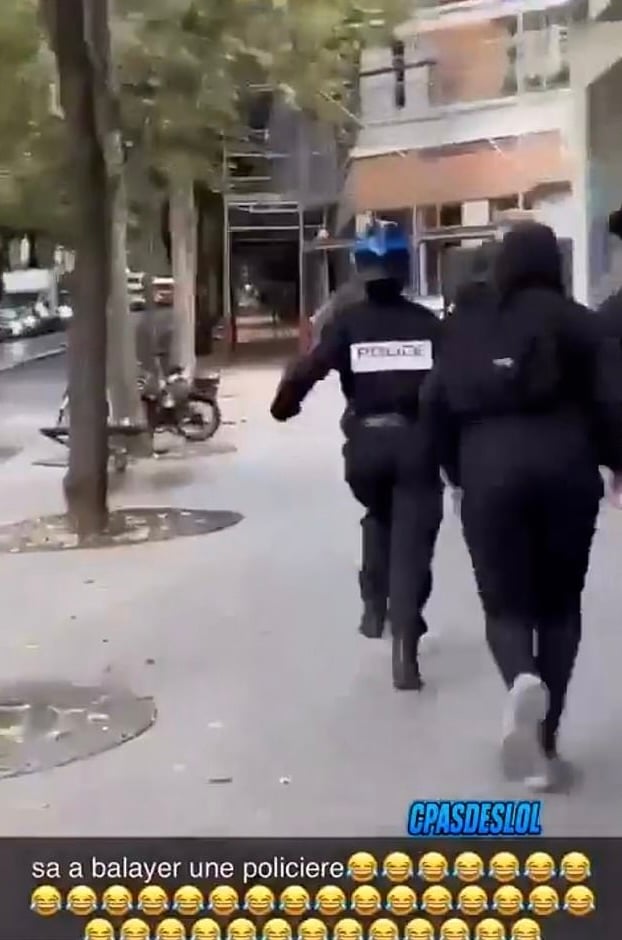
Footage showing a French policewoman being chased down and kicked to the ground by a group of young rioters has emerged as student protests over education conditions escalate into widespread violence, with almost 2,000 people arrested in a single day and schools, firefighters and police all coming under attack.
A policewoman has been filmed being chased through the streets of a Paris suburb and kicked to the ground by a gang of young men, as student protests over education across France descend into violent unrest. What began as demonstrations calling for better school resources and conditions has escalated sharply this week, with Interior Minister Laurent Nunez confirming that 1,949 people were arrested on Thursday alone, most aged between 15 and 18. The disorder has spread far beyond its original scope, now involving clashes with police, attacks on firefighters, arson attempts at schools, and a political row over comments made by a local mayor.
Policewoman attacked in Paris suburb
The incident involving the policewoman was captured on verified footage shot in the Paris suburbs, showing the officer, who was holding a teargas canister, being pursued and tripped by a group of young men before being kicked once as she lay on the ground. The person filming the attack captioned the clip “police officer swept away,” accompanied by laughing emojis, before moving away from the scene. One viewer who saw the footage online wrote: “The situation is catastrophic. No-one should condone this.”
The incident prompted strong condemnation from figures on the French right. Marine Le Pen, former leader of the National Rally party, wrote on X: “The image of this young policewoman, pursued by a howling mob screaming its hatred, thrown to the ground and assaulted, is unbearable. These acts deserve exemplary punishments. Let her know that tonight, millions of French people offer her their warm support.” National Rally President Jordan Bardella said the footage illustrated “what France has become after decades of laxity and mass immigration,” adding: “How long will we tolerate this barbarism? How long will we let our country sink without reacting?”
How the protests began
The unrest traces back to demonstrations that began last Monday, when students and teaching staff took to the streets in towns and cities across France to call for the replacement of absent teachers, increased educational resources, school renovations and improved learning conditions. The protesters’ demands have since broadened considerably, now encompassing concerns over overcrowded classrooms, staff shortages, deteriorating school buildings, inadequate temperature control during periods of extreme heat, school timetables and workload, and pressure surrounding the French baccalauréat exam. Some teachers and education workers have joined students in supporting the demonstrations.
According to figures gathered since the protests began, the movement has spread to around 356 high schools across the country, with authorities recording roughly 900 blockades or related incidents and more than 160 schools forced to close. Around 50 schools in the Paris region alone are reported to have been affected by violence, clashes or damage. The unrest has also extended to higher education, with approximately 30 university campuses blocked by students.
Violence spreads to Marseille and Nantes
Paris and Marseille saw some of the worst violence this week. At the Victor Hugo high school in Marseille, staff were reportedly assaulted and doused in petrol during an attempted arson attack, forcing all members of staff to take refuge inside the building for their own safety. Separately in Marseille, a firefighter was injured after rioters set a fire engine alight near the Saint-Exupéry high school; footage of the incident showed black-clad individuals battering the emergency vehicle with metal objects before cheering as it caught fire. The firefighter involved is reported to have suffered a facial fracture from a thrown projectile. Around 10 police officers were also injured during the disturbances in Marseille, and two school principals were reported to have been hurt.
In Nantes, the entrance hall of Nelson Mandela High School was destroyed by fire on Thursday morning, an incident the school’s deputy head, Gaelle Cordier, described as an act of arson. Footage from the scene showed all storeys of the building’s entrance hall alight as onlookers watched, with further footage captured from a distance showing smoke rising from the building. Videos circulating online have also shown heavily armed police using teargas and baton charges in an effort to contain the rioters.
Mounting arrests and casualties
The scale of arrests has grown rapidly as the unrest has continued, rising from approximately 625 people detained on Wednesday to 1,949 arrests on Thursday alone. Interior Minister Laurent Nunez condemned what he described as “unbridled violence,” specifically criticising “the targeting of law enforcement officers, the throwing of missiles, acts of violence, verbal abuse, attempted arson, and all-round urban violence.” According to the latest figures, at least 305 police officers and members of the armed forces have been injured during the unrest.
Government response and political fallout
Prime Minister Sébastien Lecornu held a crisis cabinet meeting as the situation escalated, with ministers reportedly asked to remain focused on the unrest rather than proceed with planned travel. The government has accused the left-wing party La France Insoumise (LFI) and other radical left groups of helping to organise or intensify the protests, an accusation LFI has firmly rejected, while in turn criticising the government’s handling of the demonstrations. Members of LFI have reportedly been seen outside blockaded school buildings using megaphones to encourage protesting students.
The unrest gathered further momentum this week after Bally Bagayoko, the left-wing mayor of the Paris suburb of Saint-Denis, told protesters on Tuesday that “violence can be legitimate” in certain circumstances when discussing confrontations between young demonstrators and police. The remarks sparked widespread anger, and the Paris police prefect subsequently referred Bagayoko to prosecutors over alleged provocation to commit an offence. Bagayoko has disputed the way his comments were interpreted and said violence is not his preferred method of action. A separate video that circulated online had falsely suggested he helped set fire to a bin, though longer footage later showed him attempting to deal with the burning bin rather than starting the fire himself.
Police conduct also under scrutiny
The unrest has prompted scrutiny of law enforcement as well as protesters. France’s police watchdog, the IGPN, has opened an investigation after footage appeared to show an officer firing a Cougar grenade launcher at close range towards a student in Saint-Ouen-l’Aumône, indicating that authorities are examining conduct on both sides of the confrontations rather than focusing solely on the actions of demonstrators.
Teenagers at France’s lycées, broadly equivalent to British upper schools including sixth form, have been blockading their schools since protests first began last week, as the French government continues to grapple with unrest that has spread well beyond its original focus on education policy.
