



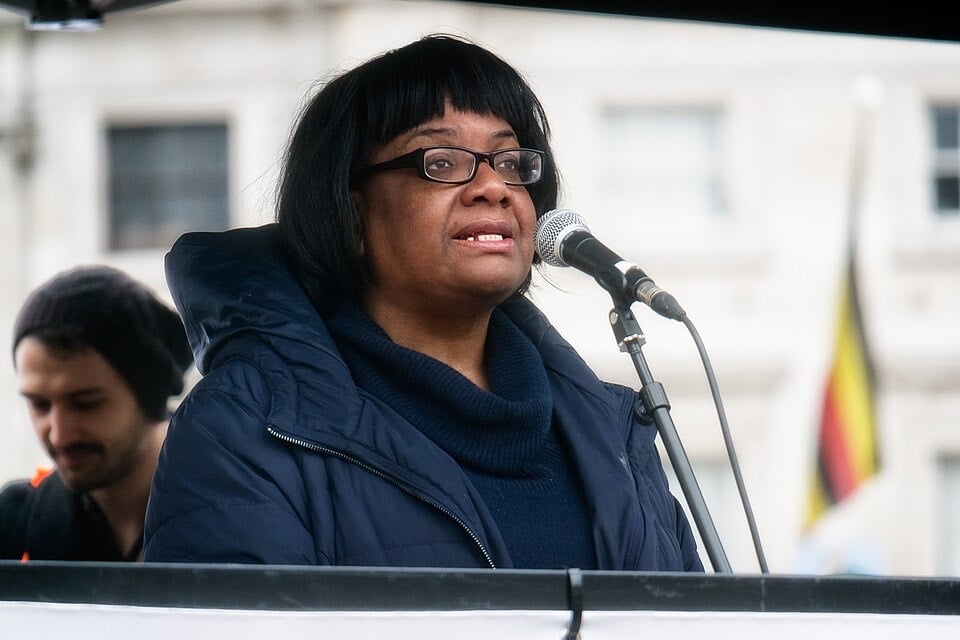
Labour MP Diane Abbott has triggered a fresh political storm after describing the threat from Russia as a “NATO fiction” designed to justify higher defence spending, drawing sharp criticism from across Westminster just weeks after her readmission to the party and hours after Germany formally blamed Russia for an attempted drone attack on its territory.
Diane Abbott has become embroiled in fresh controversy after describing the threat from Russia as a “NATO fiction” and arguing that a planned increase to UK defence spending “should not go ahead.” The veteran Labour MP wrote on social media that “the imminent threat from Russia is a NATO fiction to justify their complete capitulation to Trump’s demands for more military spending,” despite escalating tensions with Moscow this week. Her comments have drawn strong criticism from politicians across the political spectrum, coming just weeks after she was readmitted to the Labour Party following a year-long suspension.
The backdrop to her comments
Abbott’s remarks came as Vladimir Putin issued his clearest signal yet that Russia could strike Britain over its supply of weapons to Ukraine. Asked on Wednesday whether Russian forces might target British military facilities, Putin declined to rule it out, saying: “That’s a secret. A military secret.” Russia had already warned last week that it could strike British military targets both inside and outside Ukraine in response to Ukraine’s use of British-supplied Storm Shadow missiles. Russia’s Foreign Ministry spokeswoman, Maria Zakharova, separately accused Britain and France of “playing with fire” by supplying Ukraine with advanced missile technology, warning that British military facilities could become legitimate targets.
Abbott’s comments also came just a day after Germany’s Leipzig airport confirmed that a drone attack on the site had originated from Russia. Berlin has since formally concluded that Russia bore responsibility for the 4 August attempted drone attack, with intelligence and police investigations indicating those involved were acting on behalf of Russian state agencies. The drone reportedly carried around 600g of explosives and was discovered close to a Ukrainian cargo aircraft. Germany has described the incident as part of a wider Russian hybrid-warfare campaign, rather than an isolated event, and responded by announcing the closure of Russia’s consulate in Bonn and the shutdown of the Russian House cultural centre in Berlin, while pushing for additional EU sanctions.
Political reaction
The backlash to Abbott’s comments has spread rapidly across Westminster. Conservative leader Kemi Badenoch described her remarks as “reprehensible,” while Tory MP Ben Obese-Jecty accused Abbott of being “dangerously out of touch,” suggesting she was effectively acting as a mouthpiece for Putin.
Downing Street has notably declined to condemn Abbott directly, with No 10 refusing to comment when questioned about her statement, despite the government’s own defence policy resting on a significantly higher assessment of the Russian threat than the one Abbott described. The timing is particularly awkward for the government, with Prime Minister Andy Burnham facing pressure over defence spending at Prime Minister’s Questions today. Burnham has committed the UK to reaching 3% of GDP on defence spending during the next Parliament, though he has not yet set out a firm timetable for achieving that target.
Government’s defence spending plans
The government’s June Defence Investment Plan set out that defence spending would rise to almost £80 billion a year by 2029, increasing from 2.3% of GDP in 2024 to 2.7%. The plan described reaching 3% during the next Parliament as the government’s “number one priority” for the next Spending Review. The government is separately investing more than £5 billion in drones and autonomous weapons, alongside major spending on ammunition, nuclear weapons, fighter aircraft and naval capabilities.
Britain’s Defence Investment Plan specifically identifies Russian activity as a driving factor behind the push to strengthen the UK’s military, including plans to develop precision-strike weapons jointly with Germany and build frigates with Norway intended to counter Russian submarine activity.
Intelligence assessments of the Russian threat
The House of Commons Library published a new briefing today warning of Russia’s wider threat to NATO countries, noting that intelligence agencies and NATO’s secretary-general have warned of a possible Russian attack on NATO within the next four years, while also highlighting Russia’s ongoing campaign of sabotage and other activity that falls below the threshold of open warfare. The UK’s Defence Committee has separately warned that Britain is at a “dangerous juncture,” pointing to the growing threat level and warnings that NATO needs to be prepared for a possible Russian attack by 2030.
There remains some genuine disagreement among Western leaders over how imminent a conventional Russian attack on NATO actually is. Finnish President Alexander Stubb recently said he believed Russia was unlikely to attack a NATO member, arguing that doing so would make little strategic sense and would test the resolve of the world’s most powerful military alliance. Donald Trump has also said he is not worried about Russia attacking NATO, illustrating that even within the Western alliance, there is not complete agreement over the immediacy of the threat.
It is worth noting that there is no established evidence Russia is preparing an imminent invasion of Britain itself. British and NATO authorities are instead assessing a broader Russian threat that encompasses potential military confrontation, sabotage, cyberattacks, espionage and attacks on critical infrastructure, alongside the possibility of a future direct conflict with NATO.
A pattern of similar comments
Abbott’s latest intervention is not an isolated one. In July, she described warnings of a future Russian invasion of Western countries as “outlandish,” and the month before that criticised what she called “the Nato campaign against Russia.” Writing in the left-wing Morning Star, she argued: “The reason there is such a hue and cry about military spending now is not because Russian forces are in Ukraine; that happened well over four years ago. No, the reason for the outlandish claims about an imminent Russian invasion is simply because Trump demanded more military spending from Nato members.”
She went on to argue that Western policy was making Britain less safe, writing: “None of this is making us any safer. On the contrary. Russia is a major military power, but Nato is engaged in a war which is now striking deep into Russian territory, provoking widespread calls for retaliation against Nato countries.” In the same July Morning Star article, Abbott argued that Britain should break with automatic support for US foreign policy and questioned the government’s broader approach to Ukraine, NATO and increased military spending.
Background on Abbott’s suspension
Abbott’s latest comments come just weeks after she was readmitted to the Labour Party, having been expelled in July last year for doubling down on previous comments about Jewish people, for which she had earlier been suspended before issuing an apology. The longstanding MP for Hackney North and Stoke Newington has faced sustained criticism over her repeated questioning of Western support for Ukraine in the months since her return to the party.
