



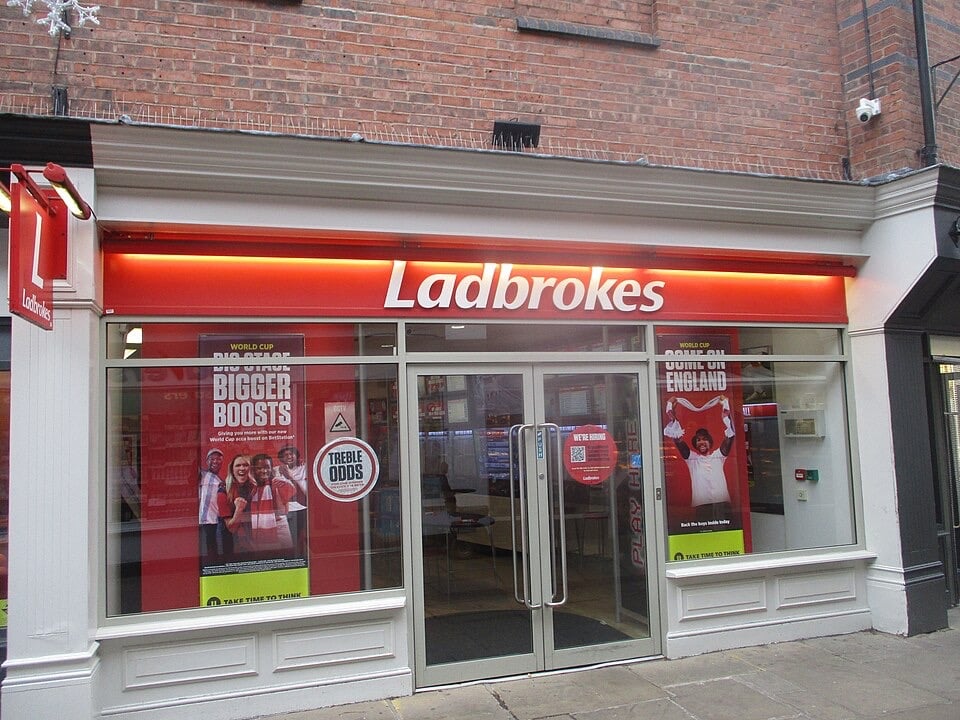
Ladbrokes and Coral owner Entain has narrowed its first-half losses to £11.4 million, boosted by record World Cup betting activity, even as higher UK gambling taxes continue to weigh on its online business and force further high street shop closures across the sector.
Entain, the gambling giant behind Ladbrokes, Coral and Foxy Bingo, has narrowed its first-half losses after what it described as the “biggest World Cup final in history” drove a surge in betting activity. The FTSE 100 firm reported post-tax losses of £11.4 million in the six months to June, a significant improvement on losses of £85.8 million over the same period last year. Entain said betting activity during the tournament was almost double that of the previous World Cup, with the final becoming “the biggest football betting event in Entain’s history.” Despite the improved performance, the company continues to grapple with the impact of higher UK gambling taxes introduced in April.
World Cup drives strong revenue growth
Net gaming revenue, a key metric for the business, rose 5% in the first half compared with the same period a year earlier, coming in ahead of market expectations. That growth was underpinned by a 7% rise in online revenue, with particularly strong performances recorded in the UK and Australia.
Headline earnings of £479 million also came in ahead of expectations. However, the company said the impact of higher gambling taxes had held back growth in its online business specifically, with Entain stating that the year-on-year decline in online underlying earnings in the first half “reflects the impact of the UK remote gambling tax increase.”
The tax changes behind the pressure
The tax rise in question stems from Chancellor Rachel Reeves’s last Budget, in which she raised remote gaming duty from 21% to 40%, alongside a separate increase in the levy on online sports betting from 15% to 25%. The changes have had a marked impact across the wider gambling sector.
On Wednesday, William Hill owner Evoke, which has agreed to a takeover by Bally’s Intralot, revealed it had closed more than a fifth of its betting shops over the past year as a direct result of the tax changes. Entain has faced similar pressure, having closed 45 stores across the Republic of Ireland and Northern Ireland earlier this year.
Entain chief executive Stella David acknowledged the difficulty of the tax changes while pointing to the company’s broader positioning. “Significant and disappointing,” she said of the changes, adding that Entain was “well positioned to capture potential opportunities as the wider market adjusts to the higher tax regime.”
UK and Ireland performance
Despite the pressures facing the sector, Entain’s UK and Ireland revenues rose 8% over the period, with 13% growth in the online segment helping to offset the impact of the company’s high street store closures. Even so, Entain shares dipped 0.36% to 558p following the results, and have now fallen 27.6% so far this year.
US joint venture faces headwinds
Entain’s joint venture with BetMGM reported net revenue growth of 4% year-on-year, reaching $1.4 billion, with adjusted earnings of $99 million driven by the World Cup and the NBA playoffs. However, Entain has previously flagged a deterioration in market conditions in the US, and BetMGM has indicated it may take longer than its original 2027 target to reach $500 million in adjusted earnings.
Debt reduction and strategic changes
Entain’s net debt currently stands at £3.6 billion, which the company is looking to pay down following the sale of a 20% stake in its Central and Eastern Europe unit to joint venture partner EMMA Capital. The company also plans to launch a phased exit from the region, with excess capital to be returned to shareholders as part of that process.
Analyst reaction
Richard Hunter, head of markets at interactive investor, offered a mixed assessment of Entain’s current position. “Entain’s current strategy shows some pockets of strength as it attempts both to streamline the business and increase its attractiveness as a gambling destination, but more broadly there are other factors at play which have held back any share price progress,” he said.
He added that investor confidence in the business remained despite recent volatility: “Despite all the turmoil, there is a loyal band of investors who remained prepared to take a punt on a business which undoubtedly has some exciting potential – if it can be delivered – and the market consensus of the shares as a strong buy reflects this commitment.”
