



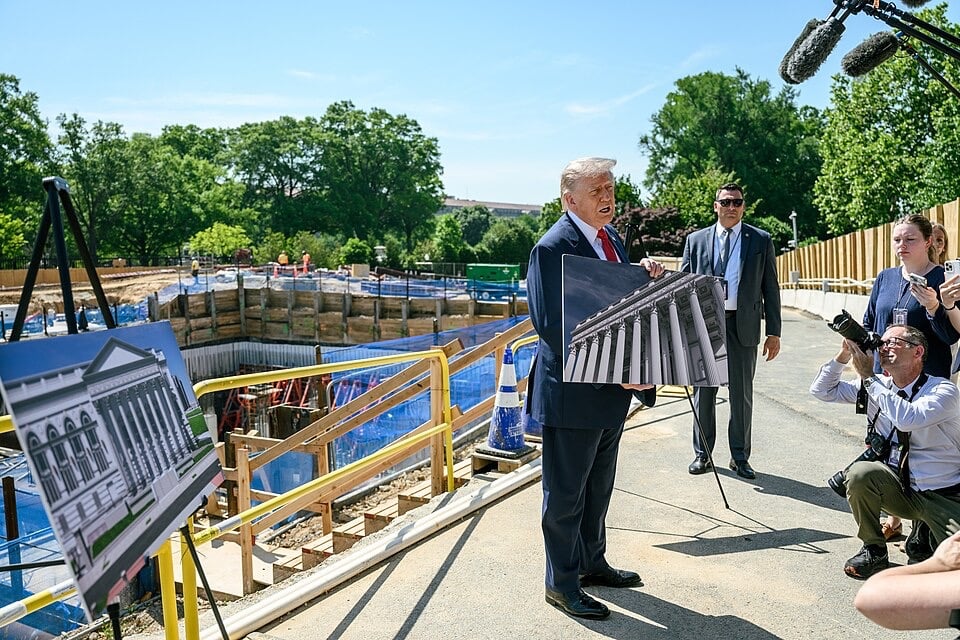
President Donald Trump has attacked a federal appeals court ruling that halted construction of his planned $400 million White House ballroom, after judges upheld an injunction won by a historic preservation group over the demolition of the building’s East Wing.
Donald Trump has hit out at a US appeals court decision blocking his $400 million (£297 million) White House ballroom project, after the Trump administration was ordered to stop construction on the site of the building’s demolished East Wing. In a post on his Truth Social platform, Trump described the ballroom as “desperately needed,” “totally secure” and said it was being built “ahead of schedule and under budget.” He accused the court of having “refused to acknowledge” that the ballroom “is a gift from President Trump and Great Patriots of the United States of America,” and called for the ruling to be overturned by the Supreme Court.
What the court ruled
On Friday, the Washington-based US Court of Appeals for the District of Columbia Circuit upheld a preliminary injunction that had been won by the National Trust for Historic Preservation. The non-profit organisation sued last year after the Trump administration demolished the East Wing and began constructing the roughly 90,000 sq ft (8,360 square metre) ballroom without seeking authorisation from Congress.
The ruling upholds an earlier decision by US District Judge Richard Leon, who twice blocked above-ground construction at the site while allowing underground work to continue. Judge Leon, who was appointed by former Republican President George W. Bush, found that no existing federal statute “comes close to giving the President” the authority required to build the ballroom without congressional approval.
The appeals court also paused the block on construction for 14 days, giving the Trump administration a window to seek emergency intervention from the US Supreme Court.
Trump’s response
Responding to the ruling, Trump insisted the project would come at no cost to taxpayers, writing: “There will be no expense to the American taxpayer.” He added: “This unjust decision must be overturned by the Supreme Court in its entirety.” Trump has repeatedly argued that the White House lacks a large enough venue for state dinners, diplomatic receptions and other major official events, a shortfall that has previously forced administrations to erect temporary tents on the South Lawn.
Trump has said the roughly $400 million cost of the ballroom would be met entirely through private donations. However, Senate Republicans have separately sought around $1 billion (£750 million) in taxpayer funding for security upgrades to the ballroom and other structures beneath it, a request that has drawn criticism from opponents of the project. Democrats have criticised the ballroom more broadly as expensive and frivolous, arguing it diverts federal resources away from efforts to help Americans cope with rising living costs.
The legal arguments
During oral arguments before the DC Circuit on 5 June, Justice Department attorney Yaakov Roth argued that the courts had no role in scrutinising a privately funded project of this kind, and that blocking it at any stage would have been improper. Roth contended that the National Trust’s “architectural preference” against the ballroom should not outweigh national security considerations, pointing to claims that the former East Wing layout left the president and others in the White House vulnerable during large gatherings.
Thaddeus Heuer, a lawyer representing the National Trust for Historic Preservation, rejected that framing, telling the court: “They just don’t want to go to Congress.” Preservation groups have maintained throughout the dispute that the case is not about architectural taste, but about whether a president can make significant alterations to one of the country’s most historic government buildings without congressional authorisation.
What happens next
The ballroom project represents the most ambitious of Trump’s efforts to reshape the landscape of government buildings and national monuments in central Washington. Should the Supreme Court agree to hear the case, legal observers suggest it could become a significant constitutional test of the limits of presidential authority over federally owned historic property.
