



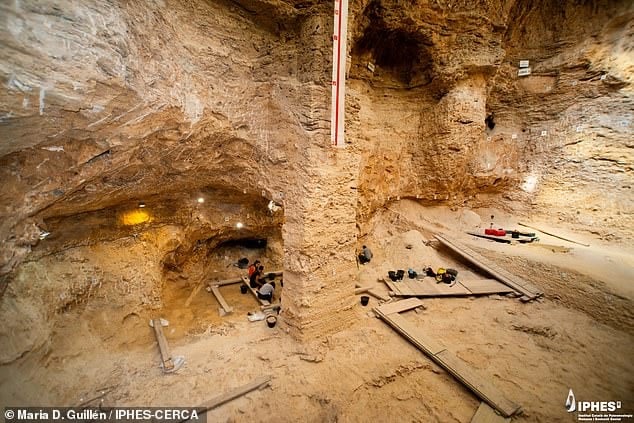
Evidence from a Spanish rock shelter suggests that Neanderthals crafted a far wider range of wooden objects than the surviving archaeological record has previously shown.
Archaeologists excavating the Abric Romaní site in Spain have found imprints and charred remains of 13 wooden objects made by Neanderthals between 40,000 and 62,000 years ago. The items include spears, a club, bark trays and a tripod-like structure. The researchers say the finds show Neanderthals selected different types of wood for different jobs. Their findings were published in the journal Science Advances.
What was found
The team examined 597 pieces of wood and wooden impressions recovered over more than four decades of excavation, drawn from 16 archaeological layers. The 13 recognisable artefacts include two wooden spears, pointed implements, four bark trays, structural components and a distinctive club-like object.
Some of the simplest items are small trays shaped from the flexible bark of the juniper tree, preserved in a carbonised state. The researchers suggest they may have “functioned as containers for transporting food or as scoops or ladles, perhaps for collecting embers or ashes”.
The excavations also revealed pointed sticks that appear to have been deliberately shaped. According to the researchers, these could have served as spears for hunting, fishing and warfare, or as simple tools for digging holes.
More elaborate woodwork was also uncovered. In one part of the site, fragments of three sticks, each more than a metre long, are thought to have formed an elevated structure or tripod that could have been used in food processing. Elsewhere, the team found a tree 5.1 metres (16.7ft) long that had been stripped of its branches, apparently intended as a “structural element and as part of a resting area”.
The club
The most advanced object is a wooden club carved from a single piece of wood. Shaped somewhat like a kitchen knife, it has a clear handle and head section that the researchers say show a “deliberate and technically controlled shaping process”.
The handle widens towards the bottom, which would have made it more secure in the hand during a swing. A sharp transition between handle and head would have stopped the hand slipping on impact, and the “blade” section is carefully tapered to a point. Its handle and working end appear to have been shaped through several stages of controlled manufacture, rather than being a naturally convenient branch.
Wooden Neanderthal clubs are extremely rare. Only one other possible example is known, dating from about 400,000 years ago, which makes its purpose hard to determine. The researchers say its shape suggests it might have been used as a weapon against other Neanderthals or for “dispatching” animals such as deer and horses.
Choosing the right wood
The Neanderthals appear to have selected timber according to its properties. Alongside the flexible juniper bark used for the trays, they chose Scots pine for harder-wearing tools, a wood the researchers describe as “relatively compact and resistant, yet easy to work with”.
In their paper, the researchers say the collection shows “a remarkable technological versatility and the diversified exploitation of wood as a raw material”. They link the artefacts to food preparation, the carrying or storing of materials, construction and the organisation of living spaces.
Why wood is so rarely found
Unlike stone tools, which can survive for millennia, wood rapidly decays, so evidence of ancient woodworking is extremely rare. Abric Romaní is one of the few places where it has been preserved, through two processes. Some pieces survive as charred remains preserved by carbonisation. Others survive as imprints formed by travertine incrustation, in which calcium carbonate from the surrounding rock builds up around a wooden object as it slowly decays. This leaves an impression in the rock that can preserve fine detail, even down to the cellular level.
As a result, archaeologists have historically had a much clearer picture of Neanderthal stone technology than of their organic technology. The finds do not necessarily mean Neanderthals suddenly became highly skilled carpenters. Instead, they suggest that their woodworking abilities were probably far more extensive than the surviving record has shown.
The site
Abric Romaní lies beneath a dense limestone cliff known as Cinglera del Capelló. It comprises a sheltered area covering more than 300 square metres. During the Middle Palaeolithic, between 300,000 and 30,000 years ago, it was a vital corridor linking inland Catalonia with the coast, attracting both Neanderthals and early Homo sapiens. Excavations began in 1983. The woodworking evidence spans a period of 22,000 years.
The discovery adds to evidence from other European sites. Wooden implements dating to roughly 171,000 years ago at Poggetti Vecchi in Italy have already demonstrated sophisticated woodworking, and the Schöningen site in Germany has produced a large collection of wooden artefacts, including hunting weapons and everyday tools. Abric Romaní has also yielded a bone spear point dating to around 50,000 years ago, which showed signs of deliberate manufacture, impact damage and possible attachment to a shaft.
The researchers conclude: “Beyond their deftness with stone, Neanderthals had a remarkable ability to work with organic materials such as bone, shell, fiber, and wood.”
