



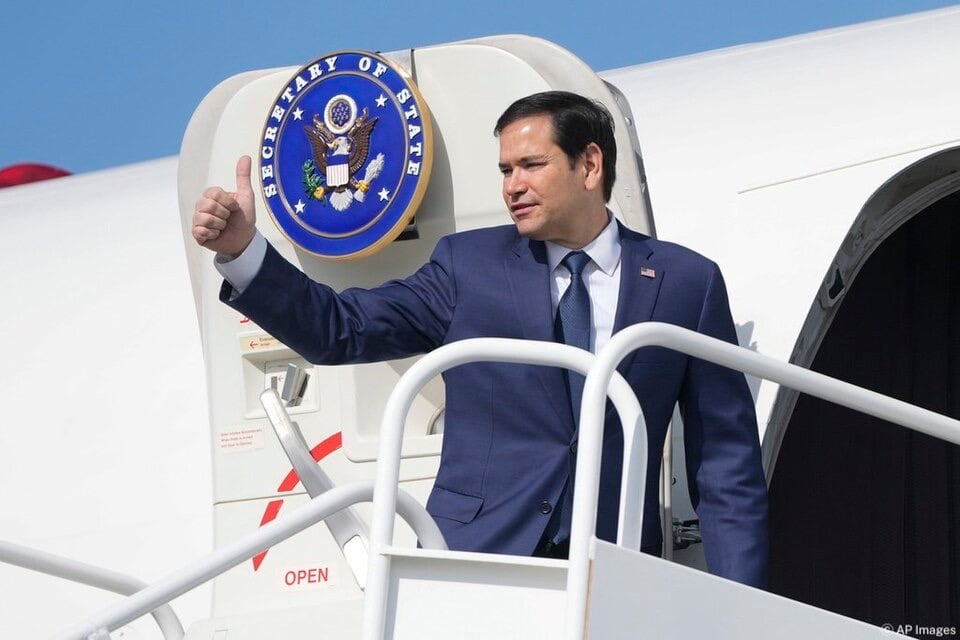
The US secretary of state used a speech at the foot of the Acropolis to argue that rising military budgets signal a generational shift across the continent, while urging allies not to let strained relations damage the transatlantic partnership.
US secretary of state Marco Rubio has said rising defence budgets across Europe show the continent “can awaken from its long slumber”. Speaking in Greece, he pointed to the pledge made last year by the UK and other Nato members to raise defence spending to 5% of economic output by 2035. He acknowledged that “passions” had strained ties between Washington and Europe but said they must not be allowed to break them. His remarks come as the British Government faces pressure to explain how it will meet the target.
Ancient Greece and ‘America First’
Standing before the ruins of the Acropolis, Mr Rubio drew on classical ideas of statecraft to defend President Donald Trump’s “America First” agenda. The former Republican senator, who has been tipped as a frontrunner for his party’s nomination in next year’s race for the White House, said the ancient Greeks understood that nations have interests.
“They understood that power requires not only having the means to defend yourself, it requires the credibility that you are willing to use it,” he said. “This is the classical understanding of politics and of statecraft that the Trump administration hopes to reclaim – reclaim not just for our country, but for the whole of our civilisation.”
He went on to say: “We believe that Europe can awaken from its long slumber and rekindle the fire that was lit here millennia ago. There are already signs.”
‘A generational shift’
Mr Rubio said the continent was witnessing “what we hope will be the beginnings of a generational shift”. He listed “skyrocketing defence spending, a flurry of new partnerships and programmes, expanded manufacturing and production”, which he said followed the “historic defence commitments” made in The Hague last year. Those commitments came amid growing threats from Russia and China and demands from Mr Trump that allies contribute more to their own security.
He said the alliance should not be viewed as a contest with a winner and a loser. “Though passions may, at times, have strained the bonds of affection between the United States and Europe, it must not be allowed to break them,” Mr Rubio said. “Together, we must strengthen an alliance capable of confronting threats of our age. And we can.”
“Because we do not believe the transatlantic friendship should be zero sum,” he added. “Quite the opposite. Our vision is of an alliance whose strength is greater than the sum of its parts.”
He also highlighted the “unprecedented” agreement recently reached between the US, Denmark and Greenland over the Arctic territory. “All three partners in that deal emerged victorious,” he said. “All of Europe, and Nato and the United States emerged safer, stronger, and more secure because of it. We want to win together. We must win together.”
The secretary of state also warned that the West had come “to feel ashamed of the very things that made us exceptional”.
How the Nato target works
The 5% goal is divided into two parts: at least 3.5% of GDP for core military defence, and up to a further 1.5% for wider security-related spending, such as critical infrastructure, cyber security and resilience.
European Nato members and Canada raised their core defence spending by almost 20% in real terms in 2025 compared with 2024. Five countries are expected to reach the 3.5% core threshold in 2026: Lithuania, Estonia, Latvia, Poland and Greece. Lithuania is projected to spend about 5.33% of GDP on core defence, Estonia 5.1%, Latvia 4.92% and Poland 4.68%. Greece, where Mr Rubio spoke, is projected to spend roughly 3.65%.
Nato secretary general Mark Rutte has said total defence and security spending across the alliance is already around 4% of GDP, just a year after the 5% commitment was agreed.
Pressure on the UK
Britain has committed to the 5% target but has yet to publish a definitive roadmap for reaching the earlier milestone of 3% on defence spending. Reports suggest Prime Minister Andy Burnham is considering delaying an announcement on the timetable, with some indicating it could be put off until 2027. The Treasury has disputed that a final decision has been made.
Reaching 3% is expected to require tens of billions of pounds in additional annual spending. The Budget on 28 October is therefore seen as potentially important in determining how the Government intends to fund the increase.
Mr Rubio’s comments come amid continuing disagreements between Washington and European governments over burden-sharing, Ukraine, trade and the future of Nato.
