



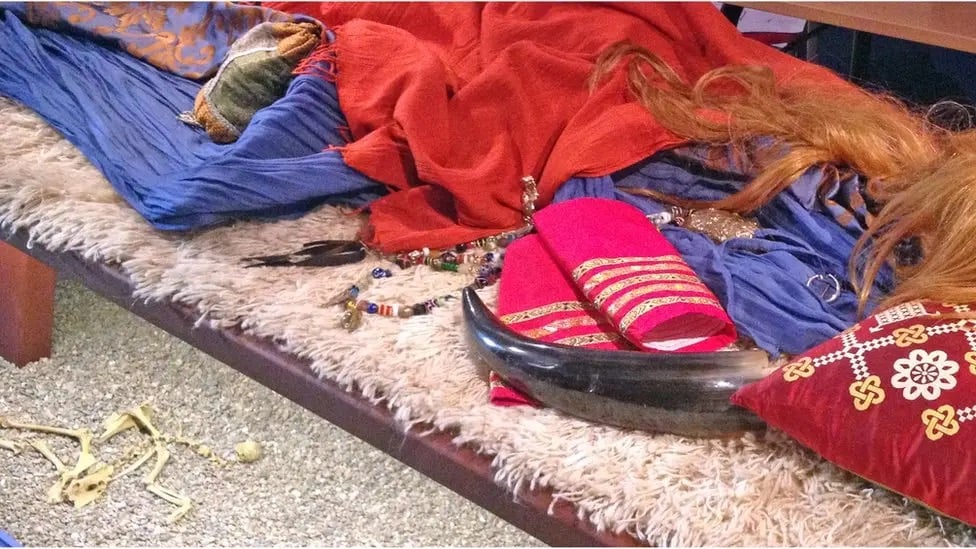
Textile fragments from Viking Age boat graves in Sweden, dismissed for more than a century as ordinary funeral garments, have been found to contain Arabic script spelling out the words “Allah” and “Ali,” according to research reported by the BBC’s Tharik Hussain, raising fresh questions about contact between Viking and Muslim societies.
Burial costumes recovered from Viking Age graves in Sweden have been found to contain patterns spelling out Arabic words, including “Allah” and “Ali,” according to new research reported by BBC journalist Tharik Hussain. The garments, taken from graves dating to the 9th and 10th centuries, had spent more than 100 years in storage, largely dismissed as unremarkable examples of typical Viking Age funeral wear, before a fresh examination uncovered what researchers describe as significant new evidence of contact between the Viking and Muslim worlds.
Rediscovering forgotten fragments
The breakthrough was made by Annika Larsson, a textile archaeologist at Uppsala University, while re-examining the remains of burial costumes recovered from both male and female boat and chamber graves. The garments were originally excavated at Birka and Gamla Uppsala in Sweden, in digs carried out in the late 19th and mid-20th centuries. Larsson’s interest in the long-overlooked fragments was sparked after she realised that some of the material used had originated in Central Asia, Persia and China, suggesting the garments were woven using imported textiles rather than purely local materials.
Spotting a familiar pattern
Examining the pieces more closely, Larsson found small geometric designs, no more than 1.5cm, or around 0.6 inches, in height, unlike anything she had previously encountered in a Scandinavian context. “I couldn’t quite make sense of them and then I remembered where I had seen similar designs – in Spain, on Moorish textiles,” she said. That recollection prompted her to reconsider what she was looking at entirely.
Deciphering the script
Larsson came to realise the patterns were not decorative Viking motifs at all, but ancient Arabic Kufic script, one of the earliest calligraphic forms of written Arabic. Two words appeared repeatedly throughout the fragments. With the help of an Iranian colleague, she identified one of them as “Ali,” a reference to the fourth caliph of Islam. The second word proved harder to decipher, but was ultimately identified as “Allah.” Together, the words had been woven into the garments using silk and silver thread.
What the discovery could mean
According to Hussain’s reporting, this fresh investigation into the burial garments has produced what researchers describe as groundbreaking insight into the extent of contact between Viking society and the Muslim world during the 9th and 10th centuries. The presence of Arabic religious script in Viking burial costumes has raised new questions about the extent to which Islamic influence, whether through trade, travel or cultural exchange, may have reached Scandinavia during the Viking Age.
