



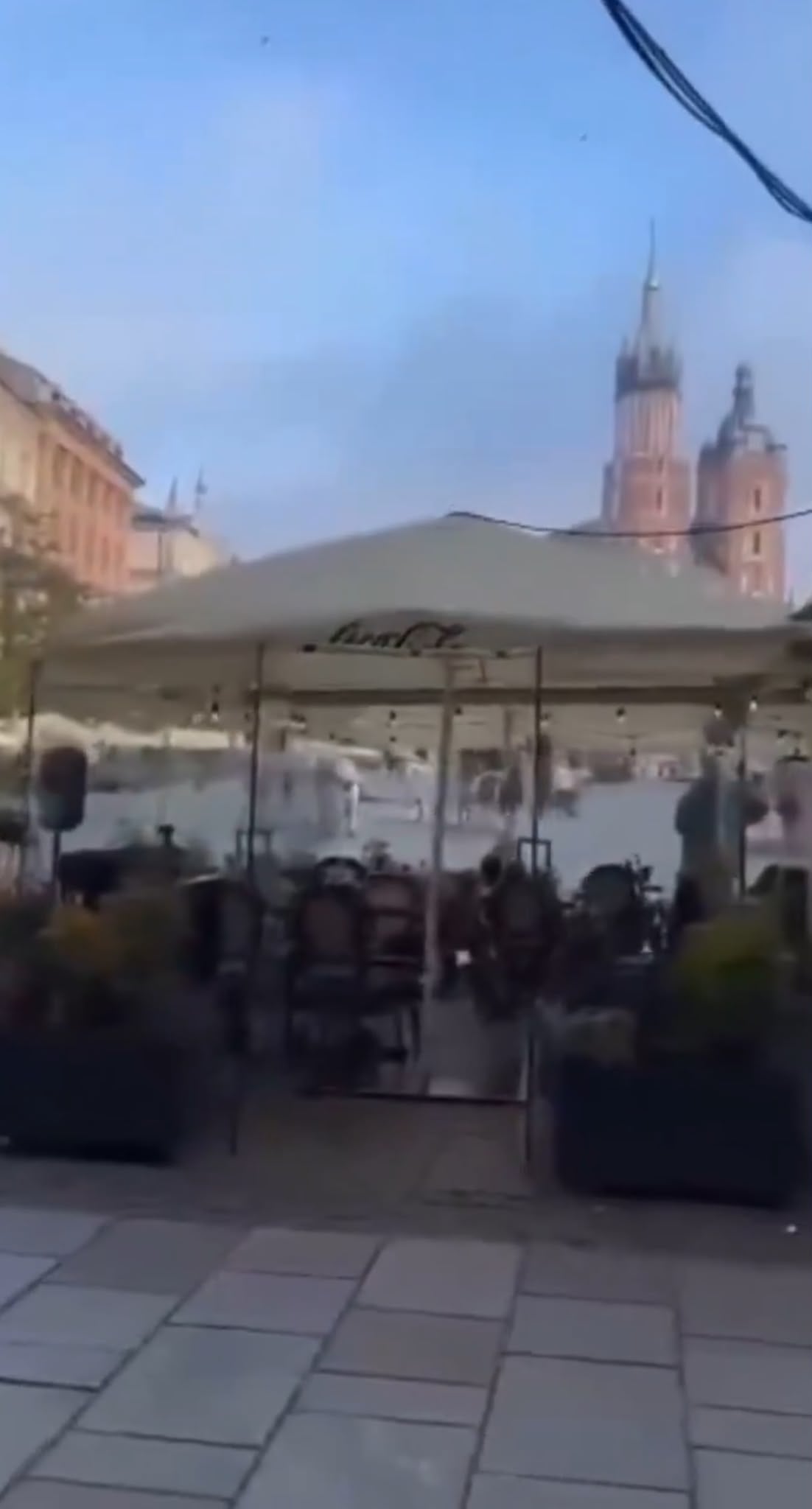
Professor Michał Pędziwiatr and Dr Mateusz Wierdak treated two shot officers on the street. One says the officer “would have bled to death” without it, though both doctors say they do not feel like heroes.
Two surgeons who were having lunch in Krakow’s Main Market Square when a gunman opened fire on Saturday ran towards the wounded and gave emergency care to two police officers. Six people, including a 32-year-old British man, were killed in the attack, which began at around 3pm. Professor Pędziwiatr and Dr Wierdak were eating nearby with their families. Dr Wierdak held back the bleeding from one officer’s wounds until emergency crews arrived.
“They’re shooting at people over there”
Prof Pędziwiatr told the local outlet WP that his son raised the alarm. “Suddenly my son shouted, ‘Dad, they’re shooting at people over there, and they’re falling to the ground’,” he said.
Their families took shelter in a nearby pharmacy while the two doctors went to help the injured. Dr Wierdak said both police officers were conscious when he reached them but had suffered gunshot wounds to the chest. The suspect was also conscious and had multiple gunshot wounds, he added.
Dr Wierdak used his hands to press on Senior Police Constable Jakub Kulik’s wounds until paramedics arrived. Mr Kulik was shot three times as he tried to confront the attacker. “If not for this, the officer probably wouldn’t have survived, as he would have bled to death,” Prof Pędziwiatr said.
The professor said he then monitored seriously wounded people on the street. Fakt reported that he later operated on other victims in surgery. “We don’t feel like heroes,” he said, adding that the two men “did everything a paramedic would do at the scene of such an incident”.
Confusion at the scene
Dr Wierdak said some witnesses first reported two attackers, and others believed there were more. The conflicting accounts made things uncertain for the medical teams working near the scene. Police let one of the surgeons coordinate treatment after he identified himself as a trauma specialist, and officers concentrated on securing the area, according to regional broadcaster TVP Katowice.
Prof Pędziwiatr rejected claims circulating online that emergency services were absent. He told Radio Kraków that police were there almost immediately and that bystanders also helped treat the injured.
Hospital response
Krakow University Hospital carried out six emergency operations at the same time, Prof Pędziwiatr said, according to Podyplomie. Doctors, nurses and surgical teams returned from their homes and holidays to help. The number of surgical teams available across the city exceeded the number of patients needing operations, and the hospital system had prepared extra capacity in case more victims arrived. The doctors described the response as unusually difficult because casualties were spread across several locations, and praised emergency workers who mobilised while off duty.
Prosecutors said on Monday afternoon that two injured people had left hospital and seven were stable. Others remained seriously injured, including two in a critical condition. Both wounded officers have regained consciousness, which does not mean either has fully recovered. The regional governor, Krzysztof Jan Klęczar, said 15 wounded people were being treated in six Krakow hospitals at the time of his briefing, with one officer still in a serious condition. Earlier reporting had described Mr Kulik as in a “very critical condition” after surgery.
The attack and the response
Police said the first patrol reached the scene 23 seconds after the attack was reported, and that the suspect was “shot and neutralised” three minutes later. Prime Minister Donald Tusk praised the officers “who risked their lives” to intervene at once. “Thanks to their heroic actions, the attacker was quickly apprehended,” he said.
The suspect, a 24-year-old Polish national, died in hospital early on Monday, at around 4.30am according to Mr Klęczar. Local media reported that he had driven about 125 miles from his home in Ostrowiec Świętokrzyski to the market square and opened fire from his car. Police described him as armed with a military-style rifle and dressed in combat gear. A tram was also hit by gunfire at Plac Wszystkich Świętych, according to the city’s transport operator. A window in the driver’s compartment was shattered, but neither the driver nor any passengers were hurt. Tram services through the Dietla, Krakowska and Stradomska junction have resumed.
Mr Klęczar said the dead were three Polish women aged 47, 53 and 61, the 32-year-old British man, and a 51-year-old woman who is not Polish and whose nationality had not been confirmed. Another Briton was among 16 people injured, including the perpetrator. The wounded also included people from Portugal, Russia, Germany and Austria. Among those injured were Mr Kulik and his colleague, Senior Police Constable Artur Morański.
Weapons and motive
According to prosecution spokesperson Przemysław Nowak, investigators recovered two AR-15-style rifles, two pistols and about 500 spare rounds from the suspect’s car. Prosecutors said he had held a firearms licence since March 2026 and had attended a shooting range, and that early evidence suggested he practised static shooting rather than tactical exercises. Investigators believe between several dozen and several hundred shots may have been fired, and forensic examiners are working to establish a more precise figure.
Local media reported that the suspect was believed to have been inspired by “far-right ideologies”. Mr Nowak stressed that it was too early to determine his ideology or motive, which qualifies earlier remarks by government officials suggesting ultranationalist or far-right influences. A yellow Gadsden flag was found in his room. Prosecutors said the symbol has several interpretations, and that investigators did not find obvious far-right or far-left insignia in the flat. Defence minister Władysław Kosiniak-Kamysz called the incident a “terror attack” and denied that the suspect was a soldier. “We have never had such drastic cases of terrorism in Poland before, because that is how we should call the attack in Krakow,” Mr Tusk said.
Poland’s National Prosecutor’s Office is investigating the six killings and the attempted murder of others as a terrorism case. Investigators are examining whether anyone helped or influenced the attacker. No accomplice or organised extremist link has been confirmed.
Deaths at the family home
Authorities said on Sunday that they found three bodies at a property in Ostrowiec Świętokrzyski, which local media put about 93 miles north-east of Krakow. They were the suspect’s sister, 21, and his parents, aged 52 and 53, who are believed to have been shot. Prosecutors believe they were killed either overnight on Friday 6 November or early on Saturday 7 November. Preliminary findings show that each suffered two gunshot wounds to the head area, and post-mortem examinations are needed to establish the precise timing.
The suspect’s death does not end the wider investigation. Prosecutors intend to keep examining his preparations, motives and any connections, though no criminal charges had been filed against him before he died.
