



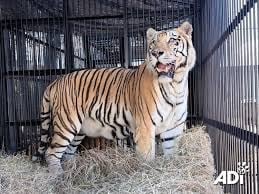
Animal Defenders International says the animals spent years in cages on trailers after the country banned animal circuses. The circus says its family felt pressured into surrendering them, and its supporters have called a protest.
London-based Animal Defenders International (ADI) has rescued seven tigers from a family-run circus in Guatemala after a campaign lasting eight years. The charity says the animals had been kept in makeshift cages on the back of trucks since Guatemala banned animal circuses in 2018. Police and government officials took part in the 18-hour operation, which ADI says had to be kept secret for fear that the circus would move the animals. The tigers are now receiving veterinary care in a temporary rescue unit and will eventually be flown to ADI’s wildlife sanctuary in South Africa.
The rescue
According to ADI, the circus, Circo Rey Gitano, refused to hand over its animals when the ban came in. It instead moved them onto private land, which ADI says made rescue extremely difficult. The tigers are named Simba, Kimba, Jix, Chiquita, Nala, Africa and Kenia. ADI says two are believed to be around 20 years old, while others were cubs when the charity first tried to rescue them.
ADI co-founder and president Jan Creamer and other staff were reportedly jostled and threatened during a tense standoff outside Guatemala City. The charity arranged transport away from the circus’s base before moving in at the last minute.
“They tried everything possible to avoid giving up the animals, but eight years of extra hell for these wonderful tigers is now over,” Ms Creamer said. “They can now get healthy, swim, breathe fresh air and walk on grass free to do as they please, in a safe environment.”
ADI co-founder Tim Phillips said the circus had refused to follow government rulings. “It is beyond comprehension how anyone could be so cruel,” he said. “The tragedy is that if the circus had surrendered the animals when the government enforced Guatemala’s circus ban, the animals could have enjoyed their freedom. Instead, they lost those years, stuck in small cages on the back of a truck in a field. Two of the tigers are believed to be around twenty years old so time was running out for them.”
The charity says it has rescued 20 lions and tigers from Guatemalan circuses since the ban. It fears that other animals belonging to the circus, including a white tiger and African lions, died during the dispute.
The government’s account
Guatemalan authorities describe the handover differently. A judicial agreement reached on 17 March 2025 gave the circus 18 months to set up a suitable sanctuary for its seven tigers. Guatemalan outlet Publinews, citing the National Council of Protected Areas (CONAP), reported that the deadline passed on 17 September 2026 without the facility being completed. The animals were formally handed over under an agreement with the circus and a court order, according to the Guatemalan government, whose Agriculture Ministry describes the transfer as voluntary. The government published its handover statement on 5 November.
Publinews reported that the group comprises four females and three males. Five are adults estimated to be between 10 and 20 years old. The other two are siblings of about two and a half, born at the circus. Officials said they may stay together at the future sanctuary, while the others are expected to have separate areas, according to La Hora.
Care and the journey to South Africa
Agriculture Minister María Fernanda Rivera said the tigers could stay in temporary care for four to six months while veterinary checks and international transport arrangements are completed, La Hora reported. No flight has been scheduled. ADI says each animal will have blood tests, vaccinations and any necessary treatment before travelling, and the charity must meet international import and export rules. The Agriculture Ministry says the tigers cannot be released into the wild, because their long captivity means they lack the skills to survive independently.
ADI says its temporary rescue unit in Guatemala was still being finished when the animals arrived, and that it received the building permit only the previous week. It has secure accommodation and veterinary areas, with more exercise space being developed, and the animals now have deep bedding instead of bare cage floors. The charity is not revealing the location, citing threats and interference during earlier rescues.
In South Africa, four 2.5-acre habitats with heated houses are being built, and the sanctuary will offer swimming pools and acres of natural space. ADI has launched an appeal to raise $300,000 for the operation, veterinary treatment, transport and the tigers’ lifelong care.
Disputed claims
ADI says the circus circulated a claim that one tiger died during the operation. The charity rejected it and published photographs of all seven animals after their removal. It also said a video showing one tiger looking unsteady was consistent with anaesthesia, and disputed claims that it showed mistreatment. The Agriculture Ministry confirmed on 6 November that all seven were alive and in good condition and receiving individual assessments.
Cristian López, a representative of the circus, told La Hora that the family felt betrayed by the authorities and had surrendered the tigers under pressure from the court proceedings. He said family members had cared for the animals, and claimed each tiger ate about 20 pounds of chicken a day. He said relatives had taken other work, including metalworking and transport, to fund their upkeep, and that the circus had been unable to travel for about two years after its transport documents were withdrawn. He said the family was reconsidering whether the circus could continue. These are Mr López’s claims and have not been independently checked.
Publinews reported that supporters of the circus planned a protest outside the National Palace of Culture at 3pm local time on Monday 9 November, demanding the tigers’ return. They argue that the animals have bonds with their keepers. This is the supporters’ position, not an independent assessment of the animals’ welfare, and the outlet had not confirmed attendance or outcome.
