


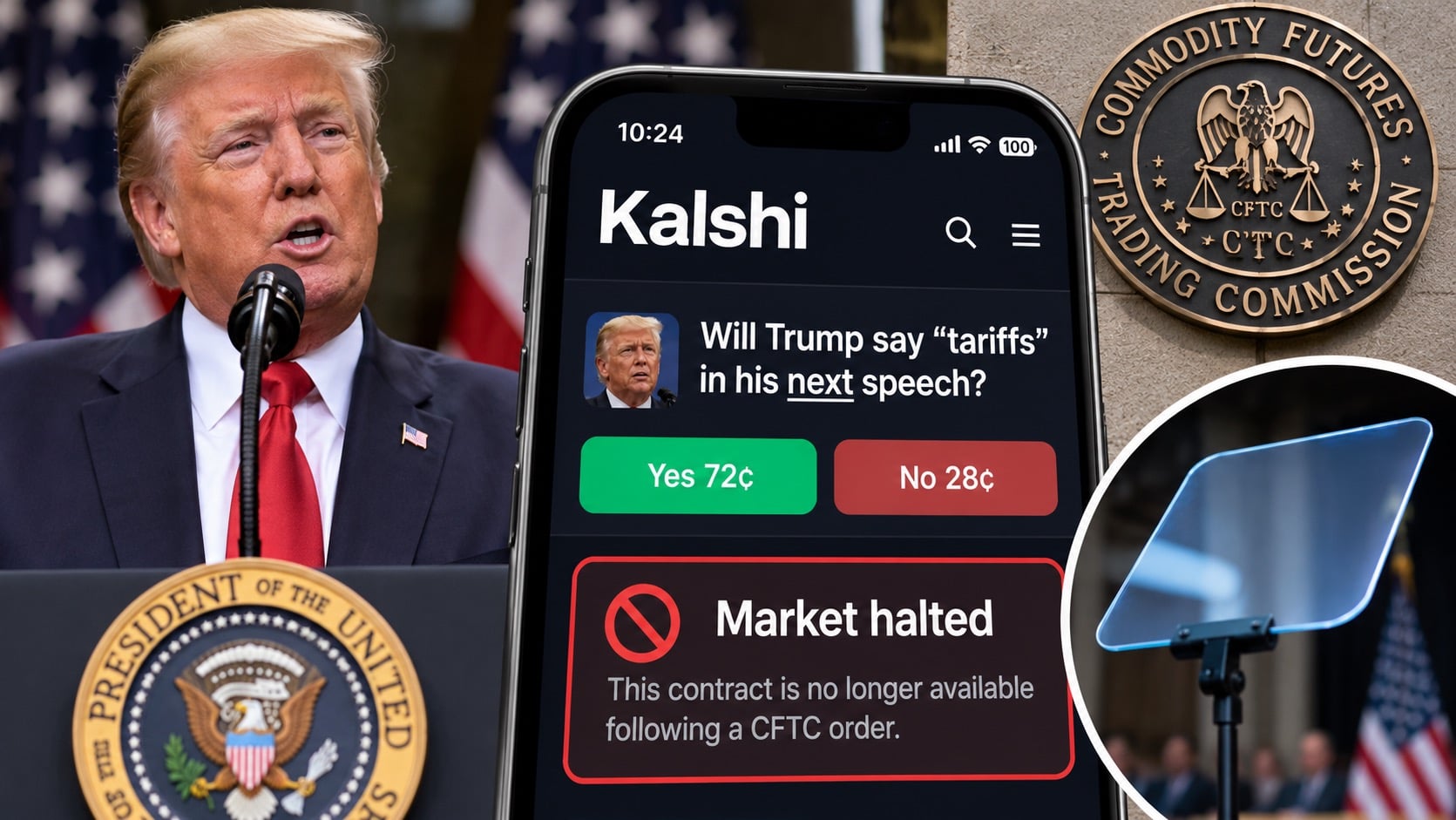
The prediction market ended wagers on which words the president would say after the CFTC’s intervention, following an insider-trading case involving a White House teleprompter operator.
Prediction market platform Kalshi has stopped offering bets on whether President Donald Trump will use particular words in speeches, after an order from the US Commodity Futures Trading Commission (CFTC). The decision, disclosed on Tuesday, follows an order issued by the federal regulator last week. Earlier this year Kalshi’s own surveillance flagged possible insider trading in these markets to the CFTC. A White House teleprompter operator was later found to have traded on contracts tied to the president’s remarks.
The CFTC’s order
The CFTC’s order, dated 13 November, requires Kalshi to submit a written explanation by 11 December of why its original certification of the contracts should not be treated as false. The regulator will then decide whether to take further steps. It says it has not reached a final conclusion that the contracts are unlawful. Its concern is whether Kalshi showed that the contracts meet federal requirements against market manipulation.
The CFTC issued a warning on these products on 22 September. It said a speaker, speechwriter or anyone able to influence prepared remarks could decide whether a contract paid out. It also said outcomes should be independently verifiable, and that events controlled by one person or a small group raise particular manipulation concerns. Kalshi first certified the presidential word contracts on 20 February 2025 and amended its rules for multi-word phrases on 29 July 2026. The CFTC says neither filing provided the extra anti-manipulation assurances it later sought. It also says Kalshi listed a contract on Mr Trump’s nicknames up to 2027 on 1 October without updating its certification.
An analysis by EventMarkets of Kalshi’s public records identified 75 inactive contracts across four categories. These were 13 on words Mr Trump would say in November, 32 on companies he would mention, 20 on countries and 10 on nicknames. The analysis found around 59,000 contracts of open interest across them. EventMarkets says trading had effectively stopped by Tuesday morning. The figures come from a reported data snapshot and were not independently recalculated.
The teleprompter case
Gabriel Perez, the White House teleprompter operator, was banned from Kalshi for three years and ordered to pay $65,000 in penalties. He also had to surrender $107,000 in winnings to the CFTC, in a consent order dated 28 August 2026. The CFTC found he traded profitably on 39 of 43 contracts, using advance copies of speeches that he generally received about an hour before Mr Trump spoke. It said he sometimes changed his position when Mr Trump departed from the script. He opened his account on 8 December 2025 and began trading the next day. The regulator cut his penalty by about 40 per cent because of his cooperation, which it described as extraordinary. According to CNBC, the CFTC began an internal review of prediction markets by August.
Wider scrutiny
The move comes during a tougher turn by the CFTC under chairman Michael Selig, who had previously championed the industry. The agency has opened investigations into Kalshi and its rival Polymarket. Politico reported earlier this month that Kalshi was under investigation for developing new products without notifying the commission. Donald Trump Jr stepped down last week as a paid strategic adviser to Kalshi. The CFTC also sued Arkansas on 13 November to block state enforcement action against Kalshi, the 11th state it has sued over prediction-market jurisdiction. “The CFTC will continue to defend its sole jurisdiction over these federally regulated markets,” Mr Selig said. Reuters reported that Kalshi has also stopped listing some markets, including certain sports-related ones, at the regulator’s request.
A House Oversight Committee investigation has obtained nearly 1,700 pages of documents from prediction-market companies. A committee memorandum dated 13 November records five bipartisan briefings with the platforms. The inquiry widened on 29 September to include Hyperliquid Labs, Crypto.com and PredictIt. Committee staff propose considering rules to stop government staff, members of Congress and their aides trading on markets tied to government actions. These are recommendations, not enacted restrictions. The Senate passed a resolution on 30 April banning senators and their staff from taking part in prediction markets.
Other cases cited in the memorandum are allegations or penalties in separate matters. A federal indictment announced in April accuses US Army master sergeant Gannon Ken Van Dyke of making more than $409,000 on Polymarket using classified information. The CFTC filed a complaint on 27 May accusing Google engineer Michele Spagnuolo of making $1.2m on markets about the year’s most searched terms. On 31 July the CFTC ordered former congressman George Santos to pay $35,000 over manipulative activity in a market on his attendance at the State of the Union. Kalshi had detected that trading and reported it to regulators.
Markets that remain open
Kalshi has pulled markets on mentions by the president. Markets on what other prominent figures will say are still active. They include remarks by Vice President JD Vance and New York Mayor Zohran Mamdani at the upcoming New York Times DealBook Summit, and by executives at Microsoft and SpaceX. They also include what companies such as Nvidia and Target will say on their earnings calls. Reuters reported on 17 November that Kalshi is in talks to raise funds at a $65bn valuation. The discussions have not been confirmed as a completed funding agreement.
