



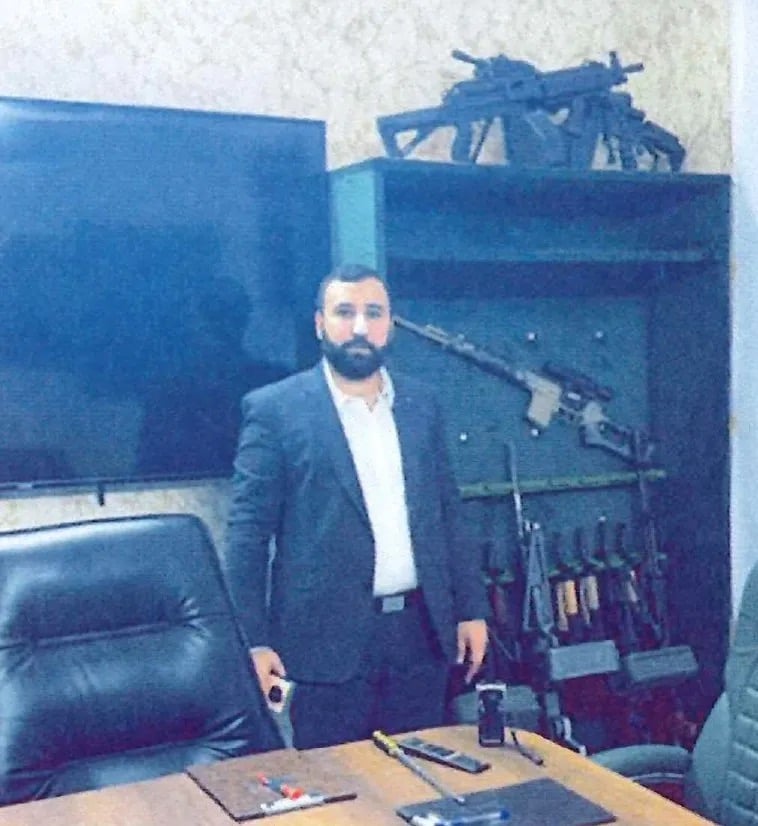
Prosecutors say one of the accused coordinated the plan while in custody. A US indictment alleges a wider network behind attacks on Jewish communities in Europe, and the three men are presumed innocent.
The United States has charged three men with plotting a “campaign of terror” across Europe, including an alleged bomb attack on RAF Fairford, the joint US-UK airbase in Gloucestershire. The charges against Mohammad Baqer Saad Dawood al-Saadi, Mohsen Mohajeri and Mohammad Ali al-Hassani were set out in a New York court on Tuesday. US Attorney Jamie McDonald alleged that al-Saadi coordinated with the other two while in prison in the days before the alleged plot in September. The allegations are unproven.
Who is accused
According to the US Department of Justice (DOJ), al-Saadi is a dual Iranian-Iraqi national and Mohajeri is an Iranian national. Al-Hassani, 35, is an Iraqi national and a former British citizen. Only al-Saadi is in American custody, the Associated Press reported, while the other two are overseas. Al-Saadi has pleaded not guilty to earlier charges.
The new indictment contains eight counts, covering alleged support for designated terrorist groups, financing terrorism and conspiracy to bomb a place of public use, among other offences. The maximum penalties, according to the DOJ, are:
| Alleged offence | Maximum penalty |
|---|---|
| Conspiracy to support Kata’ib Hizballah | 20 years |
| Conspiracy to support the IRGC | 20 years |
| Conspiracy to support terrorist acts | 15 years |
| Providing support for terrorist acts | 15 years |
| Attempted transnational terrorism (al-Saadi only) | Life |
| Conspiracy to bomb a public-use location | Life |
| Attempted destruction using fire or explosives (al-Saadi only) | 20 years |
| Financing terrorism | 20 years |
Those are maximums, not predictions of any sentence.
The alleged Fairford plot
Prosecutors say al-Hassani began paying contacts in Britain in August 2026 to prepare an attack on the base. On 22 August, one associate allegedly surveyed the perimeter and sent video recordings to him.
The indictment alleges that three vans were fitted with custom decals so they resembled vehicles run by a fuel-delivery company and a swimming-pool supplier. It says associates were paid to buy fuel containers, research chemicals and acquire metal objects that prosecutors say could have been used as fragmentation material.
On 26 September, three vans were allegedly sent towards the base. At least two came up against a security checkpoint and could not continue along their planned routes, prosecutors say, and al-Hassani stayed in frequent contact with the drivers. In the early hours of 27 September, British officers seized three white vans with commercial logos and detained five men near the airbase, according to Counter Terrorism Policing.
What the British court heard
Westminster Magistrates’ Court heard on 27 October that a handler known as “Ali” told the men to leave the vans and run after saying the vehicles contained a bomb, Sky News reported. One of the men then called police. Investigators found petrol, large water containers and internet-connected dashcams in the vehicles, and no explosives, according to evidence presented in the British proceedings. The DOJ alleges that British associates referred to al-Hassani as “Ali” in messages.
Prosecutors in London told the court that Mohmed Abdulkarim had received about £70,000 from the overseas handler and bought equipment for the operation.
Two London men have been charged in the UK, according to the Crown Prosecution Service. Abdulkarim, 24, faces an allegation of assisting a foreign intelligence service under Section 3 of the National Security Act 2023. Nouman Essghir, also 24, is charged under Section 4, which concerns prohibited places and conduct prejudicial to UK security. The surveillance charge relates to 22 August, the same date as the reconnaissance described in the US indictment.
Both men are due at the Old Bailey on 20 November, Sky News reported. Abdulkarim was granted conditional bail, including surrendering his passport. Seven people were arrested during the British investigation, and two have been charged. A 25-year-old dual British-Iranian national was released without charge after a further arrest but remains on bail over an earlier arrest. Assistant Commissioner Laurence Taylor said officers reviewed substantial CCTV material and the contents of dozens of seized devices before securing the charges.
Alleged communications from custody
The DOJ says al-Saadi was arrested abroad around 1 May 2026 and moved to American custody. Prosecutors allege that the group resumed preparing further activity in August, after about four months without attacks attributed to the network.
According to the DOJ, al-Saadi spoke to his mother and sister in Iraq about Mohajeri using aliases, including Abbas, Abu Daniel and Sayyid Abbas. Prosecutors claim references to outstanding “work” meant operations and not ordinary employment. In a conversation on 24 September, two days before the vans were allegedly sent towards the base, he is said to have asked relatives about “Ali” and told them to give him money so that he could go ahead.
The alleged wider network
US investigators say a group calling itself Harakat Ashab al-Yamin al-Islamiya (HAYI) was used to claim attacks, and prosecutors allege it was a front for Kata’ib Hizballah and other designated terrorist organisations. HAYI claimed 18 attacks in Europe in spring 2026, seven of them in the UK, according to the DOJ. That is about 39% of the total, more than in any other European country.
Prosecutors allege the campaign included the near-fatal stabbing of two Jewish men in London, one of whom held dual British-American citizenship. They say they have obtained footage, dated around 6 April, that allegedly shows Mohajeri and al-Hassani in a room in Iraq with a map of London, with al-Hassani discussing the need to focus on the British capital. HAYI claimed six attacks in and around London starting about a week later.
On 17 April, the three defendants allegedly took part in a live video call with someone carrying out an attack, with al-Hassani giving instructions and al-Saadi filming. The following day, prosecutors say, al-Hassani remotely directed an individual during an attack in which an improvised explosive device was ignited and thrown at a London synagogue. The DOJ also alleges that al-Saadi tried to arrange attacks in the United States in March and April, and that the network considered targeting a Manhattan synagogue.
Military and political fallout
The Associated Press reported that the US withdrew B-1 bombers and other aircraft from RAF Fairford after assessing threats to American personnel and aircraft. Reuters reported that the base was used by US military aircraft during the conflict with Iran.
Mr Taylor said in an update on 20 October that investigators considered Iranian state involvement highly likely, though the extent and nature of any involvement was still being examined. He told reporters that decisions that looked unusual to the public, including releasing suspects on bail, had helped officers gather stronger evidence. Iran has denied responsibility, Reuters and The Guardian reported. Iranian officials summoned Britain’s ambassador over the accusations. The Revolutionary Guards previously described bases used to launch attacks against Iran as legitimate military targets.
US Attorney General Todd Blanche said: “Anyone who plans a terrorist plot on a military base housing American servicemembers will be prosecuted by the United States government.” Senior Justice Department official M. Scott Proctor described the indictment as “a major disruption of an alleged global terrorism conspiracy”.
FBI Director Kash Patel said the bureau had disrupted more than 1,300 terrorists and made almost 7,000 arrests linked to designated foreign terrorist organisations over the preceding 21 months. Those are figures asserted by Mr Patel and not independently audited statistics.
