



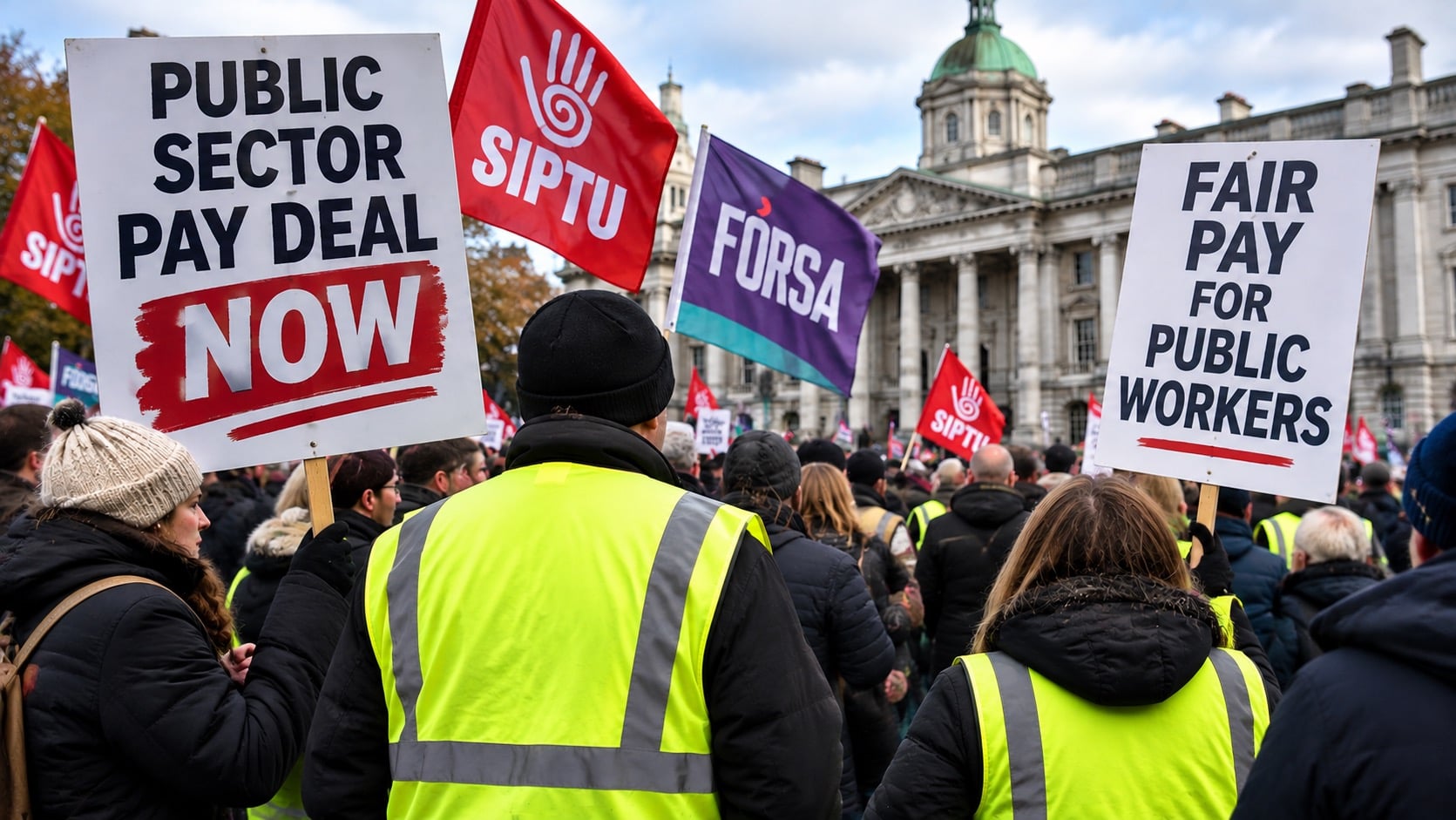
The Government has described its latest offer of 10.5% as “substantially improved”. Unions are weighing it and say the length of the deal is a concern.
Formal talks on a public sector pay deal are due to resume at the Workplace Relations Commission (WRC) today, though a 24-hour strike planned for Thursday is still going ahead. Trade unions and Government representatives held talks overnight with an independent group led by WRC Chair Kevin Foley, which ended in the early hours of this morning. They found a route back to formal negotiations. Unions are now considering a 10.5% offer that would run until early 2029.
What is on offer
The Government has called the offer “substantially improved”. Union sources told reporters they were worried about its duration. If it becomes a three-year agreement, they said, they would seek a bigger pay rise. Unions have said they want a better deal than the last agreement, which was worth 10.25% over two and a half years and expired at the end of June.
The Irish Times reported on 8 November that some lower-paid workers could receive increases of up to 17.8%, and that the 10.5% headline figure would equate to about 11% when compounded across the agreement. The Irish Examiner reported that the package includes an extra payment for 2026 of €1,200 or 2%, whichever is higher, bringing the year’s total increase to 4% once an earlier 2% rise is counted. The minimum payment would help lower-paid staff most.
The Government’s earlier proposal was worth 7.75%, according to Fórsa’s strike FAQs. It consisted of 1.75% initially, followed by five separate 1% increases between November 2026 and October 2028, with a further 1% allocated to local bargaining in 2028. The union rejected it. The Irish Times reported on 9 November that unions were also uncertain whether backdated increases would apply from June or November, and worried that spreading increases over up to three years would cut their annual value.
The cost
A 10.5% rise in public sector pay is expected to cost the Exchequer €4.58bn over the life of the deal. Additional measures for lower-paid workers push the total close to €5bn.
The Irish Times reported that the Government had budgeted €1.2bn for the first year of the new agreement, but that the latest offer could cost about €2bn in cash terms in 2027. That would leave the fiscal position about €800m worse than forecast for that year. It also reported that each extra 1% on the public sector pay and pensions bill costs about €370m, and that the Parliamentary Budget Office projected a public sector wage bill of €31.2bn in 2026, about 27% of gross Government spending.
The newspaper put private sector wage growth since 2008 at about 52% to 56%, against 25% in the public sector, though it said high salaries at multinational firms influence the comparison. Government forecasts put economy-wide wage growth at 4.1% in 2027 and 3.7% in both 2028 and 2029.
Thursday’s strike
Fórsa deputy general secretary Katie Morgan told members that more than 50,000 had said which demonstration they planned to attend by Monday afternoon, the Irish Examiner reported. The paper said more than 20,000 are expected in Dublin alone.
Members are being encouraged to march in rallies instead of picketing workplaces. There will be eight demonstrations from 12pm to 2pm, in Dublin, Cork, Limerick, Galway, Waterford, Sligo, Tullamore and Letterkenny. The Dublin event will coincide with a major meeting of world leaders in the capital as part of Ireland’s EU Presidency. About 350 staff involved in the presidency arrangements could be affected by the strike, the Irish Examiner reported, though Taoiseach Micheál Martin said the meetings would go ahead.
Fórsa has published routes and assembly points for the rallies:
| Location | Assembly | March begins | Route |
|---|---|---|---|
| Dublin | 11.30am | 12pm | GPO to Stephen’s Green East |
| Cork | 11.45am | 12.30pm | Lapps Quay to Grand Parade |
| Limerick | 11am | 12pm | Pery Square to Pery Square |
| Sligo | 11.30am | 12pm | ATU to Sligo City Hall |
| Letterkenny | 12pm | 12.30pm | Town Park to An Grianán Theatre |
| Waterford | 11am | 12pm | The Glen to Bishop’s Palace |
| Tullamore | 12pm | 1pm | Lloyd Park to O’Connor Square |
| Galway | Not yet published | Not yet published | Details pending |
Fórsa advises participants to avoid driving into central Dublin because of restrictions around the North City Quays and Merrion Square. The accessibility meeting point is at the junction of Merrion Row and Stephen’s Green East. Fórsa says some hospital and emergency-services staff may have to stay close to their workplaces to respond to critical incidents.
The Irish Examiner reported that Wednesday morning, 11 November, is emerging as a critical deadline. Government and union sources told the paper that a deal might have to be reached by then to avoid the stoppage, though union sources accepted that it could be called off later on Wednesday.
Fórsa says no further nationwide strike of the same scale is planned after Thursday, and that any later action would be targeted, with arrangements to compensate workers for lost pay. Kevin Callinan outlined a possible rotating strike strategy to RTÉ on 5 November, involving about 1,000 members at a time, with the union’s strike fund supporting workers withdrawn from selected services for a week before action moves to another group.
Issues beyond pay
Fórsa says talks have covered more than salary. Unions are seeking protections for remote and hybrid working, and the union lists reduced outsourcing, pensions and other employment conditions as matters discussed, with several unresolved. It also says the Government’s earlier proposal did not adequately account for the extra productivity measures being sought, and that problems with the local bargaining provisions of the previous agreement had not been resolved.
Other disputes
The Association of Secondary Teachers, Ireland (ASTI) has authorised a further phase of industrial action from Monday 16 November, which is separate from Thursday’s strike. Members voted 95% to 5% in favour of action in September, and more than 20,000 secondary teachers began an earlier phase on 5 October, withdrawing from selected duties including Croke Park Hours.
The Garda Representative Association planned work-to-rule action from 10 to 14 November over alleged breaches of working-time arrangements, including rest periods between shifts, the Irish Examiner reported on 30 October. Labour TD Alan Kelly raised concerns about whether this could affect policing of the European meetings. The Irish Examiner also reported on 31 October that the existing public sector work-to-rule had delayed publication of homelessness figures, because the Department of Housing had not received returns from the nine administrative regions.
What ministers have said
Mr Martin said the improved offer was not a final ultimatum. Speaking on 9 November, he rejected describing it as take-it-or-leave-it and argued it met the criteria previously identified as necessary for a settlement, according to the Irish Examiner. Tánaiste Simon Harris described the remaining negotiating period as a “very small but crucial window” and urged both sides to prioritise a settlement over preparations for further industrial action, The Irish Times reported.
The Irish Times also reported unhappiness among senior union officials after the revised offer was disclosed publicly. They believed the release of the details could undermine their negotiating position. That is a reported account of union concerns, not an established Government intention.
