



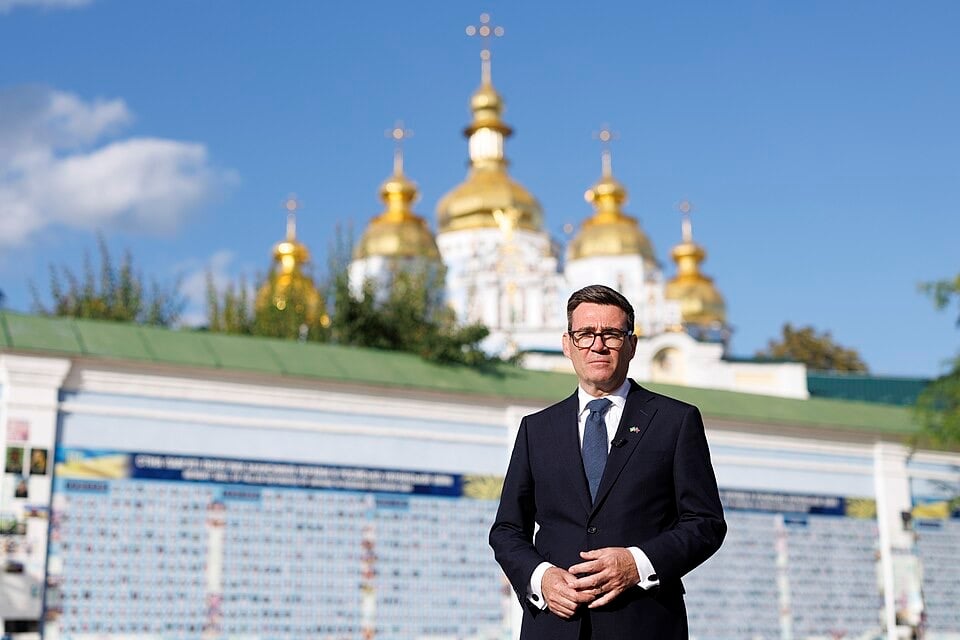
The prime minister told MPs he was not questioning the referendum result, but would not commit to publishing evidence, as Nigel Farage branded him “a liar”.
Prime Minister Andy Burnham has said it is “inconceivable” that Russia did not try to interfere in the 2016 EU referendum. In a podcast interview he said it was “clear” that Moscow had interfered, but later told MPs he had not been questioning the legitimacy of the vote. A No 10 spokesperson said Mr Burnham thought it highly likely Russia tried to influence the result, but did not believe those efforts succeeded. Reform UK leader Nigel Farage and former prime minister Boris Johnson have both challenged his account.
What Burnham said
In the interview for The Rest is Politics, released on Monday, Mr Burnham said he had asked on arriving in Downing Street whether there had been Russian interference in the referendum. “I’ve had the clear answer that, yes, there was,” he said.
He added: “I think we’ve been too much on the back foot on that actually and we haven’t informed people sufficiently about the extent to which people are seeking to disrupt the political process from overseas.” He gave no details of the extent or nature of any Russian activity.
Pressed in the Commons on Monday afternoon, he appeared less definitive.
Exchanges in the Commons
Conservative leader Kemi Badenoch said the prime minister had “implied that the referendum result was illegitimate because of Russian interference”. She asked him to confirm that he believed the referendum was legitimate and, if not, to “publish the evidence that Russia swung the result of the 2016 referendum”.
Mr Burnham said he had “implied no such thing”. He said it was a “matter of record” that Russia sought to interfere in the 2019 general election. “We think it is inconceivable that this was the first time,” he said.
Liberal Democrat leader Sir Ed Davey welcomed the comments, saying it “took courage after the Conservatives took so long suppressing the evidence”. He urged the prime minister to publish evidence of interference in the referendum and other UK votes. Mr Burnham did not commit to making any evidence public, but said he wanted to make sure the democratic system was protected in future.
Farage and Johnson respond
Mr Farage said: “The prime minister is a liar, yes, a liar.” He added: “There was no Russian interference – the Russian hoax has run all the way through this.”
Mr Johnson wrote on X that when he became foreign secretary in 2016, the security services told him “there was no evidence of any successful interference in the 2016 referendum, by Russia or any other power”. He added: “Either the security services have changed their view – which would be very odd – or Burnham is lying about what he has been told.”
Asked in 2017 whether he had seen evidence of Russia successfully meddling in UK elections, Mr Johnson, then foreign secretary, replied: “Nyet [Russian for no], not a sausage.”
What earlier inquiries found
Attempted interference and successful interference are different things, and the earlier inquiries did not establish the latter.
- The 2020 parliamentary report. The BBC says it did not reach a firm conclusion on whether Russia had tried to intervene in UK elections and referendums, but criticised the government for failing to assess and counter Russian “troll” accounts on social media. The research notes add that the Intelligence and Security Committee found MI5 provided only six lines of evidence on the referendum, and that no comprehensive assessment had been carried out. The committee recommended that MI5 take operational responsibility for protecting democratic processes.
- The Leave.EU inquiries. In 2018 the Electoral Commission examined allegations about Leave.EU, Arron Banks and financial links to Russia. The National Crime Agency then investigated an £8m loan linked to referendum campaigning. In September 2019 it found no evidence of criminal offences under electoral law. Mr Banks has consistently denied receiving Russian money.
- This year’s independent review. The government published a review of foreign influence in UK politics which said there were attempts to “sow distrust and exacerbate divisions in UK society with the ultimate aim of undermining confidence in our democracy”. Its author, Philip Rycroft, said the impact was hard to establish and that the public could be “credited with sufficient common sense” to see through the more egregious attempts. He said there was no “immediate crisis” in British democracy, but “no guarantee that this will persist”.
The referendum itself was won by Leave with 51.9% against 48.1%. That was 17,410,742 votes to 16,141,241, a margin of 1,269,501 on a 72.2% turnout. Showing that Russian interference changed the result would require evidence of its effect on voters, not just of an attempt.
Unanswered questions about the briefing
It is unclear whether Mr Burnham received a new formal intelligence assessment or an informal briefing from officials. He has not said which agency supplied the information. No newly declassified intelligence document had been identified in reporting on Monday. The Guardian’s defence and security editor raised the possibility that the remarks reflected a fresh assessment, but stressed that the available information does not establish this.
EU context
The research notes say Mr Burnham has linked interference to his wider argument for closer European co-operation. He is preparing for a UK-EU summit in Brussels on 20 November, expected to cover trade, energy and possible regulatory alignment. A food and drink trade agreement and youth mobility arrangements are among the topics. He has not ruled out Britain rejoining the EU in the longer term, though the Government has not committed to applying.
He said German Chancellor Friedrich Merz had raised concerns about Russian connections to the Alternative for Germany party. He referred to Germany and France as facing similar risks, with national elections due in both in 2027. The AfD has faced long-running scrutiny over alleged links between individual figures and Russian interests, which is not proof that the whole party is directed by Moscow.
