



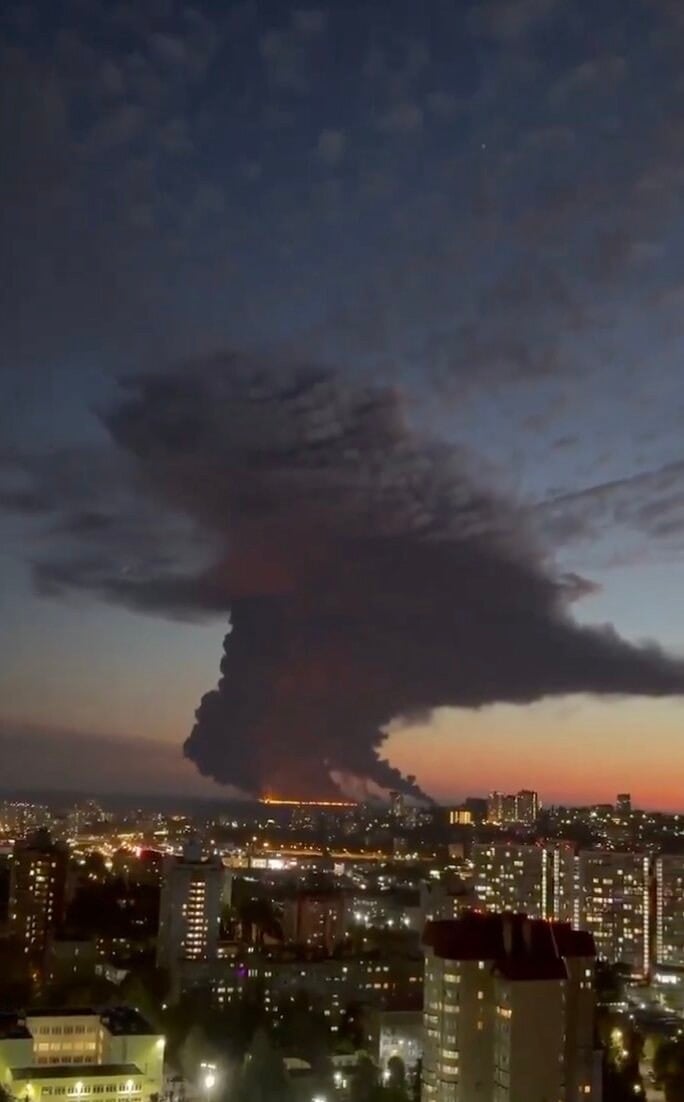
A huge fire broke out on a Russia-linked oil tanker in the Black Sea, forcing tourists in the resort city of Sochi to shelter indoors, as separate attacks on two merchant vessels in Bulgaria’s exclusive economic zone sparked wider alarm over the safety of Black Sea shipping.
A massive fire has broken out on a sanctioned oil tanker in the Black Sea, with footage showing thick black smoke rising above the vessel near the Russian resort city of Sochi, where tourists were told to remain indoors as smog spread across the area. The Liberian-flagged Aframax Rio, which Ukraine sanctioned in February 2026 over alleged links to Russia’s so-called shadow fleet, is reported to have been struck by naval drones, though this has not been officially confirmed. The incident comes amid a wider escalation of attacks on commercial shipping across the Black Sea, with two further merchant vessels reportedly struck the same day inside Bulgaria’s exclusive economic zone.
What happened to the tanker
The Aframax Rio, a large crude-oil carrier, was reportedly located near Nizhneimeretinskaya Bay, close to the Russian-Georgian maritime border, when the fire broke out. Satellite imagery is said to have detected the blaze, while video footage filmed from the Sochi coastline showed a vast column of black smoke rising above the burning vessel. Reports also indicated the presence of burning oil around the tanker, raising concerns about a potential marine pollution incident in addition to the fire itself.
The precise cause of the fire has not been officially established, and Russian authorities have not yet commented on the incident. However, reports suggest the vessel may have been targeted by Ukrainian naval drones. If Ukrainian involvement is ultimately confirmed, the strike would be notable given Sochi’s distance from Ukrainian-controlled territory, demonstrating what would represent a significant extension of Ukraine’s maritime strike capabilities deep into Russian waters.
Sochi has faced repeated attacks in recent months, including strikes on the city’s port and an oil facility last month. The timing of the tanker fire has also been noted given its proximity to Russian President Vladimir Putin’s official residence, Bocharov Ruchey, located in Sochi, with Putin due to turn 74 on Wednesday.
Separate attacks in Bulgarian waters
On the same day, two merchant ships were attacked inside Bulgaria’s exclusive economic zone, approximately 70 to 80 nautical miles from the Bulgarian coast. The vessels have been identified as the Togo-flagged Alfa Watan and the Palau-flagged Able. According to reports, the Alfa Watan suffered severe damage and sank, with several crew members initially reported missing. The Able caught fire, though its 18-person crew was successfully rescued; two crew members sustained serious injuries in the incident. This is believed to be the first such attack recorded within Bulgaria’s exclusive economic zone.
Responsibility for the Bulgarian attacks remained unclear in the immediate aftermath, with Bulgarian officials saying the drones involved could have originated from either Russia or Ukraine. Ukrainian President Volodymyr Zelensky subsequently blamed Russia for the strikes, though Russian responsibility had not been independently confirmed at the time. Separately, maritime security analysts have assessed that Russian forces were highly likely responsible for a series of recent attacks on merchant vessels in waters off Romania and Bulgaria, though this remains an intelligence assessment rather than a formally confirmed attribution.
International reaction
European Commission President Ursula von der Leyen condemned the attacks on commercial shipping, describing such strikes as unacceptable. Bulgarian Prime Minister Rumen Radev warned of the risk of further escalation, saying: “If this war is not brought to an end in time, it will continue to expand its geographical scope and increase the risk of even a global conflict.”
Why the incidents matter
Taken together, the attacks represent a significant escalation involving commercial shipping across the Black Sea, with vessels struck in waters surrounding Russia, Bulgaria and Romania within a short period, resulting in ships sunk or damaged and crew members killed, injured or reported missing. The Bulgarian incident is considered particularly sensitive, as it occurred within the exclusive economic zone of a NATO member state, although an attack within a country’s EEZ does not in itself constitute an attack on NATO territory under international law.
