



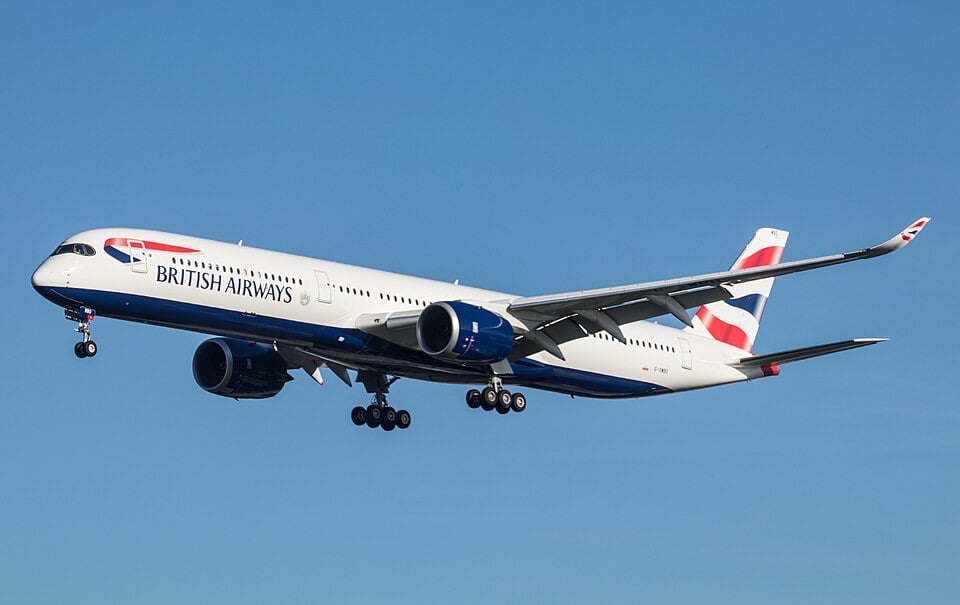
A British Airways Boeing 777 bound for Chicago was forced to abandon its transatlantic crossing after dropping from 37,000 feet to roughly 9,000 feet over Irish waters, declaring an emergency before eventually landing safely back at Heathrow more than four hours after departure.
A British Airways flight to Chicago was forced into an emergency diversion after plunging nearly 28,000 feet shortly after reaching cruising altitude. Flight BA295, operated by a Boeing 777-200ER, departed Heathrow Terminal 5 at 11.15am and had just reached 36,000 feet when it began a rapid descent around 34 minutes into its planned near-nine-hour journey. According to flight-tracking data from Flightradar24, the aircraft dropped to approximately 9,000 feet within minutes, before eventually turning back and landing safely at Heathrow several hours later.
A dramatic descent over Irish waters
The aircraft had been cruising at 36,000 feet when it suddenly began its descent at around 11.50am, reaching roughly 9,000 feet by 11.57am, Flightradar24 data showed. The drop occurred over Irish waters as the jet made its way across the Atlantic approaches. At 12.10pm, the aircraft executed a sharp U-turn, with flight-tracking records confirming it was being redirected back towards Heathrow rather than continuing on to Chicago O’Hare.
Footage circulating online appeared to show oxygen masks deployed for passengers and crew, consistent with reports suggesting the aircraft may have experienced a cabin pressurisation problem. However, British Airways has not officially confirmed this as the cause, describing the incident only as a “technical issue.” The crew is reported to have squawked code 7700, the international transponder signal used to alert air traffic control to a general in-flight emergency, prompting authorities to clear surrounding airspace and notify emergency services on the ground.
Why the plane descended so rapidly
The sudden loss of altitude is understood to reflect standard emergency procedure rather than any loss of control. In the event of a cabin pressurisation issue, pilots are trained to descend quickly to an altitude at which passengers can breathe normally without needing supplemental oxygen, typically around 10,000 feet. The aircraft is reported to have remained at roughly 9,000 feet for an extended period as it made its way back towards Britain, allowing the crew to maintain a safe, breathable altitude while preparing for the return to Heathrow.
Burning fuel before landing
Rather than returning immediately, the aircraft, registered G-VIIA, spent around an hour and a half circling and burning off fuel over the Bristol Channel. This is understood to be a standard precaution for long-haul aircraft forced to turn back shortly after departure, as a Boeing 777 carrying a full load of fuel for a near-nine-hour transatlantic flight can be significantly heavier than its permitted landing weight. Reducing fuel levels before touching down helps avoid the risk of an overweight landing.
Flightradar24 tracking placed the jet over Cornwall at around 3.10pm as it continued its route back towards London, before it ultimately landed safely at Heathrow at approximately 4.02pm, more than four hours after it had first departed.
British Airways’ response
A British Airways spokesperson confirmed the aircraft had returned to Heathrow following a technical issue, stressing that passenger and crew safety remained the airline’s priority throughout. “The safety of our customers and crew is always our top priority, and the aircraft landed safely after our highly-trained pilots returned to Heathrow following a technical issue,” the spokesperson said. “Customers disembarked the aircraft normally and our teams are working to get their travel plans back on track as quickly as possible.”
About the aircraft
The aircraft involved, registration G-VIIA, is a Boeing 777-236ER and is understood to be the oldest plane currently operating in British Airways’ passenger fleet. According to aviation news site Simple Flying, it was delivered to the airline in July 1997, making it approximately 29 years old. While its age has been noted, there is no confirmed link between the aircraft’s age and the cause of the technical issue. Flight-tracking records show that BA295 had been operated by a different 777 aircraft the previous day, indicating the aircraft assigned to the route had changed shortly before the incident occurred.
Despite being over the Atlantic approaches and Irish waters at the time the issue arose, the flight crew ultimately opted to return to Heathrow rather than divert to a nearer airport, and the aircraft completed its emergency return journey without further incident.
