


Belgian powerlifter Sonita Muluh says she no longer feels safe competing after a spotter at the European Powerlifting Championships in Lithuania later claimed on Instagram that he had deliberately interfered with her record squat attempt because of her race, a claim that has triggered a criminal investigation, a lifetime ban and a review of safeguarding procedures within the sport.
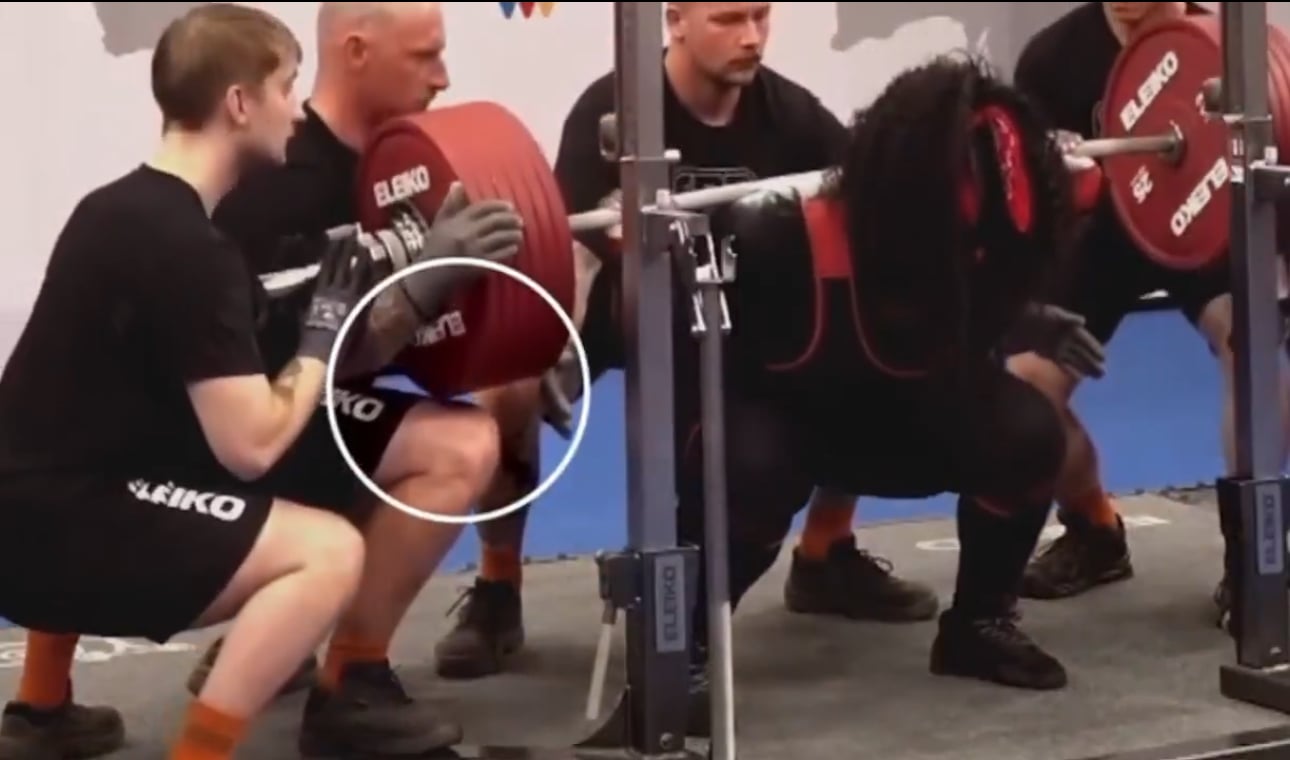
Belgian powerlifter Sonita Muluh has said she “does not feel safe” competing after a spotter’s actions during a record squat attempt in Lithuania were later described by him as racially motivated. Muluh was attempting a 334.5kg squat, which would have been the heaviest ever recorded by a woman, at the Powerlifting Championships in June when spotter Ernestas Kusinas touched the weights with his knee. She was subsequently disqualified by judges over a separate technical infringement and denied the chance to reattempt the lift. Police in Lithuania have since opened a criminal investigation after Kusinas wrote on Instagram: “I am racist, and I did it intentionally.”
What happened during the lift
In powerlifting, spotters are responsible for protecting athletes during their lifts but are not permitted to touch the barbell unless an attempt has failed or the lifter is in danger, as any unnecessary contact can invalidate the lift. During Muluh’s attempt at the 334.5kg squat, Kusinas made contact with the weights using his knee. Judges went on to disqualify the attempt over a technical infringement, rather than citing the spotter’s contact with the bar as the direct cause, and did not permit Muluh to attempt the lift again.
Speaking to BBC Sport, Muluh, 29, described the danger the incident posed. “I feel unsafe and uneasy that this person is standing beside me with massive weight, with what can go wrong, with the amount of weight on your back,” she said. “I was lucky when I realised [it hit his knee] and I could stabilise it. Not everyone could. It was the heaviest ever squat for a female.”
From presumed accident to alleged intent
In the immediate aftermath, Muluh said she did not blame Kusinas, believing the contact had been an honest error. “He did not reach out afterwards to apologise, but he is not obliged to. I thought it was a human mistake, that cost me a lot on the day,” she said. “But there was no hatred [from me]. I didn’t lash out; didn’t curse at him. There was a video of it posted afterwards and I said: ‘I hope he does not get hate.’ I believed it was an honest mistake.”
That changed roughly five weeks later, when Kusinas’s Instagram post surfaced online. “It’s shocking to wake up five weeks later and it’s all over the internet that he did it on purpose because of the colour of my skin,” Muluh said.
Kusinas told Reuters that the Instagram comment had been written out of anger after he was accused of racism by an unidentified social media user, and that he had intended it as mockery of the accusation rather than as a genuine statement. Separately, he told Reuters he had unintentionally interfered with attempts by Muluh and other athletes because he had been tired following his duties at the event.
Criminal investigation and lifetime ban
Lithuanian police have opened a criminal investigation focusing on the Instagram post and the circumstances surrounding the incident at the championships. A police spokesperson told Reuters that any resulting offence would carry a maximum sentence of two years’ imprisonment under Lithuanian law.
The Lithuanian Powerlifting Federation has imposed a lifetime ban on Kusinas, stating that the views attributed to him were fundamentally incompatible with the federation’s values. In a statement, the federation said: “We would like to address the situation that unfolded on social media. We reviewed available information relating to Ernestas Kusinas and were deeply shocked by the views and activities addressed publicly which contradict the principles we stand for. The federation takes full responsibility for addressing this matter.” Kusinas has since set his social media accounts to private.
Criticism of the International Powerlifting Federation
Muluh, who has won multiple European and world medals and is regarded as one of the sport’s leading squat specialists, said she felt let down by the sport’s global governing body, the International Powerlifting Federation (IPF), arguing that meaningful action only followed once the story gained wider attention.
“I feel like the federation needs to do background checks. If you are going to put my life in someone else’s hands, at least make sure that person is well equipped to be able to protect me or keep me from harm,” she said. “But they failed me [through] negligence and putting my life in danger.” She added: “[Kusinas] doubled down in his racist behaviour [afterwards]. Only now is he saying it was a joke. There’s nothing jokey about any of what he said. He put my life in danger. Nobody spots like that, with their knee.”
Reflecting on the toll the situation has taken, Muluh said: “It’s never going to feel justified… I trained through injuries just to prepare. I’ve put my body through a lot for this to happen. There’s never going to be any real justice.”
In response, the IPF issued a statement condemning the conduct: “The IPF unequivocally condemns racism, discrimination, and hateful conduct in all its forms. Such behaviour has no place within the IPF or the global powerlifting community.” The federation said it commended the Lithuanian Powerlifting Federation “for its prompt and decisive response to this matter, including its immediate action to permanently ban the individual from participation within the federation,” and confirmed it would “co-ordinate with the relevant IPF commissions, the IPF safeguarding officer, and the IPF Championships Team to identify opportunities to strengthen the recruitment, screening, accreditation, and oversight of volunteers supporting IPF events.” It added: “The IPF remains steadfast in its commitment to equality, inclusion, integrity, and fair play. Racism, discrimination, and hate have no place in our sport.”
Wider concerns about racism in the sport
Muluh also said she had not felt welcome at the event in Lithuania, describing a broader pattern of experiences she believes minority athletes face in the sport. “I hope [the IPF] do things differently – that they consider the safety of athletes more and especially minority people. I feel that’s what has been missing – we have been made to compete in places we didn’t feel welcome,” she said. “People looked down on us in Lithuania in a very disgusting way. When I competed in Poland someone sneezed in my face at the airport. Some black athletes are booed in competition, we have to worry about our skin colour while competing.”
She said the episode had changed her perception of support within the sport. “Powerlifting has been a very supportive niche sport, so far. But who is standing up for athletes against racism? This situation has changed my view a lot. There’s a lot of people who didn’t speak out about it. A lot of big names didn’t say a word about it. They didn’t reach out to me. All the black athletes reached out, so we all supported each other.”
Calls for stronger safeguarding
The case has prompted renewed debate within powerlifting over athlete welfare, volunteer training and safeguarding standards at international competitions, with several athletes calling for stricter oversight of championship officials. Muluh has specifically called for stronger vetting of volunteers, arguing that athletes should be able to trust that those responsible for their safety have undergone proper screening and training, a review the IPF has said it will now undertake following the incident.
