



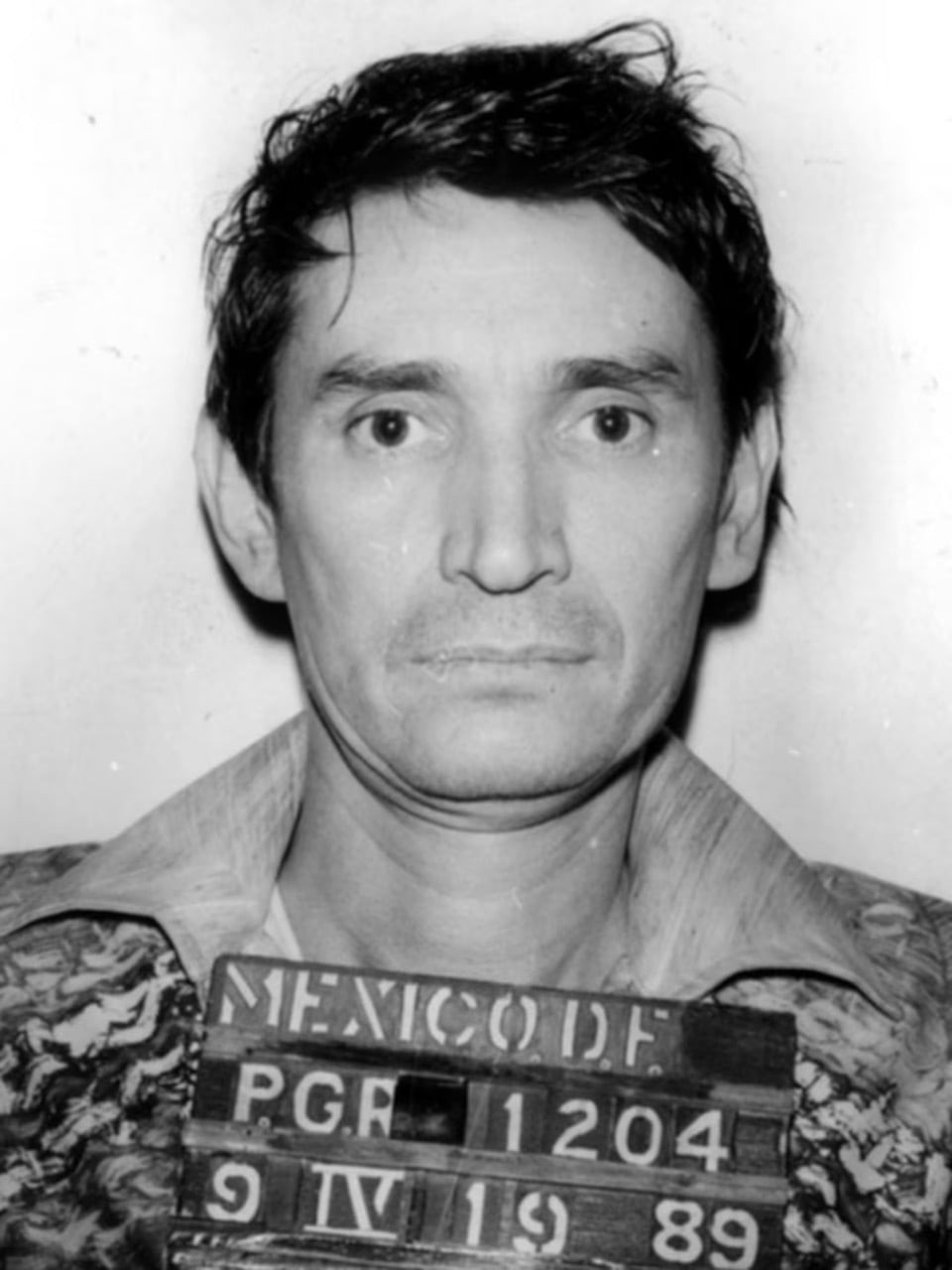
The founder of the Guadalajara cartel, jailed since 1989, died of multiple organ failure on Sunday. His remains were reportedly cremated privately in Guadalajara the same evening.
Miguel Ángel Félix Gallardo, the man widely known as the “godfather” of Mexico’s modern drug trade, has died in hospital at the age of 80. The security ministry of Jalisco state, where he was being held, said he died on 15 November after suffering multiple organ failure. “After remaining under observation with a guarded prognosis, he died on November 15 at the medical facility,” its statement said. He had been jailed since 1989 and was moved to a private hospital two days before his death.
Death and a heavy police presence
More than a dozen police vehicles reportedly escorted Félix Gallardo from Puente Grande prison to Hospital Country 2000 in Guadalajara on 13 November. Infobae described armed personnel guarding the emergency department and main entrance, with aerial surveillance, and La Jornada reported that a police helicopter accompanied the transfer. State police kept a perimeter around the hospital throughout his treatment, Publimetro México said, and security was increased after his death was announced.
The N+ broadcaster reported that the symptoms behind his final transfer included low blood oxygen, disorientation and altered consciousness. Mexican authorities disclosed in September 2022 that he had about 22 medical conditions and had been prescribed 13 medications, N+ said. His history reportedly included respiratory, neurological, digestive and sensory problems. In his final years he was blind in one eye, practically deaf and unable to walk unaided. He always maintained that he was innocent.
His body left the hospital at 4.49pm on Sunday, less than three hours after his death was announced, UnoTV reported, followed by a Jalisco security vehicle. Excélsior reported at 11.06pm Mexican time that sources close to the family said he had been cremated privately in Guadalajara, without a public wake. Infobae reported security around a Gayosso funeral facility in the city, though the family has not publicly confirmed arrangements, and accounts of a wake and an immediate cremation differ. There was speculation that his remains might go to Sinaloa, but no destination has been confirmed.
Sentences and failed bids for house arrest
He was arrested in 1989 and sentenced to 40 years in prison on drug-trafficking and weapons charges linked to the cartel. While in custody, he faced a separate prosecution for the kidnapping and murder of a US drug enforcement agent, which brought a further 37 years and cemented his reputation as Mexico’s most notorious trafficker. He was held in a maximum-security prison in western Jalisco.
His lawyers repeatedly sought house arrest on health grounds, and La Jornada reports that they had applied since at least 2016, with judges rejecting several applications and citing the gravity of his crimes and security concerns. In September 2022, a federal judge approved a transfer to house arrest because of his age and medical conditions, but the Attorney General’s Office challenged it and it never took place, Anadolu reported. El País calculated that, without release, his consecutive sentences would have kept him in prison until about 2066. He died after more than 37 years in custody.
From bodyguard to “boss of bosses”
Félix Gallardo was born in 1946 in Sinaloa, the north-western state that later became synonymous with drug trafficking. He began as a police officer and bodyguard to a local governor, then turned into a powerful criminal known as the “boss of bosses”. With others he founded the Guadalajara cartel, one of Mexico’s first major drug syndicates and the forerunner of the Sinaloa cartel. It was the first group to move cocaine to the United States on a massive scale, and he was the first to forge an alliance with Colombian cartels, including Pablo Escobar’s Medellín cartel. In the 1970s his empire grew on the back of bribed law enforcers and light aircraft used to move drugs across the continent. Mexican actor Diego Luna played him in the 2018 Netflix series Narcos: Mexico.
The Camarena case
The murder that defined his legacy was that of Drug Enforcement Administration agent Enrique “Kiki” Camarena, who was abducted on 7 February 1985 while travelling to meet his wife for lunch in Guadalajara. His remains were found on 5 March. According to the DEA’s historical account, Mexican authorities gave American investigators five recordings of Camarena’s interrogation after confirming his voice. The agency opened Operation Leyenda on 3 May 1985, which became its largest homicide investigation.
Rafael Caro Quintero, another Guadalajara cartel founder, is in US custody after Mexico transferred him to the United States in February 2025 with 28 other alleged cartel figures. Reuters reported that his lawyers confirmed preliminary plea discussions on 19 March 2026, though prosecutors said no formal offer had been made. His trial was tentatively set for 8 March 2027 in Brooklyn, and the Justice Department said in August 2025 that it would not seek the death penalty. El Financiero reported that an October 2026 hearing ended without a plea deal. A third founder, Ernesto Fonseca Carrillo, known as “Don Neto”, completed his 40-year sentence in April 2025 after serving the last part under house arrest from 2016, El Financiero reported. His whereabouts have not been publicly confirmed.
