



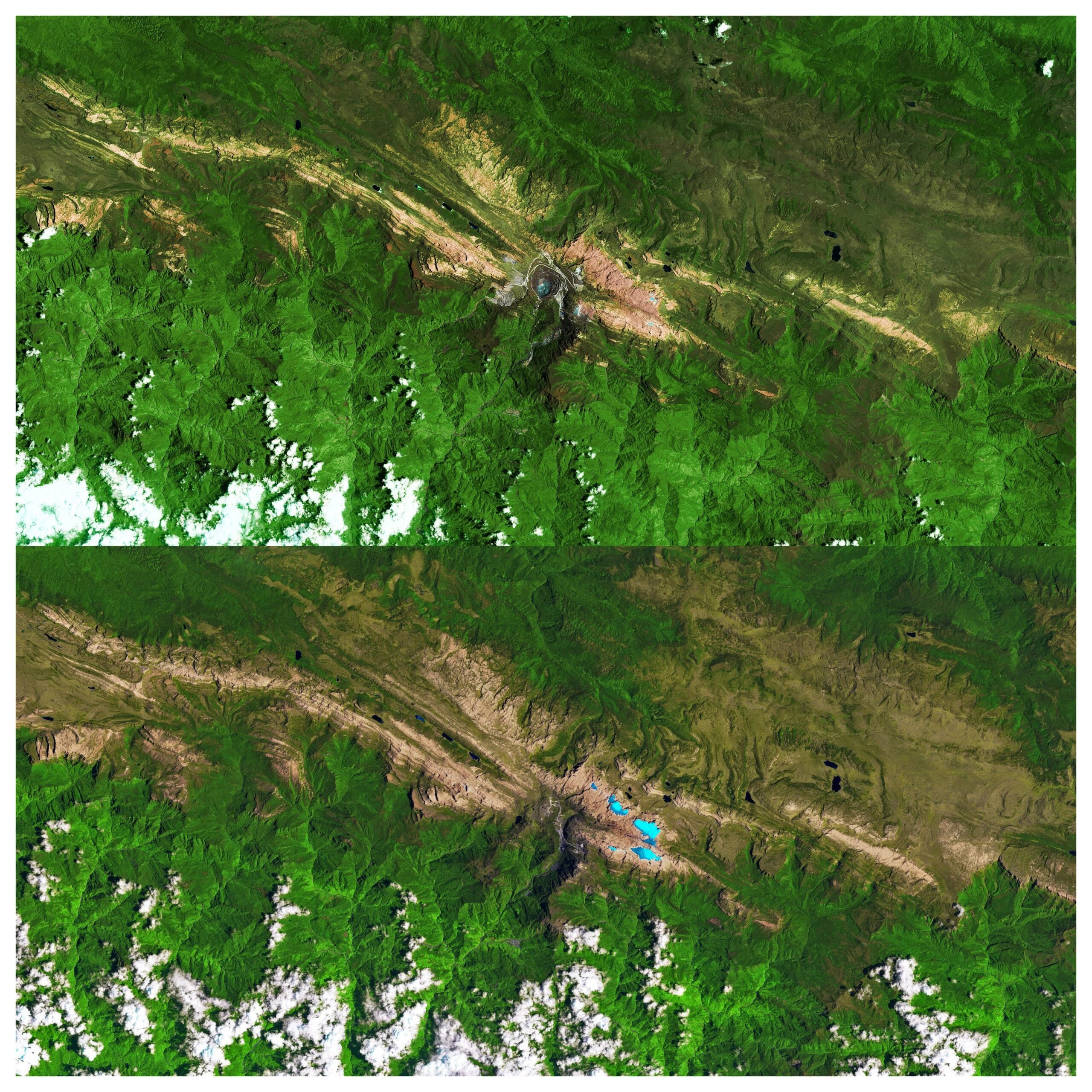
Indonesia’s last equatorial glaciers have thinned and fractured into patches too small to flow. Scientists say the main ice bodies could vanish by around 2030, or sooner, with El Niño accelerating the loss.
Near the summit of Puncak Jaya, in Indonesia’s Sudirman Range on the island of New Guinea, the ice has dwindled to patches too small to move like glaciers. Satellite images from Landsat 5 in 1988 and Landsat 9 in 2026 show how far it has retreated. Glaciers there covered about 4.31 square kilometres (1.66 square miles) in 1988, according to climate scientist Donaldi Permana of Indonesia’s Agency for Meteorology, Climatology, and Geophysics (BMKG). By September 2025, satellite and aerial data showed only about 0.09 square kilometres remained, roughly 2% of the 1988 area and equivalent to about a dozen football pitches.
“A house of cards”
The range is one of the few places near the equator that have long held ice all year round. It sits in the tropics beside the largest expanse of warm ocean water on Earth, close to the warmest conditions in which ice can survive. Scientists have called such glaciers high-altitude “canaries in the coal mine”, alongside tropical ice such as the remnants of Humboldt Glacier in Venezuela, Quelccaya Ice Cap in Peru and the ice fields of Kilimanjaro in Tanzania.
The ice has thinned as well as shrunk. At the main monitoring site on the East Northwall Firn, thickness fell from 32 metres (105 feet) in 2010 to 4 metres (13 feet) in 2023, Mr Permana said. By November 2024 the ice at that site had gone.
As the ice thins, it breaks apart, and each new fragment exposes more edges where it can melt. In the 2026 image, freshly uncovered bedrock appears between the remnants. Snow still falls, but it does not last long enough on bare rock to build into new ice.
“It’s a house of cards problem,” said Chris Shuman, a retired University of Maryland glaciologist who has tracked Puncak Jaya’s glaciers in satellite imagery. “Once this process gets going, there’s really no turning back.”
No longer glaciers
A body of ice generally counts as a glacier only if it is thick enough to flow downhill under its own weight and has an area where snow accumulates faster than it melts. Puncak Jaya’s remaining ice has thinned so much, and broken into such small, stagnant pieces, that it no longer flows. “While small ice remnants persist in high-altitude crevices around Puncak Jaya, their functional life as active glaciers is effectively over,” Mr Permana said.
An aerial survey planned for December should give an estimate of how much ice remains in 2026.
How long is left?
Recent satellite studies suggest the main areas of glacial ice could disappear completely around 2030. BMKG estimates indicate they could go much sooner, hastened by the current El Niño, Mr Permana said.
Past El Niño years have hit the glaciers especially hard. As the air warms, the freezing level rises above the summit, so precipitation falls as rain instead of snow. That leaves less fresh white snow to reflect sunlight and shield the ice, and the darker surfaces absorb more heat and melt faster. During the 2015-16 El Niño, the ice thinned about five times faster than usual, losing roughly 5.3 metres (17 feet) of thickness in a single year. The 2023-24 El Niño brought another burst of rapid thinning, about 2 to 4 metres (7 to 13 feet) a year.
A study published in Cold Regions Science and Technology in April 2026, led by Francine Hematang, analysed 44 years of Landsat imagery. It identified two surviving remnants and projected that East Northwall Firn could disappear in 2028-29 and the Carstensz Glacier in 2029-30. These are projections based on past trends. Four of the six ice bodies identified had already gone by 2024: Ngga Pilimsit Glacier, Meren Glacier, Southwall Hanging Glacier and West Northwall Firn Glacier. The researchers calculated that 7.28 square kilometres of ice disappeared between 1980 and 2024, or 97% of the area measured at the start. They put the area remaining in 2024 at 0.19 square kilometres, give or take 0.06.
More than a century of retreat
A separate paper in The Cryosphere, published on 8 December 2025 by Ibel, Mölg and Sommer, reconstructed glacier boundaries back to 1850 using historical maps and high-resolution satellite imagery from the PlanetScope and Pléiades missions. It found a loss of more than 99% of glacier area since 1850, including about 65% between 2018 and 2024. Its estimate for the remaining area in 2024 was 0.165 square kilometres, give or take 5%. The researchers have made their boundary data public.
The retreat began long before satellites. The study documents these milestones:
- 1936: about 13 square kilometres of ice.
- 1962: mountaineer Heinrich Harrer observed retreat compared with 1936.
- 1972: a scientific survey estimated 7.3 square kilometres.
- 1987: satellite imagery indicated 5.09 square kilometres.
- 1997-2000: Meren Glacier disappeared.
- 2006: about 2.15 square kilometres remained.
- 2010: the remaining ice of Southwall Hanging Glacier was found to have gone.
- 2018: East Northwall Firn and Carstensz remnants totalled about 0.458 square kilometres.
- 2024: about 0.165 square kilometres.
The two 2024 estimates, 0.165 and 0.19 square kilometres, come from different studies using different imagery and mapping methods, and their stated uncertainty ranges overlap. Mr Permana’s figure of 0.09 square kilometres refers to September 2025, so it is not directly comparable with either.
The only ice cores from the region
A 2010 expedition drilled three ice cores to bedrock, according to Ohio State University’s Byrd Polar and Climate Research Center. Two came from the western peak, at 32.13 and 31.25 metres long, and a third, 26.19 metres, from the eastern peak. They preserve climate information back to about 1964, which researchers have used to reconstruct changes in the tropical Pacific climate through variations in oxygen isotopes. That matters because the Western Pacific Warm Pool is a major part of Earth’s climate system. Ohio State says they are the only cores recovered from that part of the world. A 2019 study found a statistically significant positive trend in the oxygen-isotope record of 0.018 ± 0.008 parts per thousand a year from 1964 onwards.
Because fresh cores can no longer be drilled once the ice has gone, the existing samples and archived satellite observations are especially valuable.
Cultural loss and a wider pattern
Ohio State researchers say the glaciers are culturally and spiritually significant to local communities, so their loss is more than a physical change. The International Cryosphere Climate Initiative warned in February 2026 that when the remnants vanish, the last tropical glaciers in Asia will go with them, ending a high-altitude ice environment that has existed for thousands of years.
Puncak Jaya is part of a global trend. A 2026 study in Nature Climate Change combined three global glacier models and projected that annual glacier disappearances could peak between 2041 and 2055, depending on future warming and modelling assumptions. At the peak, around 4,000 glaciers could vanish in a single year, though the figure depends on how glaciers are defined and counted. The researchers noted that cultural, spiritual and tourism effects are not captured by the more commonly reported figures on ice mass or sea-level rise.
