



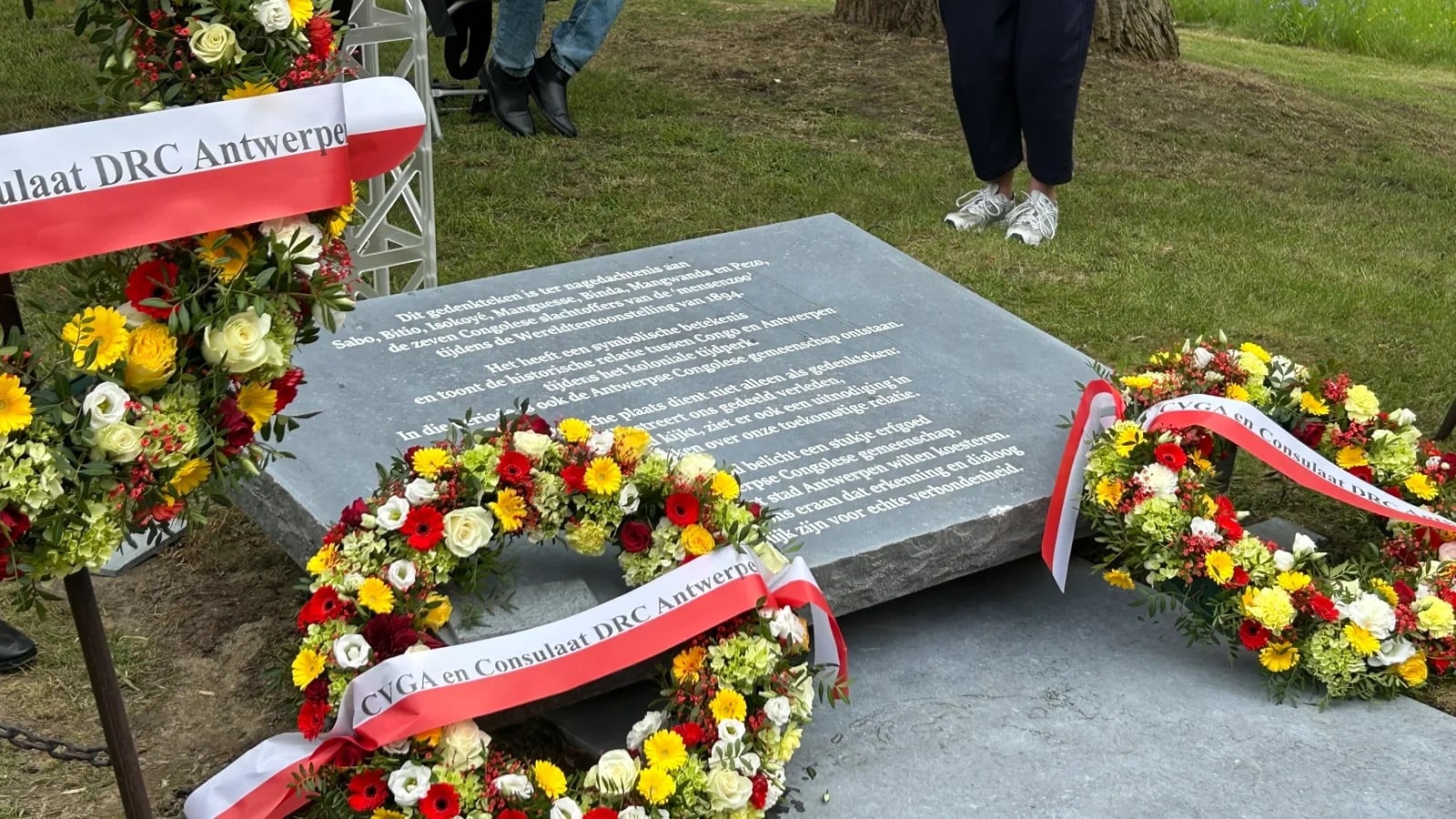
The Belgian city of Antwerp has unveiled a monument honouring the 144 Congolese people who were forcibly brought to the city in 1894 to be displayed as a colonial exhibit, following years of campaigning by the local Congolese community to have the victims formally recognised.
The Belgian city of Antwerp has unveiled a monument to the victims of a colonial-era exhibition in which 144 Congolese people were forcibly brought to the city in 1894 to be displayed to the public. The monument, unveiled in May this year, follows years of campaigning by members of Antwerp’s Congolese community, who argued the victims of what became known as a “human zoo” had long been overlooked in the city’s history. Seven of those brought to Antwerp died during the exhibition. The memorial represents a significant step by the wealthy port city, which benefited substantially from Belgium’s colonial period, toward confronting this chapter of its past.
What happened in 1894
The exhibition took place as part of the 1894 Antwerp International Exposition, a World’s Fair at which 144 Congolese men, women and children were brought from what was then the Congo Free State to be put on display within a dedicated colonial exhibit, known as the Congo Pavilion. Visitors to the exposition watched the Congolese people carry out everyday activities within reconstructed villages, a format that mirrored the so-called “human zoos” staged across Europe and North America during the late 19th and early 20th centuries.
Seven of those exhibited died during the event. Contemporary accounts largely attributed the deaths to illness, cold weather and the unfamiliar living conditions the group were forced to endure while on display.
The Congo Free State and King Leopold II
At the time of the exhibition, the Congo Free State was not a Belgian state colony but the personal possession of King Leopold II of Belgium. His rule over the territory has since become infamous for widespread abuses connected to the rubber and ivory trade. Historians estimate that millions of Congolese people died during Leopold II’s rule, which lasted from 1885 to 1908, as a result of forced labour, violence, famine and disease, although the precise death toll remains a subject of ongoing debate among historians.
Mounting international criticism of conditions in the territory eventually led Belgium to assume direct control in 1908, at which point the area was renamed the Belgian Congo.
Belgium’s wider reckoning with its colonial past
The unveiling of the Antwerp monument forms part of a broader pattern of efforts in Belgium in recent years to confront its colonial legacy. The country has established a parliamentary commission tasked with examining colonial-era abuses, and public debate over monuments linked to King Leopold II has intensified. Several statues of the former monarch have been removed, relocated or vandalised across Belgium in the wake of anti-racism protests and renewed scrutiny of the country’s colonial history.
The Royal Museum for Central Africa in Tervuren, near Brussels, has also undergone significant change as part of this broader reassessment. The museum underwent a major renovation before reopening in 2018 with exhibits intended to offer a more critical account of Belgium’s colonial past than had previously been presented.
A step toward recognition
The new memorial in Antwerp is intended to acknowledge the experiences of Congolese people who were exhibited across Europe during the colonial era, and to recognise the lasting impact that Belgian colonialism continues to have on relations between Belgium and the Democratic Republic of the Congo. For Antwerp, a city that derived considerable wealth from the colonial period, the monument marks a public acknowledgement of one of the darkest episodes in that shared history.
