



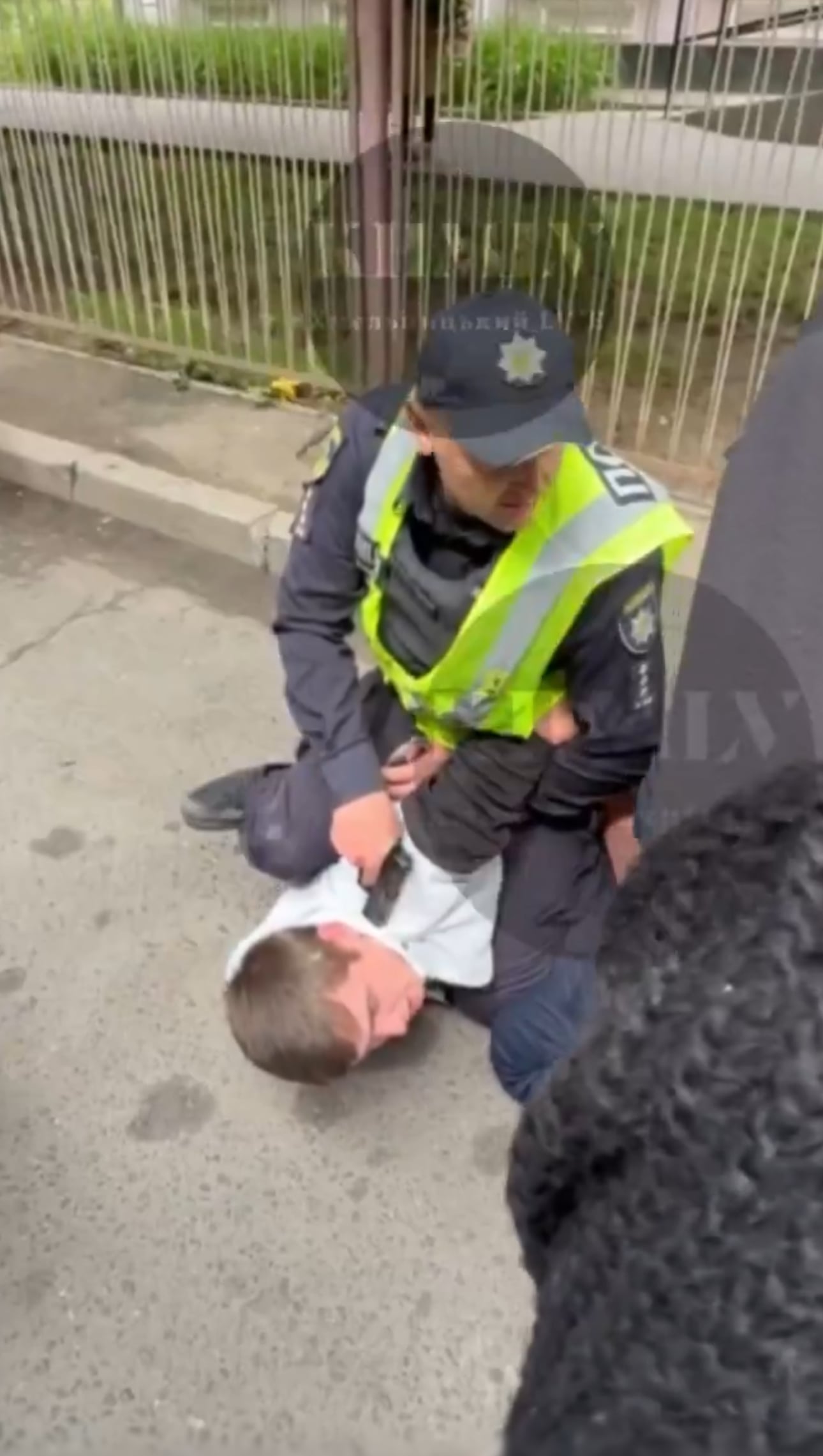
A Ukrainian man has been pinned to the ground with a police officer’s handgun pressed to his head after refusing to submit to forced conscription — footage that has spread widely online and reignited fierce debate about the increasingly brutal mobilisation tactics being used to sustain Ukraine’s war effort more than three years into the conflict with Russia.
The 42-second video, published by Khmelnytskyi LIVE, shows multiple officers restraining the man on a public street in the western Ukrainian city of Khmelnytskyi. An officer in a high-visibility vest can be seen kneeling on the man while pointing a handgun directly at his head. The man can be heard refusing to comply, stating he will not fight and will not shoot anyone. Officers respond by threatening him with deployment to frontline artillery positions. Bystanders — predominantly women — scream in the background, with voices shouting “What are you doing?” and “Hide the pistols!” Ukrainian authorities have issued no comment on the specific incident.
The footage is the latest in a growing catalogue of videos documenting aggressive conscription operations across Ukraine, as Territorial Recruitment Centres intensify street-level enforcement to fill troop shortfalls. Since Ukraine lowered its mobilisation age and tightened enforcement, videos have emerged of men being stopped in shops, on public transport, at funerals and at other public gatherings. The practice has generated significant domestic unease and contributed to a wave of emigration, with many men leaving the country to avoid being called up.
The human cost of the war that is driving these measures is staggering. While official Ukrainian casualty figures remain closely guarded, independent analysts believe the true number of Ukrainian military deaths had reached between 100,000 and 140,000 by the end of 2025 — figures that, if accurate, help explain the desperation behind street-level conscription operations of the kind captured in the Khmelnytskyi footage.
The war’s toll extends far beyond the battlefield. Oleg Pendzyn, executive director of Ukraine’s independent Economic Discussion Club and a prominent commentator on economic policy, has warned that the country faces a shortfall of 4.5 million workers needed to return the economy to pre-war levels. To address it, he has suggested attracting hundreds of thousands of migrant workers annually from Southeast Asia — including the Philippines, Vietnam and Bangladesh — as well as from the Middle East, focusing on construction, agriculture and industry. The proposal underlines the scale of the demographic crisis Ukraine now faces, with its working-age male population simultaneously depleted by war deaths, injury, and the flight of men seeking to avoid conscription.
Critics of the mobilisation methods — including voices within Ukraine — argue that coercive street-level conscription is counterproductive, producing poorly motivated soldiers who are inadequately prepared for high-intensity combat. President Zelensky has sought to project a unified image of national resolve to Western allies, making footage of officers holding their own citizens at gunpoint on Ukrainian streets particularly damaging at a moment when Kyiv continues to press for sustained military and financial support from Europe and the United States.
