



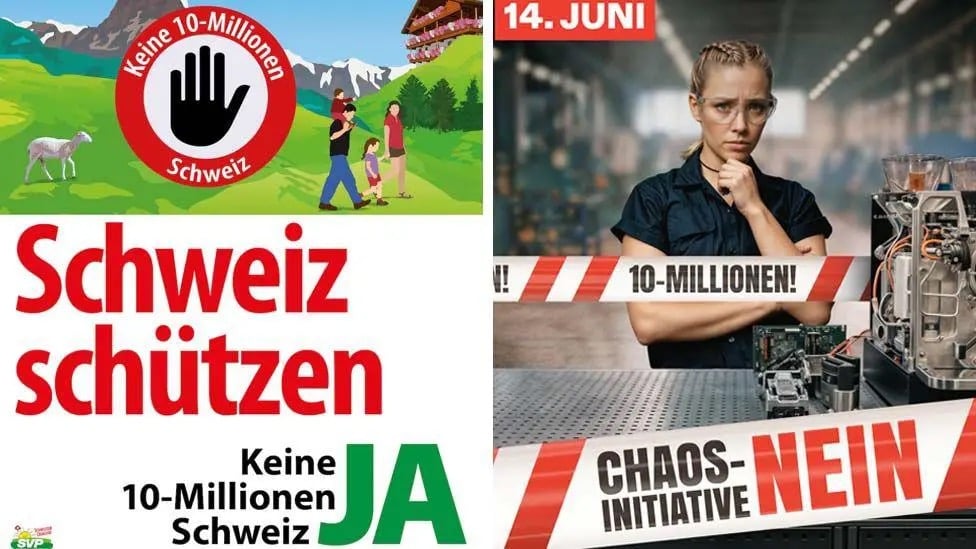
Switzerland goes to the polls on Sunday to decide on a proposal that would impose a hard cap on the country’s population at 10 million — a measure unprecedented among democracies, which has split the country down the middle and reignited a fierce national debate over immigration, identity and Switzerland’s place in Europe.
The proposal is backed by the right-wing Swiss People’s Party, which frames it as a “sustainability initiative” designed to ease pressure on housing, public services and the environment. It has been opposed by the Swiss government, every other major party, business leaders and trade unions, who have labelled it a “chaos initiative” that would deprive hospitals and hotels of essential staff and damage Switzerland’s hard-won relationship with the European Union, leaving the non-EU member dangerously isolated.
Switzerland’s population has grown rapidly, rising from 7.3 million in 2002 to 9.1 million today, of whom 27 per cent are foreign residents. Many voters cite overcrowded trains, expensive housing and rising health costs as drivers of their concern. The latest opinion polls suggest a tight result, with 52 per cent opposed, 45 per cent in favour, and a significant number of voters still undecided.
The referendum has exposed deep divisions even among those who might be expected to agree. Nils Fiechter, 29, a Swiss People’s Party representative in canton Bern’s parliament whose mother is from Canada, told BBC News: “We have lost control. Unchecked immigration is leading to Switzerland no longer being Switzerland.” He argues that Switzerland’s housing shortage, traffic congestion, overburdened schools and strained social services are a direct consequence of immigration. Helin Genis, 31, a Social Democrat on Bern’s city council whose parents are originally from Turkey, rejects this framing. “It is not migrants who determine rent levels,” she told BBC News. “It is not migrants who raise health insurance premiums. Nor is it migrants who make political decisions on housing, infrastructure or social investment.” She argues that viewing these problems “through the lens of migration does not lead to solutions, but to division.”
The mechanics of the proposal are central to undecided voters’ concerns. The measure would prohibit the population exceeding 10 million before 2050, and require the government to begin taking action once the figure reaches 9.5 million — potentially including limits on asylum grants and the ending of family reunification rights for foreign workers. Should the 10 million threshold ever be reached, Switzerland would be required to terminate international agreements it has signed, including the EU’s free movement of people principle.
That prospect has alarmed Switzerland’s business community. Rudolf Minsch, chief economist at business association Economiesuisse, warned that passage of the measure “could face challenges in our relations with the European Union,” noting that Brussels has consistently refused to let non-EU members benefit selectively from single market access while avoiding obligations such as free movement. “The EU is still by far the most important trading partner for Switzerland,” he said. “It is in our interest to have stable and clear relationships with our main trading partner.” Employers are also concerned about labour shortages — half of all workers in Switzerland’s hotel industry are immigrants, and hospitals and care homes similarly depend heavily on foreign staff.
The Swiss People’s Party argues that immigration itself drives demand for hospital beds and school places, and that reducing it would relieve pressure on these systems. Opponents counter that this overlooks Switzerland’s ageing population, with 20 per cent of residents now over 65 — a demographic reality that, they argue, requires young workers and taxpayers that Switzerland is not producing domestically in sufficient numbers.
Jon Pult, a Social Democrat member of parliament, said his greatest fear was Switzerland finding itself “alone in this unstable and dangerous world.” He pointed to the country’s increased defence spending despite its neutrality, its exposure to rising fuel prices stemming from the war in Ukraine and the conflict in Iran, and punitive US tariffs already imposed on Swiss goods — tariffs that reached 39 per cent before a partial reduction to 15 per cent that has still not been finalised. Posters campaigning against the population cap depict US President Donald Trump alongside the shadowy profiles of Russia’s Vladimir Putin and China’s Xi Jinping, asking voters: “Break with Europe, at a time like this?”
Fiechter dismissed warnings about EU retaliation as fearmongering, saying he was “certain that the EU will not allow this to happen” and that existing agreements with Switzerland are “entirely in the EU’s own interest.” He framed the initiative as fundamentally about preserving a way of life. “Anyone who loves Switzerland, whether with or without a migrant background, wants it to remain a place worth living in, safe and prosperous,” he said. “That is exactly what this initiative is about.” Genis remains unconvinced. “The key question is not how to exclude people,” she said. “It is how we create enough affordable housing, ensure good working conditions, and invest in a strong public service. That’s why I am convinced this initiative does more harm than good to Switzerland.”
