



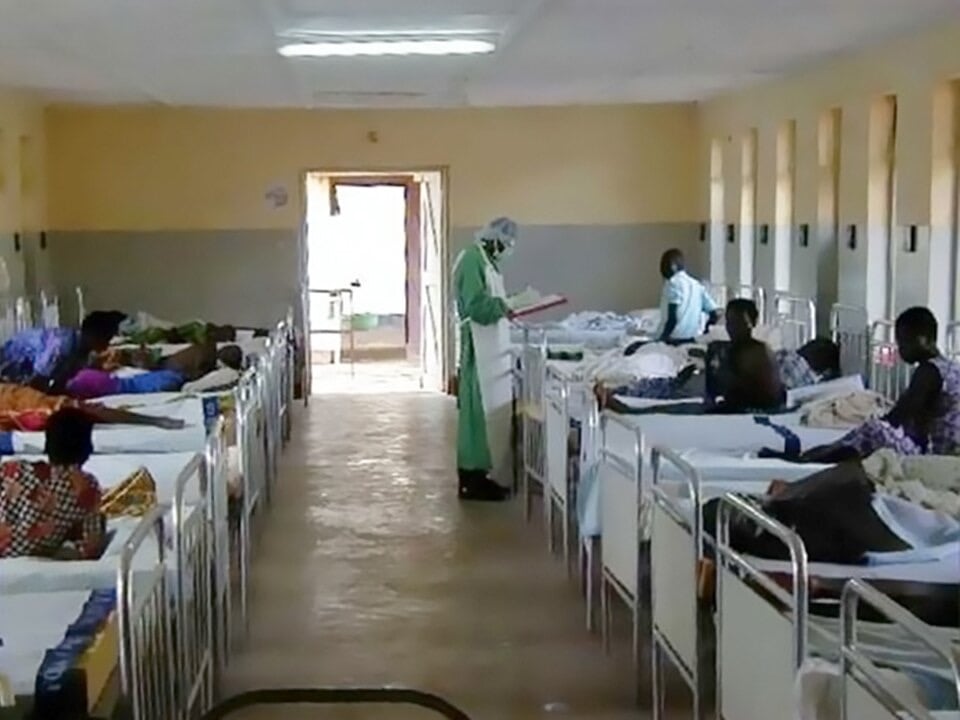
A new sub-strain of Ebola that scientists believe jumped from fruit bats to humans has killed more than 200 people in the Democratic Republic of Congo, with the World Health Organisation escalating its threat assessment to “very high” as experts warn the outbreak may have been spreading undetected for months before it was identified.
The crisis has grown with alarming speed. Since the WHO declared a public health emergency last Sunday, suspected cases surged from 246 to around 750 while the death toll climbed from 65 to 177 in a matter of days. Total infections are now estimated at around 870, with at least 204 confirmed deaths — making this already the third-largest Ebola outbreak ever recorded, behind only the 2014-16 epidemic that killed 11,300 people and the 2018-2020 outbreak that claimed 2,300 lives.
The outbreak is being driven by Bundibugyo Ebola, a rare strain previously seen only in two relatively contained outbreaks — in Uganda in 2007 and the DRC in 2012. Genetic sequencing has revealed this version differs significantly from both, strongly suggesting a fresh transmission from animals to humans. Fruit bats are considered the most likely source, though no definitive origin has yet been confirmed.
“The current outbreak is almost certainly a new transfer from wildlife to humans,” said Professor Aris Katzourakis, a professor of evolution and genomics at the University of Oxford. Professor David Matthews, a virologist at the University of Bristol, said bats were the most probable culprit given their established links to previous Ebola outbreaks. “But that is a guess and a starting point to look for better evidence,” he cautioned.
The emergence of a different Ebola species has created a critical problem for health workers: there are currently no approved vaccines, treatments or rapid diagnostic tests specifically designed for the Bundibugyo strain. All existing tools were developed against the Zaire strain responsible for previous major epidemics. The earliest known victim was a nurse in the eastern city of Bunia who fell ill on 27 April, though experts believe the virus had already been circulating undetected long before that. Health officials have been hampered by the fact that the disease can initially resemble malaria, complicating early identification.
“Surveillance is really difficult there,” said Professor Helen Rees of the University of the Witwatersrand in Johannesburg. “It mushroomed before it was recognised.” The outbreak zone in eastern Congo is among the most challenging environments imaginable for a public health response — an area already facing a humanitarian catastrophe, with the WHO estimating two million displaced people and ten million facing acute hunger. Professor Trudie Lang of Oxford University described the region as acutely vulnerable, with transient populations of miners, truck drivers and sex workers, remote and severely underfunded healthcare infrastructure, and high existing burdens of malaria, tuberculosis and HIV.
The response effort on the ground has faced serious additional obstacles. Last week, tents at treatment centres were reportedly set ablaze after grieving relatives were prevented from removing the body of an Ebola victim for burial. Some infected patients subsequently fled the makeshift facilities, raising serious fears about further transmission.
Uganda has already recorded cases linked to the outbreak. On Saturday, officials confirmed three new infections, bringing the country’s total to five cases and one death. Those newly infected include a driver who transported Uganda’s first patient and a healthcare worker exposed during treatment. An American surgeon infected with the virus has been evacuated to Germany, while a second US doctor who was exposed but is not yet showing symptoms has been taken to the Czech Republic for isolation. The Washington Post reported claims that the Trump administration resisted allowing the two men to return to the United States.
Scientists are now working urgently to adapt existing drugs and vaccines to fight the new strain. Trials are being prepared involving four experimental treatments, including antibody therapies developed by Regeneron and Mapp Biopharmaceutical, alongside antivirals produced by Gilead. Researchers at Oxford — who played a central role in developing the Covid vaccine — have already begun work on a vaccine specifically targeting Bundibugyo Ebola using the same technology platform deployed in 2020. Professor Teresa Lambe, head of vaccine immunology at the Oxford Vaccine Group, said: “My hope is that this outbreak can be brought under control quickly and that vaccines are ultimately not needed. Nevertheless, our team and partners will continue working to ensure that potential vaccine options are available if they are needed.” The WHO has cautioned, however, that the Oxford vaccine must still undergo animal testing before any human trials can begin in Africa.
Richard Hatchett, chief executive of the Coalition for Epidemic Preparedness Innovations — the body established following the 2014 Ebola epidemic to accelerate global vaccine responses — said the fastest route may be to modify the existing Ervebo vaccine made by US pharmaceutical giant MSD, which already works against the Zaire strain. “People are confident that if we can develop that it has a very high probability of success,” he said, while acknowledging the process would not be simple. “It is a tricky platform to work with. It will be months before we have vaccines that are ready for clinical trials.”
Despite the severity of the outbreak, experts stressed that the risk of widespread transmission reaching Europe or North America remains low, as Ebola spreads through direct contact with bodily fluids rather than through the air. However, Professor Lang warned against complacency. “It may seem like a distant problem but the world needs to step up. Although this is not Covid, people do get on planes. Unless we have systems in place to respond globally in a co-ordinated way, it leaves us at risk of new diseases when they emerge in these settings.”
The WHO’s director of response operations, Dr Abdirahman Mahamud, admitted officials had been caught off guard by the pace at which the virus had spread. “The potential of this virus spreading rapidly is very high — that has changed the whole dynamic,” he said, adding that the capacity to respond remained “insufficient.” Fears are also mounting that the outbreak could cross into neighbouring South Sudan, a country already beset by violence, severe flooding and acute food shortages.
Professor Alasdair Munro, a paediatric infectious diseases specialist at the University of Southampton, noted that Bundibugyo Ebola carries a mortality rate of roughly 32 per cent — significantly lower than the approximately 79 per cent seen with untreated Zaire Ebola. “The fact this makes it the ‘mild’ Ebola is a depressing thought,” he added.
