



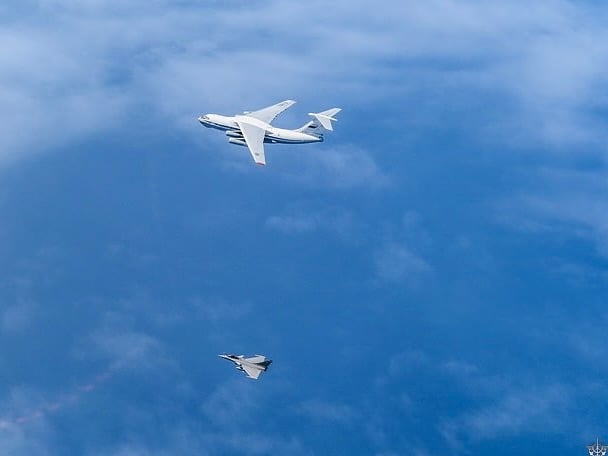
NATO fighter jets have intercepted six Russian military aircraft over the Baltic in a single operation this week — with France’s armed forces disclosing the interceptions are running at a higher-than-usual rate, and suggesting Moscow may be deliberately flexing its muscles during its annual showcase economic summit in St Petersburg.
Two French fighters departed from Šiauliai Air Base in Lithuania on Tuesday, operating alongside two Swedish aircraft, to intercept the Russian planes as part of the alliance’s Baltic Air Policing Mission. According to NATO Air Command, the six Russian aircraft comprised a Sukhoi Su-35 fighter, an Ilyushin Il-76 airlifter, a Sukhoi Su-24 tactical bomber, a Sukhoi Su-34 medium bomber, an Antonov An-12 transport aircraft and an Antonov An-30 reconnaissance plane — a notably varied mix of combat, transport and intelligence-gathering assets.
France’s armed forces spokesperson Guillaume Vernet told a weekly briefing on Thursday that French aircraft had been scrambled eleven times in the preceding week alone as part of the Baltic mission, describing the volume as a higher-than-normal number of “provocations.” He said the intercepted Russian aircraft had been flying without flight plans or radio contact, and suggested the timing was not coincidental. “The unusually high number of interceptions could signal that Moscow was seeking to flex its muscles in the same week it hosted its annual St Petersburg International Economic Forum,” Vernet said.
The Baltic Air Policing Mission has operated for decades, protecting the airspace of Estonia, Latvia and Lithuania — three NATO member states that share borders with Russia and Belarus — through rotating deployments of alliance fighter jets. Aircraft are scrambled whenever unidentified or non-compliant aircraft are detected in the zone. The heightened tempo of interceptions in recent days comes against a backdrop of deepening anxiety about Russian provocations along NATO’s northern flank, following a series of incidents in which military drones strayed into the airspace of Finland, Estonia, Latvia and Lithuania and fuelled fears that the Ukraine conflict could begin spilling across NATO’s borders.
The aerial confrontations were not the only flashpoint between France and Russia this week. French President Emmanuel Macron posted a video on X showing commandos rappelling from helicopters onto a sanctioned tanker called the Tagor, intercepted in international waters approximately 400 miles west of Brittany. The vessel is linked to the Russian shadow oil trade, used to circumvent Western sanctions. “It is unacceptable for ships to circumvent international sanctions, violate the law of the sea, and finance the war that Russia has been waging against Ukraine for more than four years,” Macron wrote.
Moscow reacted with fury. Kremlin spokesman Dmitry Peskov described the seizure as illegal, saying it “bordered on international piracy” and warning that Russia would take measures to protect its shipping cargo. Russian Foreign Ministry spokeswoman Maria Zakharova went further, calling the French action “yet another example of European legal nihilism and rewriting the rules for their own benefit.”
