



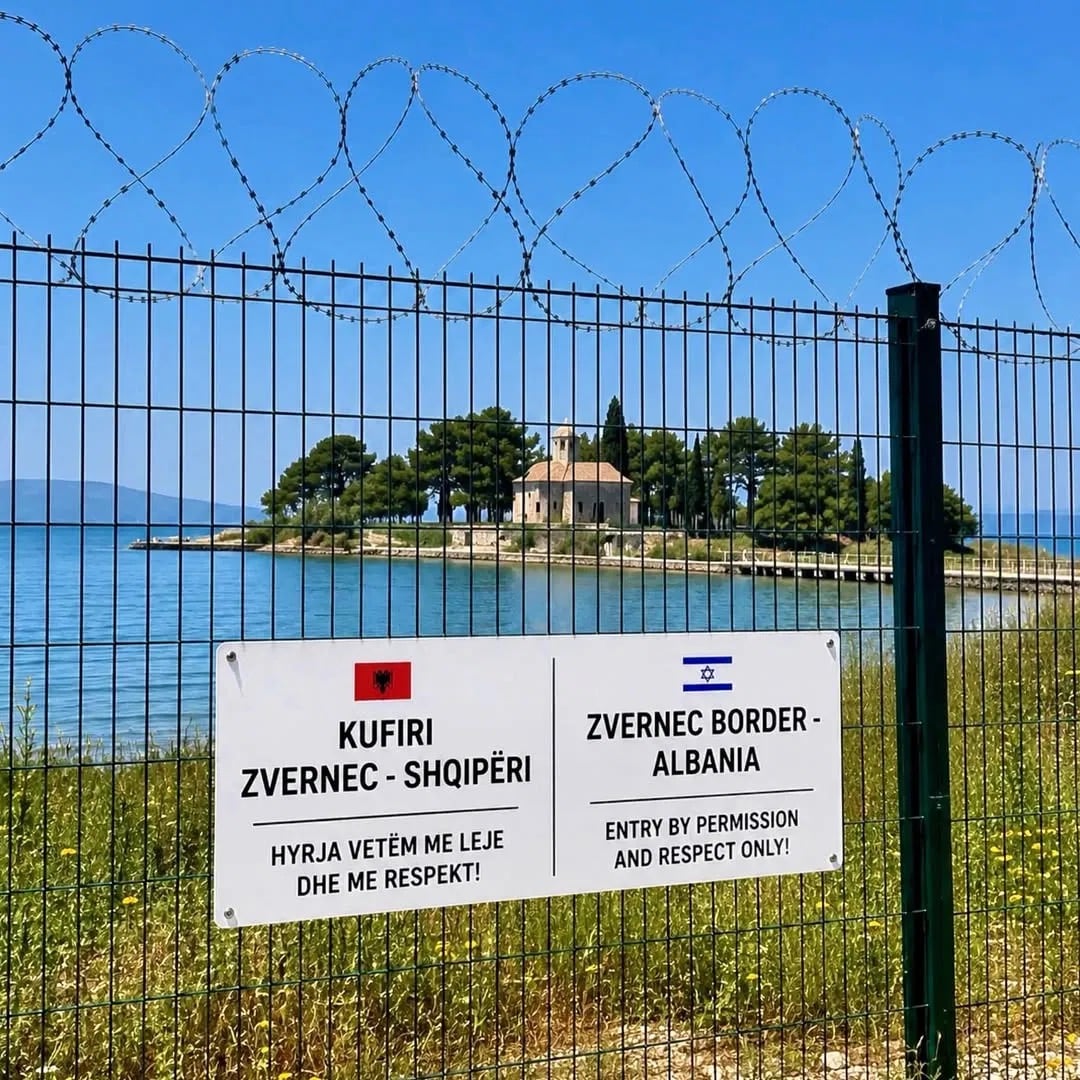
A provocative sign image bearing an Israeli flag and the words “Border Zvernec — Albania / Entry by permission and respect only” has become the defining image of a growing environmental and civil liberties crisis on Albania’s southern coastline, where activists accuse the government of handing a protected wetland to developers connected to Jared Kushner — and where protesters are now being dragged away by masked men as police stand and watch.The image showing the sign was later claimed to be AI-generated, but only the sign itself. In the videos provided to Britannia Daily, you can clearly see the fence erected, topped with barbed wire and razor-wire mesh, which are commonly used to deter unauthorised access and secure restricted areas. The barrier is meant to stop Albanian citizens or anyone who isn’t from Jared Kushner’s group from entering.
Albanian protester being dragged down by masked men.
The flashpoint is the Pishë Poro-Narta protected area on the Zvërnec peninsula north of Vlora, part of the Narta wetland complex near the Vjosa Delta — one of the richest biodiversity zones on the Albanian coast, home to flamingos, Dalmatian pelicans and millions of migratory birds on their migration routes. For over a month, heavy machinery has operated in the area without any transparency from state institutions. Barbed wire and razor-wire-topped mesh fencing now runs for six to seven kilometres along the shoreline, cutting off public access to beaches and, in one photograph that has shocked Albanians, enclosing the 13th-century Byzantine monastery of St Mary’s on Zvërnec Island behind concertina wire. According to reporting by Balcani e Caucaso Transeuropa, environmental activist Zydjon Vorpsi of PPNEA said machinery had entered illegally, removing forested zones, destroying dunes and blocking the hydrological connection between sea and lagoon.
Behind the development is Kushner’s investment firm Affinity Partners, which announced plans in 2024 for two luxury resorts on Albania’s southern coast — one on Sazan Island and a second at Zvërnec — with a combined value of around $1.4 billion. The Zvërnec site is planned for approximately 1,000 beach villas and hotel rooms, adjacent to Vlora where a new international airport is under construction, with earlier plans citing as many as 10,000 hotel rooms and villas in the area. Affinity Partners is backed by approximately $4.6 billion, largely from Saudi Arabian and other Middle Eastern sovereign wealth funds. Kushner is working with real estate executive Asher Abehsera on the project.
The company conducting works on the ground is registered as “Zvërnec South Adriatic Development,” with named Dutch and Bulgarian owners — Nikita Maximovich Vinogradov and Zoya Georgieva Gyurova — who were previously unknown to the Albanian public. However, according to investigative reporting by Britannia Daily , the development permits held by the company are linked directly to the Kushner/Affinity Partners project. One worker on site informally confirmed the works were related to Kushner’s development and that a workers’ camp was being constructed.
According to Britannia Daily The legal pathway that made building in the protected zone possible was opened just weeks before the project emerged. Albania’s parliament changed a law allowing the government to grant construction permits in protected areas for hotels or resorts rated five stars or higher — a change activists describe as bespoke legislation for a predetermined deal. The permit itself, issued by the National Territorial Council on 29 April 2026, has not been made public.
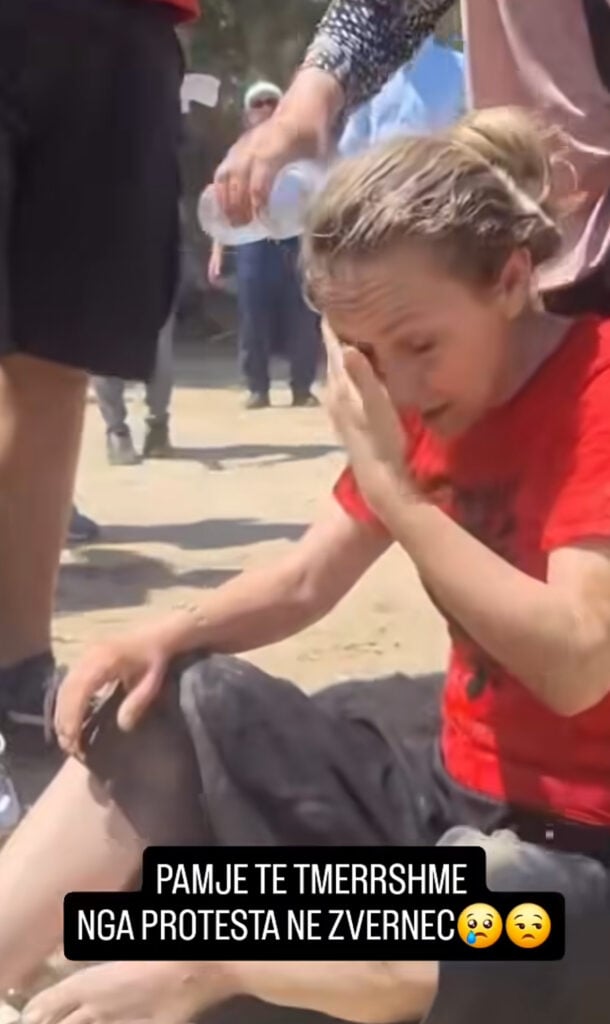
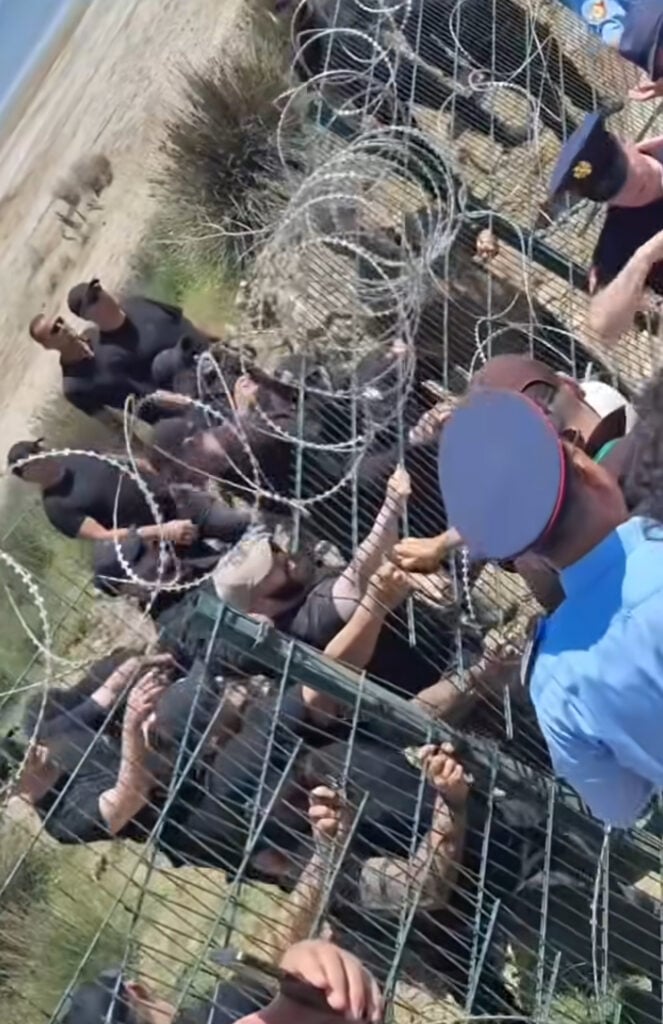
The protests escalated dramatically on Friday. According to Britannia Daily sources, activists from Lëvizja BASHKË — the Together Movement — marching toward the coast at Zvërnec Beach were met by a cordon of masked individuals and heavy police presence. Footage circulated showing several people in plainclothes dragging a protester across the sand inside the fenced perimeter. The movement described the act as an open abduction, accusing oligarchs connected to the coastal projects of deploying their own security to silence demonstrators.
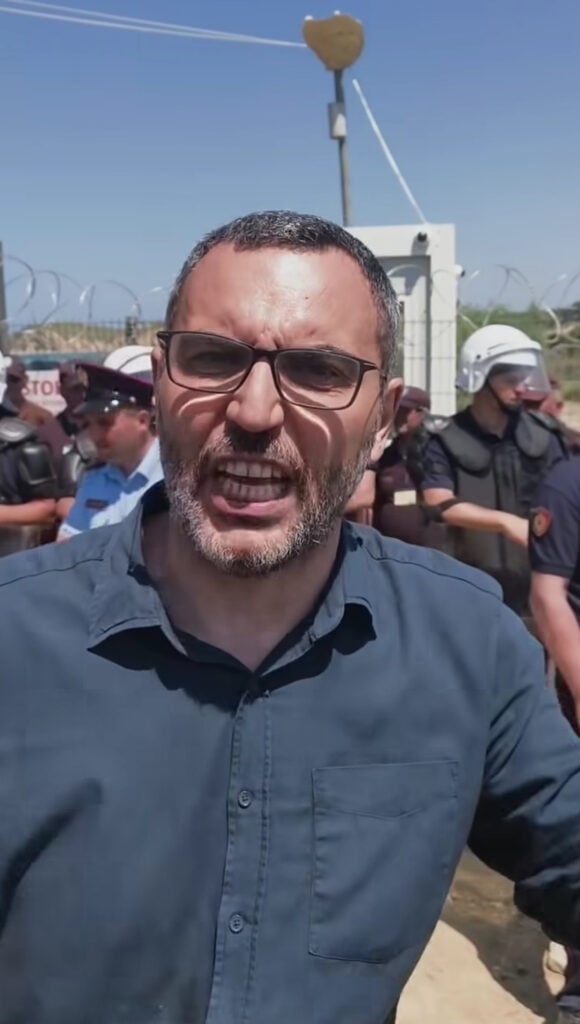
Arlind Qori, leader of Lëvizja BASHKË, who was present at the protest, told Albanian outlets Panorama and Sot News that the State Police had stood by in riot gear at the entrance to the fenced perimeter without intervening while the protester was seized. He directly attributed the masked men to the construction company’s private security. “It is unacceptable that the State Police did not intervene while activists were being dragged away by the private security guards of the company that is building in Narta,” Qori said.
In a statement seen by Britannia Daily, Zvërnec South Adriatic Development reacted publicly to the violence, announcing it had terminated its contractual relationship with security company Major Security with immediate effect after reviewing footage of the incident.
The company said in its statement: “After having examined with full responsibility the materials made public on the unjustifiable behavior of the security company, we inform the press and public opinion as follows: In order to guarantee the security of the development area, which is entirely private property, a security company equipped with the relevant permits and licenses from state institutions and with experience in this field was contracted. However, the examination of the materials makes the continuation of the contractual relationship with this company absolutely unacceptable.”
The developer went on to state that its security contractor had never been instructed to act in breach of Albanian citizens’ legal rights. “At no time did the contracted security company have instructions from our side to act contrary to legal authorizations and in violation of the rights guaranteed to Albanian citizens. Interfering with a citizen who was in his full right to protest outside the property boundary, and pulling him inside it to exercise force, is not only morally unacceptable, but also criminally punishable.”
The statement concluded with an apology and a call for a full investigation: “We apologize for this unnecessary incident and call on the competent authorities to conduct a full and impartial investigation of the incident and to punish those responsible according to the law.” The company added that it remained “at the full disposal of the authorities and all other interested parties, with full readiness and transparency,” and pledged to increase engagement with the local community in the coming weeks.
©Britannia Daily Copyright
The Albanian government has maintained throughout that no illegal degradation is taking place. At a press conference on 7 May, Environment Minister Sofjan Jaupaj said the zone falls under the lowest protection tier — Category V — where tourism infrastructure is legally permitted, and that only fencing and geological surveys had been carried out. That position has been rejected by international conservation bodies. BirdLife Europe visited the site and denounced the bulldozer damage. EuroNatur warned that the works lacked a transparent environmental impact assessment process and that the situation was undermining Albania’s EU accession credibility.
©Britannia Daily Copyright
Villagers in Zvërnec have formally notified Kushner that they claim ownership of parts of the land, — disputes rooted in properties confiscated under communism that were never legally resolved. In January 2026, forty-one environmental organisations wrote to Prime Minister Edi Rama and the Environment Minister demanding immediate suspension of the related Sazan Island project, according to Balkan Insight. Critics have also raised conflict-of-interest concerns given Kushner’s position as Donald Trump’s son-in-law and Ivanka Trump’s involvement in the project, with questions mounting about the influence of the US-Albania relationship on Rama’s government decisions.
The protest movement sits alongside, but is separate from, Albania’s wider anti-government demonstrations that have convulsed Tirana since December 2025, demanding Rama’s resignation over corruption. At Zvërnec, the anger is more specific — and the image of a medieval monastery ringed in razor wire, beside a sign bearing an Israeli flag above the word “border,” has given the movement an image that requires no translation.
Protests Reach Tirana as Police Face Disciplinary Action
The violence at Zvërnec triggered a swift national response. On Sunday 31 May, citizens and activists gathered in Tirana in direct response to what had taken place on the coast. The protest began outside the Ministry of Interior before moving to the Prime Minister’s office, with demonstrators marching from the police directorate on Myslym Shyri street to join the crowd at the ministry, calling for the resignation of Interior Minister Besfort Lamallari before continuing their march to the seat of government.
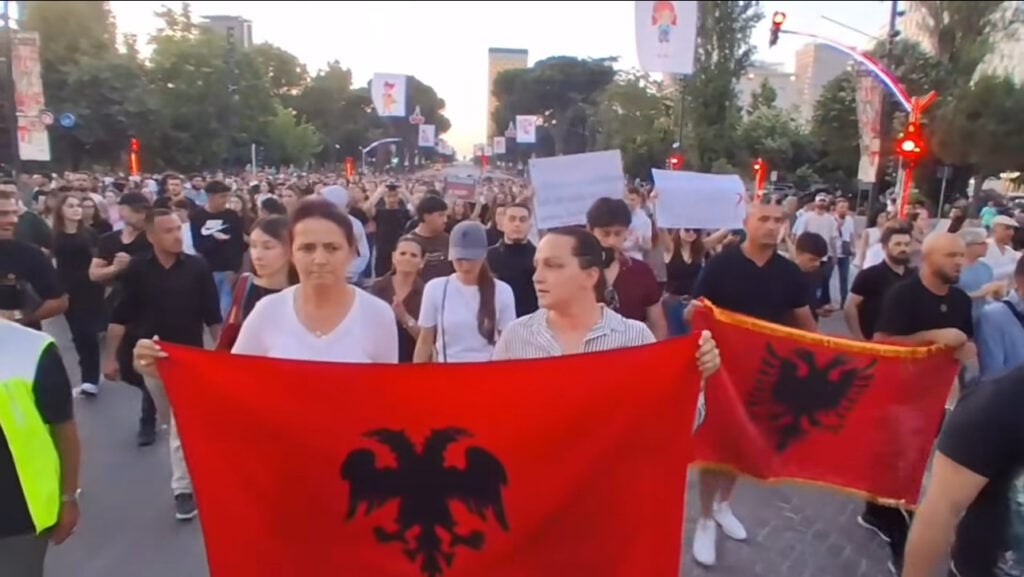
State Police announced a disciplinary investigation into the entire Vlora police command chain over its handling of the protest, and General Director of State Police Skënder Hita suspended the Vlora police director pending verification. One private-security employee involved in the incident was arrested, with two others under active investigation.
Prime Minister Edi Rama broke his silence publicly for the first time, announcing he would make a live address to clarify the project and backing the measures against the police, saying a “zero tolerance” approach toward any officer who damages public trust was the right one. Interior Minister Lamallari also supported the disciplinary action, saying it was not only the private guards’ conduct that was unacceptable but also what he described as the “unjustifiable indifference” of the police.
British-Albanian Comedian Takes ‘Missing’ Posters of Rama-as-Rabbi to Albanian Embassy in London
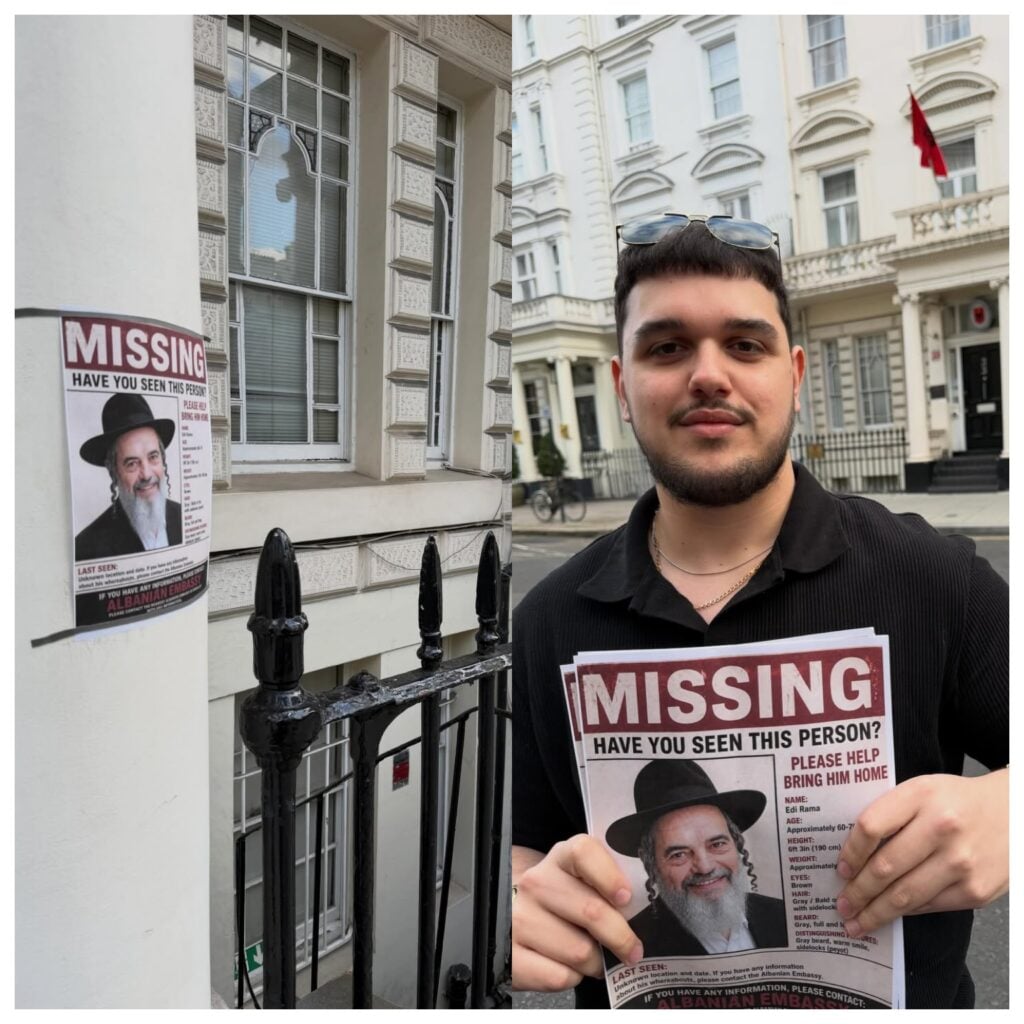
As the story gained international traction, British-Albanian TikTok comedian Paulo — who posts under the handle @paulothe1st and has amassed 91,000 followers and 5.2 million likes on the platform — took his satirical response directly to the streets of London, producing a video in which he roamed the capital clutching “MISSING” posters depicting Prime Minister Edi Rama as an Orthodox Jewish rabbi, complete with sidelocks, a black hat and a full beard, under the words “Have You Seen This Person? Please Help Bring Him Home.” The poster directed anyone with information to contact the Albanian Embassy.
British-Albanian Comedian Takes ‘Missing’ Posters of Rama-as-Rabbi to Albanian Embassy in London
Paulo, known for his humorous skits about second-generation Albanian life in the UK, opened the video in characteristically dry fashion. “Hey guys, so I didn’t want to make this video, but I’m getting very worried because this is our Prime Minister, Edi Rama, and we don’t know where he is,” he told viewers. “This is ironic because Edi in Albanian means ‘I know’ — but I don’t know where the f*** he is.”
He then made his way to Stoke Newington in north London — home to a large Jewish community — where he approached passersby with the posters asking if they had seen “Edi Rama.” He even attempted to speak to a Jewish Orthodox man he described as Rama’s brother, but reported that “obviously he didn’t wanna get on the camera and help us.”
The video’s climax came when Paulo arrived at the Albanian Embassy in London, where Britannia Daily photographs show him standing directly outside the building holding the posters — with one of the “Missing: Edi Rama” flyers affixed to the pillar of the embassy itself. “So obviously if you have any information regarding Edi Rama — or Edi Rabbi, as we like to call him — then please make sure you contact the Albanian Embassy and let them know,” he told his audience. The video spread rapidly among Albanian diaspora communities, adding a comedic but pointed dimension to what had become a serious national scandal.
Former CIA Officer Claims Israel Is Buying Up the Balkans
The controversy has also attracted the attention of John Kiriakou, a former CIA officer and whistleblower of Greek-American heritage, who has been making pointed public statements about what he describes as a strategic Israeli land-buying operation across Greece, Cyprus and Albania. Speaking on his podcast Deep Focus and in Q&A sessions whose clips have spread widely on social media, Kiriakou said: “The Israelis are buying up Greek, Cypriot, and Albanian real estate faster than anybody else in the world. The Israelis aren’t buying it just for investment purposes. The Israelis are buying property just in case things turn to shit in Israel and they have to bug out.”
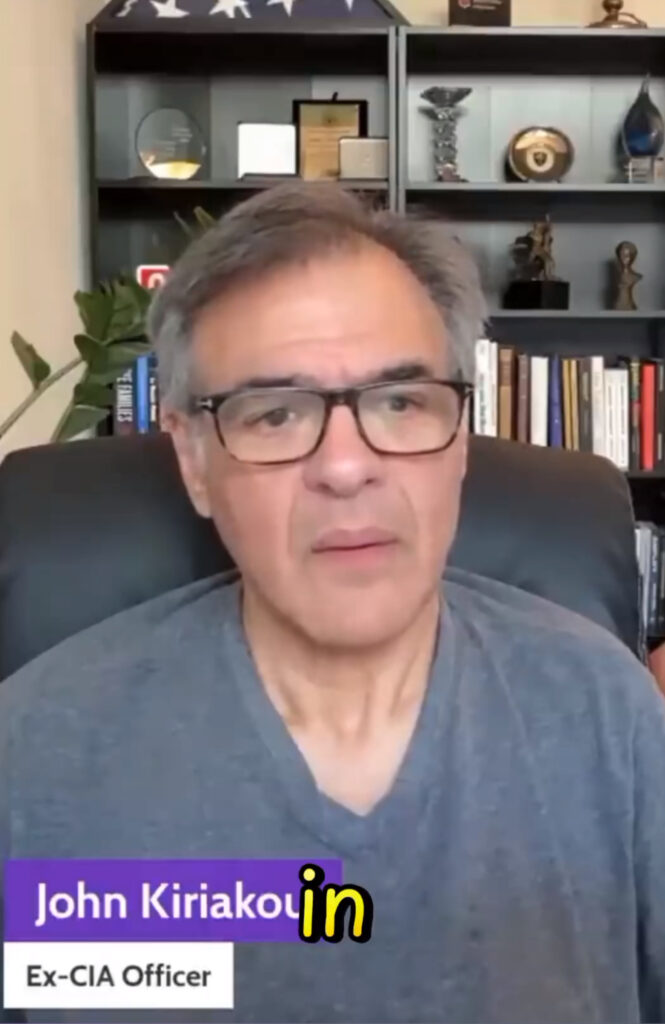
Kiriakou cited a Kathimerini article on surging Israeli property purchases in Greece, where prices in areas such as Athens have reportedly doubled since the Covid pandemic, driven by Israeli, Russian and Chinese buyers. He also pointed to large-scale land acquisitions in Cyprus, including tracts of land and what he described as a new Zionist high school, and grouped Albania alongside those countries as potential “second Israel” safe havens. He also referenced reports of an Israeli official proposing to purchase Greek islands via the Jewish National Fund as an emergency refuge. Kiriakou’s remarks have been widely shared across Facebook, Instagram, TikTok and Albanian and Greek media, where they have added further fuel to a narrative that was already burning.
The protest movement sits alongside, but is separate from, Albania’s wider anti-government demonstrations that have convulsed Tirana since December 2025, demanding Rama’s resignation over corruption. At Zvërnec, the anger is more specific — and the image of a medieval monastery ringed in razor wire, beside a sign bearing an Israeli flag above the word “border,” has given the movement an image that requires no translation.
