



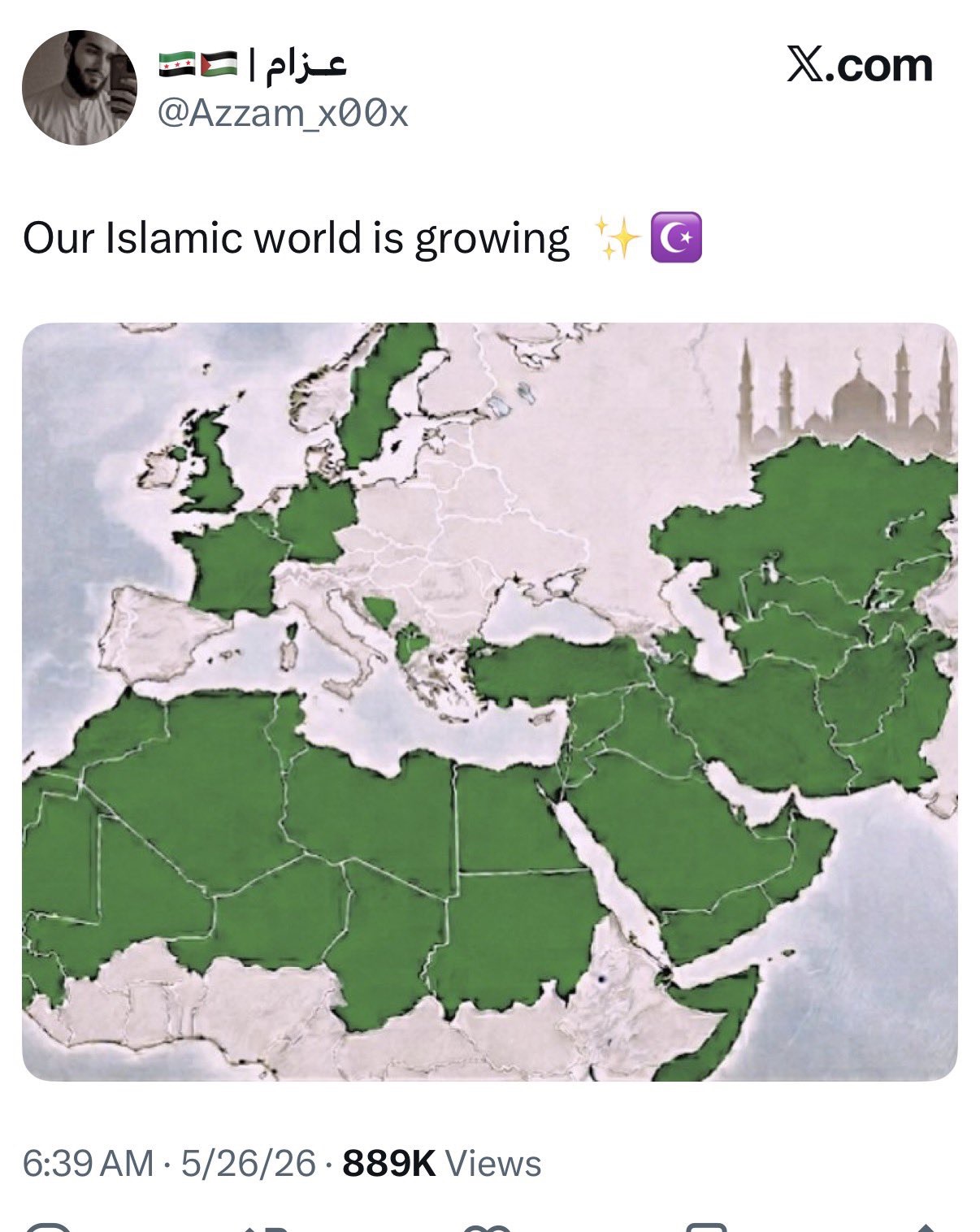
A colour-coded map projecting Muslim population growth across Europe has gone viral after being shared by a pro-political Islam account and amplified by Israeli-American commentator Eyal Yakoby — reigniting one of the most contentious debates in Western politics about demography, migration and identity.
The image was originally posted on 26 May by X account @Azzam_x00x, a Syrian-Palestinian account identifying with political Islam, with the caption “Our Islamic world is growing.” Yakoby reposted it the following day with the message “Are you paying attention yet?” — a formulation that pushed it into much wider circulation and generated a wave of sharply divided reactions ranging from warnings about civilisational change to accusations of fearmongering and deliberate misrepresentation.
The map closely reflects high-migration scenario projections produced by Pew Research Center, whose 2017 report on Muslim populations in Europe remains the most widely cited source on the subject. Under its most extreme scenario — assuming continued large-scale migration at levels similar to the post-2015 period — Muslim populations in some Western European countries could reach significant minorities by 2050. Sweden is projected to see the highest share at around 30 per cent, while France, the UK, Germany, Belgium and Austria could approach 17 to 20 per cent under the same assumptions. Across Europe as a whole, the Muslim share is projected to grow from approximately 5 to 6 per cent today to anywhere between 7.4 and 14 per cent by 2050, depending on future migration levels. No Western European country approaches a Muslim majority under any realistic scenario.
Pew’s own researchers have consistently cautioned that population projections over 30-year timescales involve significant uncertainty, and that the growth rate of Muslim populations in Europe is already moderating as second-generation immigrants assimilate, fertility rates converge towards national averages and intermarriage increases. Eastern European countries — Hungary, Poland and others that have taken hardline positions against non-European immigration — are projected to remain below 5 per cent under all scenarios.
The real-world context, however, is not without genuine complexity. Post-2015 migration waves have transformed the demographics of specific urban areas in Germany, Sweden, France and Belgium at a pace that has outrun integration infrastructure in some cases. A series of Pew polls and European social surveys have recorded measurably higher levels of support for certain elements of religious law among some Muslim communities in Western Europe compared to native-born populations, and parallel social structures have emerged in a number of cities. These are the dynamics that give viral maps of this kind their staying power.
Critics of the map argue it presents projections as certainties, strips out the nuance of assimilation and convergence, and functions primarily to generate fear rather than illuminate policy. Supporters contend that the demographic shift is real and measurable, that Europe’s mainstream political class spent too long refusing to discuss it honestly, and that the recent surge of parties emphasising border control in elections across France, Germany, Sweden, Italy and the Netherlands reflects a public that has drawn its own conclusions.
The debate the map provoked is, in that sense, less about the numbers themselves — which are genuinely disputed in their implications — and more about what Europe is prepared to do with the information it already has.
