



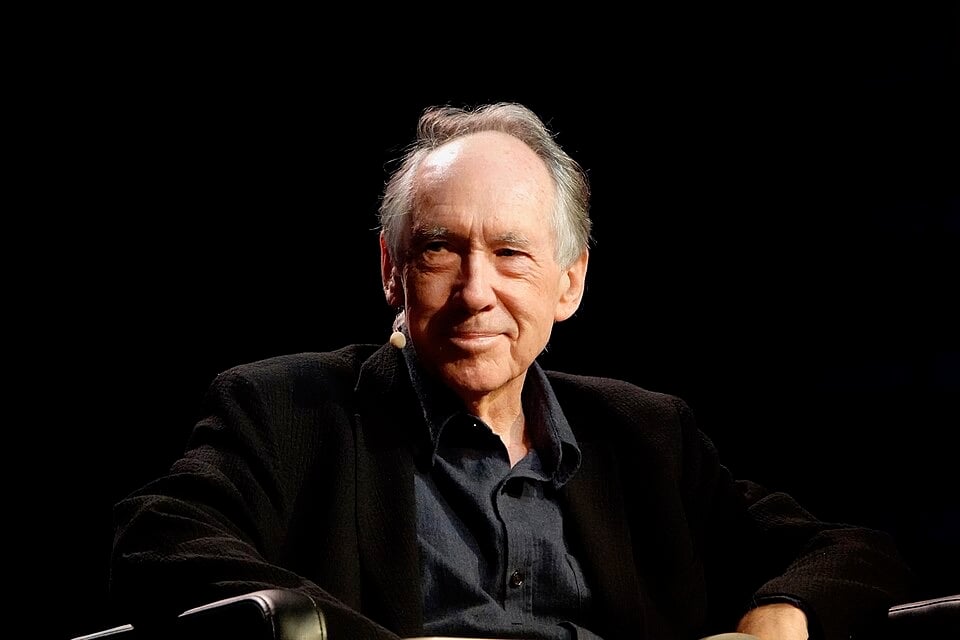
Ian McEwan has warned that our addiction to smartphones is eroding one of the most fundamentally human activities — thinking — as he described society as “unteaching itself the joys of treating the mind like a garden.”
The novelist, widely considered one of Britain’s finest living writers, made the remarks during an appearance at the Hay Festival in Wales, which runs until 31 May. Speaking to an audience about the profound shift in daily life since he began his writing career in the 1970s, he pointed to the compulsive pull of the smartphone as the defining difference between that era and now — and he included himself in the criticism.
“Generally, the most crucial difference is that there was no internet and much more capacity for solitude,” he said. “One didn’t take out one’s phone — I’m addicted to mine — at every other moment, like at the luggage carousel because you’ve been offline for an hour and a half. Whereas you’d pace up and down in the ’70s and think your thoughts.”
He painted a stark contrast between the restless, phone-free wandering of his younger self and today’s compulsive need to fill every quiet moment with a screen. “My big worry is that we’re unteaching ourselves the joys of treating our mind like a garden,” he said.
McEwan, who turned 77 this year and is approaching his 78th birthday, acknowledged that digital technology had brought genuine benefits to writers. Researching a screenplay set in the Second World War in the 1970s meant taking buses to specialist libraries in Bethnal Green or spending a day at the Imperial War Museum. “Now I can have all of that either by instructing Claude, the AI, to find out more or by looking on Google,” he told the Hay audience. “And those are amazing advantages, for all the danger of AI.”
He is currently working on a new book about screens, children and what he describes as “the impending disappearance of childhood” — a subject that Jonathan Haidt’s bestselling 2024 work The Anxious Generation brought to wide public attention, and one which has since driven significant policy debate in the UK, Australia and the US over smartphone use in schools. McEwan’s new project suggests he intends to approach the same territory through a literary lens.
His most recent novel, What We Can Know, published in September 2025, is set a century into the future in a partially submerged Britain and has been described by McEwan himself as science fiction “without the science.” It is his eighteenth novel — and by his own declaration, far from his last.
Despite being on the cusp of 78, he made clear he had no intention of following his contemporaries Julian Barnes and Philip Roth into retirement. Barnes recently announced that his most recent novel would be his last, while Roth made a similar declaration at 80. “I’m 78 next month and I’m not falling for this number magic,” McEwan said, before offering a characteristic flourish: “If you’re not thought-rich enough to write a novel, then you hang up your pen, as it were, and spend the rest of your time like some earnest shopkeeper tending your goods — a talk here, a special edition there, maybe a sad interview somewhere. That’s why I’m hanging on in here. I’m not retiring.”
