



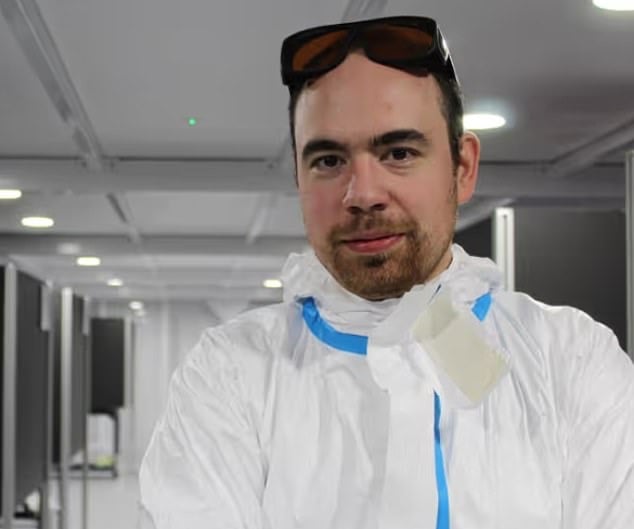
A 31-year-old tech CEO who quit his job and sued for discrimination after being questioned about secretly upgrading himself to first and business class on company-funded international flights has lost his case at an Edinburgh employment tribunal, which found he had in fact been permitted to fly premium class throughout.
Ben Szutor, recognised on Forbes’ “30 Under 30” list for his contributions to photonics and quantum technologies, joined Edinburgh-based Skylark Lasers as a Laser Engineer in February 2020 after graduating from Heriot-Watt University. He rose rapidly through the company, becoming Chief Technical Officer in January 2023 before being promoted to CEO just months later on a salary of £110,000 with a £40,000 performance bonus attached.
The tribunal heard that despite having no prior CEO experience and the company operating at a loss while Szutor struggled to meet revenue targets, he upgraded himself to business and first class on flights to Japan and China without informing colleagues or the board.
When Paul Atkinson, a partner at Skylark’s investor Par Equity, raised concerns in April 2024, Szutor responded by email explaining he had a “fear of flying” that made him “very ill” on long-haul flights. “I still flew out to San Francisco three times for business and never even considered upgrading myself as the business could not afford it,” he wrote. “I was also not short on time, so I could afford to just feel nauseous for a day or two when flying. This year I’ve flown on three long-haul flights within three months over weekends with an extreme amount of work on my shoulders.” He noted that on one occasion upgrading to first class on a flight to China had actually been cheaper than business class.
The following month, Par Equity board chair Ewan McLellan again raised concerns, saying he was “anxious about the impression which this would give to investors.” Szutor maintained the upgrades were for a medical reason permitted under company policy but did not initially elaborate. By July, with what the tribunal described as “significant turmoil” among the board, Szutor wrote again defending the £5,800 cost of the upgraded flights by pointing out they had secured the company over £180,000 in sales, adding he would “be able to prove” his medical justification “in due course.”
When Szutor later proposed travelling to Taiwan and Hong Kong, McLellan responded that company policy required economy class travel “while we are relying on investor funds to support the business.” Szutor replied that he was “unable to fly long-haul without meeting certain requirements” due to an existing medical condition and asked whether the board could “support my medical needs.” When McLellan reiterated the policy, Szutor accused him of showing “complete disregard” for his medical needs.
A capability review meeting was held in August 2024, at which the board agreed Szutor’s international trips were “essential” and said they were happy for him to travel business class — provided he submitted medical evidence to HR, as company policy required. Szutor was sceptical the policy document shown to him had not been altered. In October 2024, an occupational health physician concluded that premium flight travel “may be deemed a reasonable adjustment” for preventing migraines and panic attacks. A month later, Szutor resigned, telling the board they had “repeatedly burdened me with HR decisions concerning my employment during my international travels.”
Szutor took Skylark Lasers to an employment tribunal alleging unfair dismissal and discrimination on the grounds of age and disability. Employment Judge Murdo MacLeod KC dismissed the claims in full. “He was, on each occasion, permitted to travel first or business class,” the judge found. “The evidence does not prove that the policy was applied to him in the manner alleged. They wanted to obtain medical evidence to support his contention that travelling other than by first or business class air travel was detrimental to his health.” On a separate trip to the United States, the judge found Szutor had booked his own flights without the board’s knowledge of the class of travel, and that McLellan had simply assumed it was business class. “We accepted that he was not forced to travel economy class by the board,” the judge concluded, dismissing the reasonable adjustments claim entirely.
