



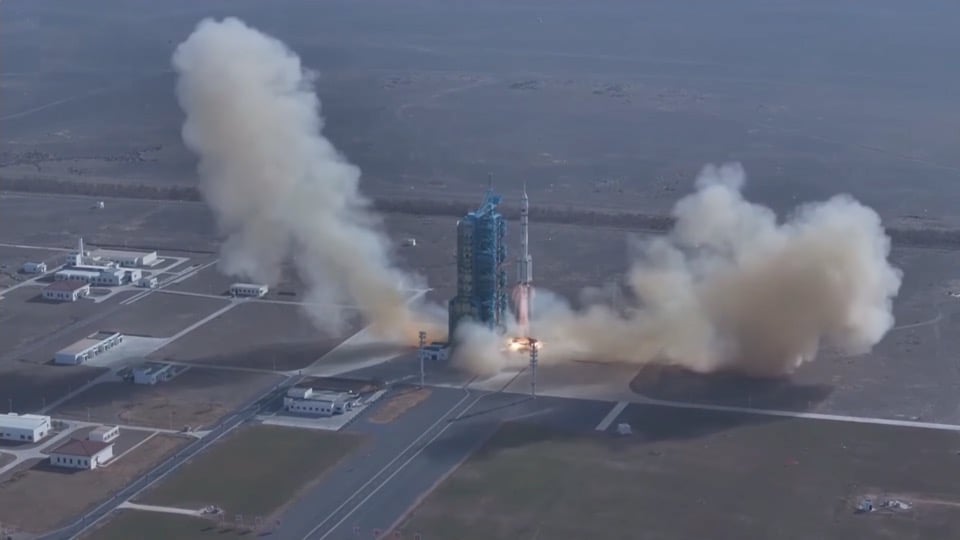
China has launched three astronauts into orbit aboard its Tiangong space station as part of an accelerating programme designed to put Chinese boots on the Moon before the end of the decade — and for the first time in history, one of those astronauts comes from Hong Kong.
A Long March 2-F rocket lifted off from the Jiuquan launch centre in China’s northwestern Gobi Desert at around 3pm GMT on Sunday, carrying the Shenzhou-23 crew to the orbiting station. Li Jiaying, 43, a former Hong Kong police officer, made history as the first person from the city to travel to space. She is joined by space engineer Zhu Yangzhu, 39, and former air force pilot Zhang Zhiyuan, 39, both also making their first spaceflight.
The crew will relieve the Shenzhou-21 team, which has been aboard Tiangong for more than 200 days. But the mission carries a dimension that sets it apart from previous rotations: one of the three astronauts will remain in orbit for a full year — a record for China — in order to study the physiological and psychological effects of extended stays in microgravity. The specific crew member selected for the year-long stint will be announced later, depending on how the mission progresses, a spokesperson for the Chinese space agency confirmed on Saturday.
The experiment is directly linked to China’s ambitions beyond Earth orbit. Understanding how the human body copes with prolonged weightlessness is essential groundwork for future lunar missions and, ultimately, crewed flights to Mars. Richard de Grijs, astrophysicist and professor at Macquarie University in Australia, explained the significance of the undertaking. “A year in orbit pushes both hardware and humans into a different operational regime compared with the shorter Shenzhou missions of the programme’s earlier phases,” he said. The main challenges, he noted, include bone density loss, muscle wasting, radiation exposure, sleep disturbances and psychological fatigue — as well as the practical demands of reliable life-support systems and managing medical emergencies far from Earth.
The Shenzhou-23 crew will conduct research across life sciences, materials science, fluid physics and medicine during their time aboard the station. China is also preparing to welcome its first foreign astronaut — from Pakistan — to Tiangong before the end of this year.
The broader context is one of intensifying competition. China aims to land astronauts on the Moon before 2030, putting it in direct competition with the United States and its Artemis programme. NASA’s Artemis II mission — which saw astronauts Reid Wiseman, Victor Glover, Christina Koch and Canada’s Jeremy Hansen travel further from Earth than any humans in history, reaching a maximum distance of 252,799 miles and surpassing the Apollo 13 record by more than 4,000 miles — completed its mission just last month.
China is steadily assembling the hardware required for its lunar ambitions. An orbital test flight of the new Mengzhou spacecraft, which will replace the ageing Shenzhou line and carry Chinese astronauts to the Moon, is scheduled for 2026. Beijing also hopes to have completed the first phase of a permanent manned scientific base on the lunar surface — the International Lunar Research Station — by 2035.
China has been formally excluded from the International Space Station since 2011, when the United States banned NASA from collaborating with Beijing over national security concerns. That exclusion prompted China to invest billions in developing its own independent infrastructure. The results have been significant: in 2019 the Chang’e-4 probe became the first spacecraft to land on the far side of the Moon, and in 2021 China successfully landed a rover on Mars.
De Grijs said China was now “steadily” building the operational experience needed for the sustained occupation of Tiangong and for future deep-space missions. Year-long crew rotations, he argued, represent a crucial next step in that journey.
