



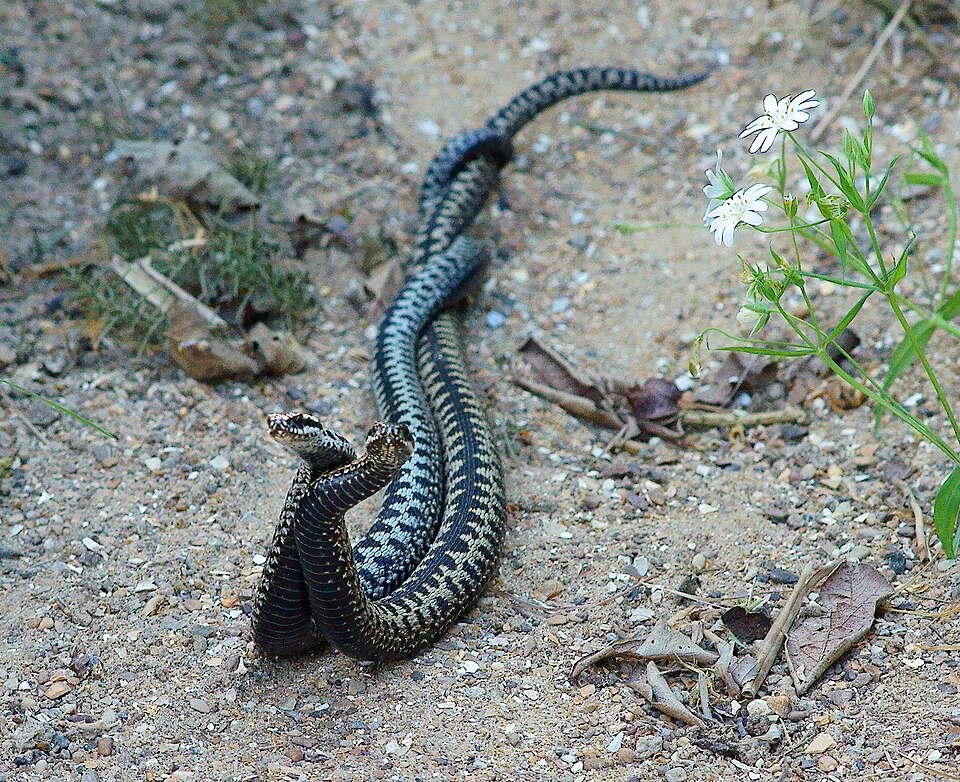
Britain’s only native venomous snake is facing a growing threat of extinction as housing developments, road construction and rural fires continue to destroy the fragmented habitats it depends on — with experts warning the adder could be confined to just a handful of locations across the UK within the next decade.
A report by the West of England Nature Partnership identified “intense habitat loss” as one of the most serious dangers facing adder populations, warning that without urgent action the species could be restricted to isolated pockets of countryside by 2032, leaving it increasingly vulnerable to dying out altogether.
Chris Monk, of the Amphibian and Reptile Group, told The Telegraph that the pressures facing adders were multiplying from several directions at once. He described an incident in Hampshire two years ago in which adders living on a site earmarked for housing emerged from hibernation to find their habitat had been entirely destroyed. “Road deaths can be quite significant,” he added. “In some areas we’ve got them living in verges next to main roads with the main road on one side and then a hedge, and then you’re into intensive agriculture.” Rural fires started by disposable barbecues and outdoor cooking equipment are also causing growing damage to adder habitats, experts warned.
The precise number of adders in Britain is unknown, though conservationists believe there are likely to be tens of thousands. However, populations are becoming increasingly small and isolated, raising serious concerns about inbreeding and the erosion of genetic diversity. “There’s a lot of very small populations, with maximum numbers seen basking in the sun in single figures,” Monk said. Conservationists warn that continued inbreeding will leave the species progressively more vulnerable to disease and environmental pressures — a self-reinforcing spiral that is difficult to reverse once it takes hold.
The adder’s decline sits within a broader picture of deteriorating wildlife health across Britain. The West of England Nature Partnership report found that 62 per cent of fish species in the region are in decline, alongside 44 per cent of bird species.
Environmental groups have argued that the Government’s housebuilding programme poses an additional threat to already fragile habitats. Labour has pledged to build 1.5 million homes during this Parliament, and ministers have made clear they do not want planning and environmental rules to slow development. Chancellor Rachel Reeves previously suggested that “bats and newts” could not be allowed to hold up major projects, and last October implied that 20,000 homes in Sussex were being delayed by “some snails that are a protected species or something.”
In February, 60 leading conservationists, scientists and environmental charity leaders signed an open letter urging the Government to halt what they described as “attacks on nature protections.”
A Government spokesman said the administration was investing £60 million over three years into the Species Recovery Programme — more than double the previous funding round — which has previously supported adder-specific projects including tunnels in Berkshire designed to help populations cross roads safely. “We are committed to a win-win for nature and for development,” the spokesman said.
