




The BBC has faced serious criticism after presenting the conclusions of an organisation that anyone can join for the price of a cinema ticket as the considered verdict of “the world’s leading genocide scholars” — in a headline that triggered parliamentary debates, shaped public opinion and rippled through international media coverage of the Israel-Gaza conflict.
On 1 September last year, the International Association of Genocide Scholars published a press release declaring that Israel’s actions in Gaza met the legal definition of genocide. The BBC ran with it immediately, headlining the story: “Israel committing genocide in Gaza, world’s leading experts say.” The Guardian and Reuters followed. In Britain, the framing landed with force.
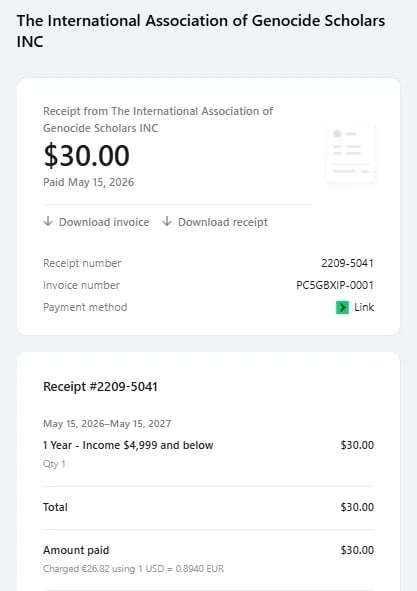
Nobody, it subsequently emerged, had checked who these world’s leading experts actually were. As The Sun has now revealed, IAGS membership is open to anyone willing to pay as little as $30 a year — with no credentials required, no background check and no verification of expertise whatsoever. The Sun confirmed this by enrolling itself despite declaring it had no expertise in genocide. Within hours of media watchdog Salo Aizenberg exposing the open membership policy in September 2025, new members had joined the organisation under the names “Adolf Hitler,” “Emperor Palpatine” and “Cookie Monster.” Dogs were registered. The website buckled under the load.
Aizenberg had already found something more troubling — of roughly 600 members, at least 80 appeared to come from Iraq, a country with virtually no tradition of genocide scholarship and wildly overrepresented in any serious academic body.
The numbers behind the headline are equally stark. Of approximately 500 eligible members, only 28 per cent voted. Of those, 86 per cent voted in favour — meaning roughly 120 individuals. The remaining 360 members abstained, did not participate or were unaware the vote was taking place. The verdict the BBC presented to British audiences as institutional scholarly consensus was, in reality, the opinion of approximately one fifth of the membership of a $30 club.
The vote was conducted anonymously. The names of the resolution’s authors were never disclosed. A planned member meeting to discuss the controversy was cancelled and dissenting voices were blocked on the internal mailing list.
Sara Brown, a member of the IAGS advisory board with a PhD in comparative genocide studies from Clark University’s Strassler Center for Holocaust and Genocide Studies and two decades of research into the Rwandan genocide, called the resolution reckless, poorly documented and based on deliberately skewed analysis. She said anyone who considers themselves a genocide scholar should be ashamed of the vote.
The resolution itself is notably one-sided in scope. The October 7 2023 attacks, in which more than 1,200 people were murdered and 250 taken hostage, are dismissed in a single subordinate clause described as “horrific,” with no analysis or condemnation. The same body that in 2016 produced a detailed resolution on the genocidal crimes of ISIS managed one word for Hamas.
Israeli diplomat Alex Gandler told The Sun: “By presenting these claims with insufficient scrutiny, major news organisations helped legitimise and spread the baseless and slanderous allegation of genocide as though it were an established scholarly consensus. Given the BBC’s reputation as a fair and neutral source of information, this had a cascading effect across international media coverage. The failure to fully and prominently correct or retract such reporting raises serious concerns regarding journalistic fairness, neutrality, and editorial responsibility.”
Eight months on, the IAGS website is fully operational, the subscription model unchanged and the credential-free membership still open. The one thing that has changed: the public membership list has quietly been removed. Nobody can now check who belongs to the organisation, how membership has shifted since October 2023, or whether a surge of new joiners may have influenced the vote.
Whether or not Israel is committing genocide in Gaza is a matter for international courts and legal proceedings — the International Court of Justice is actively considering it. What is now beyond serious dispute is that the BBC’s headline was built on foundations that have not withstood scrutiny.
