



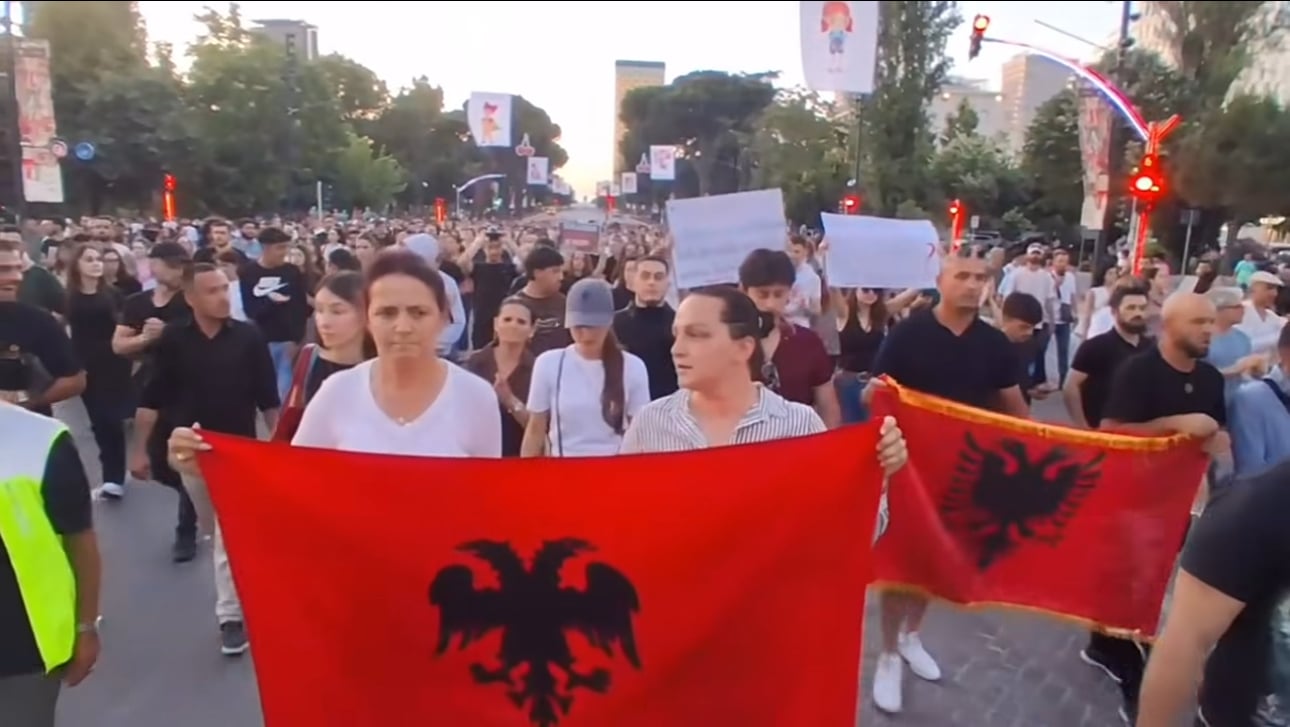
Thousands of Albanians are set to take to the streets of Tirana for a second consecutive evening to protest a vast luxury resort development linked to Jared Kushner, Donald Trump’s son-in-law — as the country’s anti-corruption prosecutors opened a formal investigation into how a protected coastal wetland was stripped of its legal status to make way for the project.
The second day of protests is set to begin at 6pm at Skanderbeg Square in the capital, with demonstrators planning to march towards the Prime Minister’s office. The call to return was amplified by well-known Albanian comedian and mayoral candidate Florian Binaj, whose Instagram post — set to The Prodigy’s Firestarter — displayed the now-iconic image of a flamingo wrapped in barbed wire alongside the words “Protestë — Sot Më Shumë!” meaning “Protest — Even More Today!” His caption read: “Today again in the square! Even more! For the future!” The post garnered nearly 5,000 likes and hundreds of shares within hours of being published. Flamingos, which are native to the threatened Vjosa-Narta lagoon and would lose their habitat if the resort proceeds, have become the defining symbol of the protest movement.

The development at the centre of the row involves two major projects pursued by Kushner’s investment firm Affinity Partners. One is a €4 billion luxury resort complex on the Vjosa-Narta coastal landscape near Zvërnec in southern Albania, covering approximately 618 acres within the protected ecosystem. A separate Kushner-linked venture has also secured strategic-investor status for a €1.4 billion resort proposal on Sazan Island, a former military outpost and Albania’s largest island. Kushner unveiled the projects in 2024 and visited the area earlier this year with his wife Ivanka Trump.
Albania’s Special Anti-Corruption Prosecution Office, known as SPAK, has confirmed it has opened an investigation into changes made in 2024 to the area’s protected status and land ownership, which paved the way for possible tourism development, according to Politico. The protests were initially triggered by footage circulating on social media showing private security guards dragging a demonstrator along a cliff during weekend demonstrations after barbed-wire fences were erected blocking public beach access. Albanian authorities subsequently revoked the licences of two private security firms, arrested one guard and stripped the local police chief of his duties. Fifteen protesters have been charged.
The second image , taken at the Greek-Albanian border crossing, tells its own story — coaches marked “Athens–Vlorë” crossing into Albania as protesters carry Greek flags and signs reading “No to the resort in Zvërnec — it is Greek property.” It directly contradicts attempts by Albanian government figures to dismiss the protests as foreign-orchestrated interference.
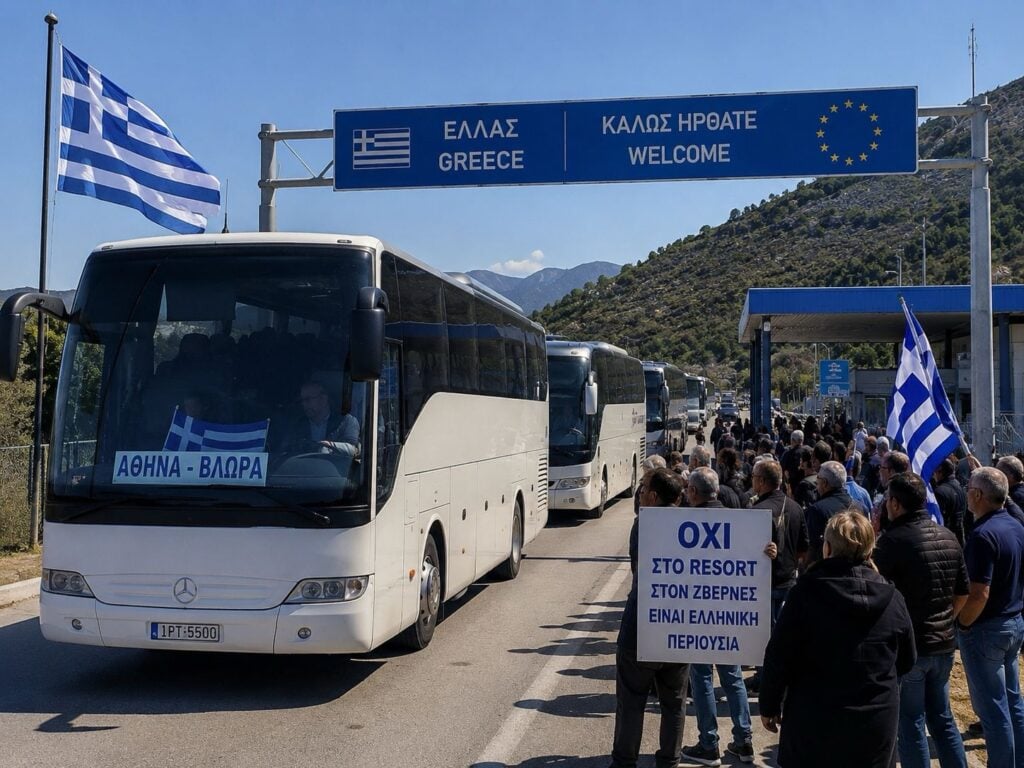
Prime Minister Edi Rama and members of his government have attempted to discredit the demonstrations by claiming they are being driven and funded by Greece, alleging buses of protesters are being sent from Greek territory and sharing what critics have described as fake AI-generated images to support the claim. The image of actual Greek buses at the border — carrying members of the Greek minority community who own land in the affected area — suggests those travelling from Greece have their own direct and legitimate stake in opposing the project, rather than representing any form of external destabilisation.

However, a verification conducted by Albanian fact-checking outlet Faktoje found the image was entirely fabricated. Using OpenAI’s official verification tool, which identifies AI-generated images through the presence of SynthID technology, Faktoje confirmed the photograph had been created using artificial intelligence. The image displayed several hallmarks of AI generation, including blurred and distorted faces, nearly identical buses, unusual wording on banners and an unnaturally neat and symmetrical composition. The SynthID watermark, designed to survive cropping, colour changes, screenshots and file compression, traced the image’s origin directly to an AI generation tool.
Faktoje also established that the claim was based on a misrepresentation of a real article. The Greek newspaper Kathimerini had published a report on 1 June about a protest that took place in Zvërnec on 30 May, noting that two buses had travelled from Athens for that earlier event. The article had no connection to the 1 June protest in Tirana and included no photograph of buses at any border crossing.
Erion Tase of the Academy of Political Studies told Faktoje: “This is a case where artificial intelligence is being used to manipulate public opinion and reinforce certain beliefs. In this instance, existing tensions between neighbouring Albania and Greece are being exploited to support the narrative that the protests are organised from abroad and do not represent the genuine concerns of Albanian citizens.”
Media and communications lecturer Erlis Çela described the episode as a textbook example of AI being used to distort public debate. “The spread of AI-generated photos as real evidence risks distorting public discussion by replacing facts with manufactured perceptions,” he said. “Such images can be used to discredit causes, individuals or social groups and to polarise public opinion.” He called for urgent improvements in media literacy and stronger professional capacity to identify and expose AI-generated disinformation.
Activist Klajdi Belo, who attended Monday’s demonstration, said: “The situation in Narta Lagoon is that, in practice, we have a protected area, but above all, our state has allowed construction work to continue without consultation and without transparency.”
Environmental organisations have warned the proposed resort threatens the habitats of endangered species including the Mediterranean monk seal, flamingos and sea turtle nesting sites, as well as one of the Mediterranean’s most sensitive marine ecosystems. Critics also accuse the Rama government of facilitating the deal through deliberate legislative changes to protected area rules adopted in 2024 — changes that are now the subject of the SPAK investigation.
Rama has remained defiant. “I want to make Albania a country that is a destination to be envied in the region, and this project is part of this effort,” he said, defending the construction as proceeding within Albania’s legal and environmental requirements and framing it as a transformational investment for the country’s high-end tourism sector.
Tonight’s protest, marching from Skanderbeg Square towards the seat of government, will be the clearest signal yet of how far popular opposition has grown — and how little faith Albanians have in official assurances that their coastline is in safe hands.
