



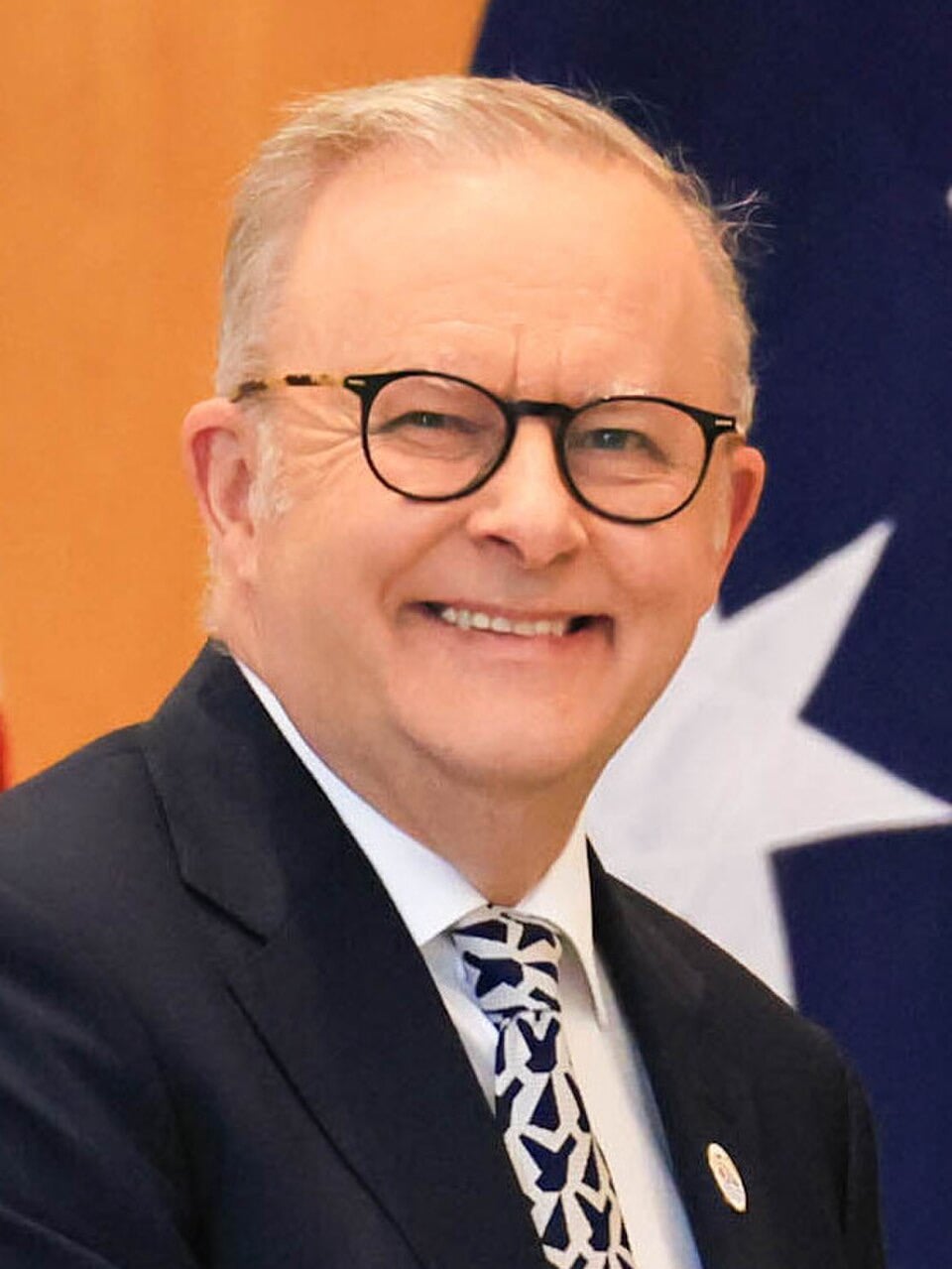
The Australian opposition leader leads the prime minister 42% to 41% in a head-to-head question, within the margin of error. Anthony Albanese’s net approval rating stands at -31.
Australian opposition leader Angus Taylor has edged ahead of Prime Minister Anthony Albanese as voters’ preferred prime minister, according to the latest Newspoll for The Australian. In a head-to-head question, 42% chose Mr Taylor and 41% chose Mr Albanese, a gap well within the poll’s margin of error. Mr Albanese’s net approval rating fell to -31, with 64% of voters dissatisfied and 33% satisfied. Labor’s primary vote held at 27%, level with Pauline Hanson’s One Nation.
The main findings
Newspoll surveyed 1,229 voters between 16 and 19 November. The Australian published the results on Sunday night, after Mr Albanese spent the previous week abroad at a series of global summits. Mr Taylor’s net approval rating was -9, the newspaper reported.
Primary votes were Labor 27%, One Nation 27%, the Coalition 22%, the Greens 14% and others 10%. At the previous Newspoll, on 29 October, the figures were Labor 27%, One Nation 28%, Coalition 21%, Greens 13% and others 11%. Labor’s primary vote has therefore not moved, and the shifts for other parties are one point each. The Australian identifies Labor’s 27% as its second-lowest in Newspoll’s history, with the only lower figure being 26% under Julia Gillard in September 2011.
Voters were also asked about leaders’ qualities. Of those surveyed, 42% found Mr Albanese trustworthy, the same figure as Scott Morrison before he lost the 2022 election. Half said he genuinely cares for people and 47% said he is likeable. Some 38% said he is in touch with voters and 53% considered him arrogant. For being a decisive and strong leader, Mr Albanese scored 43% and Mr Taylor 46%, with Ms Hanson highest on 62%. On having a vision for the country, Mr Albanese scored 52%, Mr Taylor 54% and Ms Hanson 66%.
A different picture in the three-way question
The Australian has introduced a three-way leadership question involving Mr Albanese, Mr Taylor and Ms Hanson. It argues that the traditional Labor-versus-Coalition two-party-preferred measure has become less informative as One Nation’s support has grown. It has not published a conventional national two-party-preferred figure for this survey.
According to analysis by The Poll Bludger, Mr Albanese leads this three-way question on 44%, unchanged since the previous Newspoll, with Mr Taylor on 28% (up two points) and Ms Hanson on 28% (down two points). The same analysis reports a forced-choice measure that produced a 53–47 split for Mr Taylor over Mr Albanese. These are separate questions, so the 42–41 head-to-head result and the three-way result do not contradict each other.
A simple calculation gives a sampling error of about 2.8 percentage points for a survey of this size, though the poll’s actual uncertainty depends on weighting and other factors. A one-point lead is therefore not enough to say confidently who has more support.
Other polls and economic context
Other pollsters show a similar three-party picture. YouGov (10–17 November, 1,500 people) recorded One Nation 26%, Labor 24%, Coalition 22% and Greens 15%. Resolve Strategic (2–7 November) had Labor 28%, One Nation 25%, Coalition 22% and Greens 13%. Roy Morgan’s earlier November survey had Labor 25.5%, One Nation 24.5% and Coalition 22%. Methods and fieldwork dates differ. Because Australia uses preferential voting, identical national primary votes do not necessarily mean identical seat totals.
The poll was taken less than three weeks after the Reserve Bank of Australia raised its cash rate by 0.25 percentage points to 4.85% on 3 November, the highest level since 2008. The decision was split six to three. The bank said weak productivity growth and housing pressures complicated the outlook, and its minutes indicated that returning inflation to the middle of its target range could take until mid-2028. The polling data do not show that the rate rise caused the change in Mr Albanese’s ratings.
The Australian’s coverage lists historical lows in net approval: Paul Keating -57, Julia Gillard -45, Tony Abbott -44, Bob Hawke -37 and John Howard -36. Mr Albanese’s -31 remains above those figures. They are not like-for-like comparisons of government performance.
What comes next
Victoria holds its state election on 28 November, so the federal poll arrives in the final week of that campaign. The Herald Sun reported that federal leaders have made comparatively few appearances in it. News.com.au reported that a separate Agenda C poll recorded a 59–41 two-party-preferred lead for the state Coalition, a state measure that should not be compared with the federal Newspoll. Mr Albanese is due to travel again for the G20 summit in Miami in December.
