



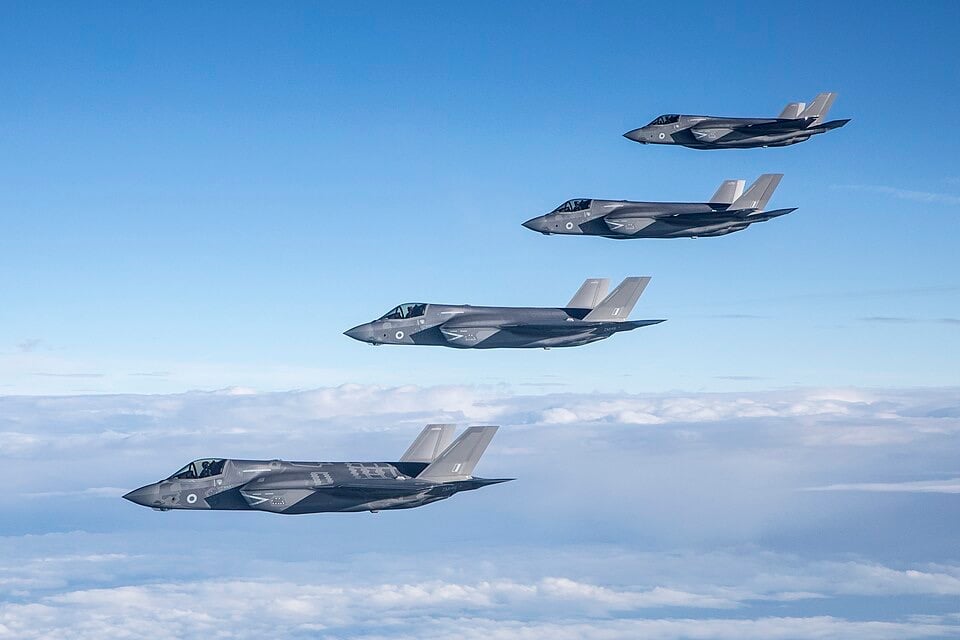
Air Chief Marshal Sir Harv Smyth says AI-enabled aircraft will operate alongside Typhoons and F-35s as the RAF adapts to the lessons of the war in Ukraine.
Uncrewed fighter jets will begin flying in British airspace in 2027, the head of the Royal Air Force has said. Writing in The Telegraph, Air Chief Marshal Sir Harv Smyth said AI-enabled aircraft would change military aviation as profoundly as the move from propellers to jets. He said autonomous systems would take on the most dangerous tasks alongside crewed Typhoons and F-35s, but that accountability must stay with people. His comments come as the war in Ukraine has raised the importance of unmanned aircraft.
What Sir Harv said
Sir Harv wrote that “by far, uncrewed systems promise the greatest change”, pointing to Ukraine’s inexpensive drones, which gather intelligence and reach far beyond the front line. “I firmly believe that AI-enabled, uncrewed aircraft will transform military aviation as profoundly as the shift from propellers to jets,” he said. “Uncrewed fighter jets will start flying in UK airspace next year.”
He said people would remain central to the service. “Technology must enhance human judgment, not replace accountability,” he wrote. He described the plan as a key part of the UK’s work with Italy and Japan on the Global Combat Air Programme (GCAP). “The GCAP jet is perhaps the last crewed fighter we will ever build, not because people will become less important, quite the opposite,” he said.
Sir Harv said the RAF still hoped to grow, with around 300 trainees graduating each month. “We will ensure they have excellent equipment, training and support: ready to deter and, if deterrence fails, to fly, fight and win,” he wrote.
Protector’s first UK mission
Sir Harv told the newspaper that the RAF’s remotely piloted Protector aircraft made its debut in October. He said it tracked Russian shipping through the English Channel for 10 uninterrupted hours in controlled airspace on its first UK operational mission. “With endurance of up to 40 hours, the potential of this uncrewed system is phenomenal,” he said.
The RAF said on 15 November that Protector had worked alongside HMS Tyne during the October operation. The aircraft helped monitor Russian maritime activity and potentially vulnerable undersea cables. The RAF also reported that Protector RG1 passed 1,000 operational flying hours by 3 November 2026, after its first operations began in November 2025. Protector is remotely piloted rather than an autonomous fighter.
The aircraft behind the 2027 target
Britain unveiled its first domestically designed autonomous collaborative combat aircraft, Brontanax, on 22 July, according to BAE Systems. The firm is developing it at Warton in Lancashire. BAE Systems expects a first flying prototype in 2027 and hopes to have the aircraft available for operational service before the end of the decade. The 2027 date is therefore a flight-demonstration milestone, not the arrival of a combat-ready fleet.
BAE Systems says Brontanax is designed for electronic warfare and precision strikes against air and ground targets. It would fly alongside frontline fighters such as the Eurofighter Typhoon. It is expected to be about the size of a BAE Systems Hawk trainer jet. Its intended control arrangements would let a Typhoon pilot or mission commander direct it remotely as part of a coordinated operation, so it is not necessarily meant to make every operational decision independently.
Brontanax is the first publicly identified aircraft linked to the RAF’s Storm Fighter programme. In a written parliamentary answer on 7 September, the Ministry of Defence (MoD) confirmed three programme names: Storm Fighter, Storm Chrome and Storm Fire. They are intended to provide complementary capabilities rather than a single replacement for conventional fighters. StormShroud, the existing electronic-warfare platform, is already flying. It completed flight trials in Cornwall in February 2026, according to the RAF. It is not equivalent to a pilotless fighter flying air-combat missions.
Funding and wider programmes
The MoD has committed £300m to developing a UK autonomous combat aircraft, according to the 2026 Defence Investment Plan. That sits within wider investment of more than £5bn in autonomous military systems announced on 29 June, covering the Royal Navy, Army and RAF. Earlier government guidance had set 2030 as the deadline for an autonomous combat-aircraft demonstrator. The 2027 prototype target is more ambitious, though the dates may refer to different stages of development and testing.
Separately, First Sea Lord General Sir Gwyn Jenkins said on 10 November that the Royal Navy plans to launch an uncrewed jet from an aircraft carrier in British waters during 2027. The Navy intends to sign an agreement with the American manufacturer Northrop Grumman to prepare its TALON demonstrator for testing under Project Vanquish. The trials will examine how pilotless aircraft can operate alongside the Navy’s F-35B fighters.
The British Army plans to introduce up to 24 armed autonomous drones by 2030 under Project Nyx, working with Apache helicopters. Another 24 surveillance drones are planned under Project Corvus to replace the Watchkeeper system, according to the House of Commons Library. The Library also reports that the Defence Investment Plan allocates almost £7.3bn to digital infrastructure and a targeting network. A further £17bn is envisaged for related digital capabilities during 2030–2035.
Days before Sir Harv’s article, the MoD announced £25m for drones and “cutting edge battlefield technology” for British forces protecting NATO’s eastern flank in Estonia. The money comes from the Defence Investment Plan. Defence Secretary Wes Streeting said on Tuesday: “This investment will increase our deterrence on NATO’s front line, with our troops in Estonia being kitted out with the latest drones and capabilities. It will mean our Army can move faster, be more agile and strike the enemy harder. And it shows how we’re investing today to step up our deterrence and readiness for tomorrow.”
GCAP and the crewed fighter
The UK, Japan and Italy signed a £4.6bn GCAP development contract on 3 July 2026, awarded to the joint venture Edgewing. The UK has earmarked £8.6bn over four years for the programme. The MoD says it supports about 4,500 British jobs and a supply chain of about 600 organisations. GCAP is planned to enter service in 2035. It will be crewed but designed to work with autonomous systems, which separates it from the uncrewed prototypes planned for 2027.
