



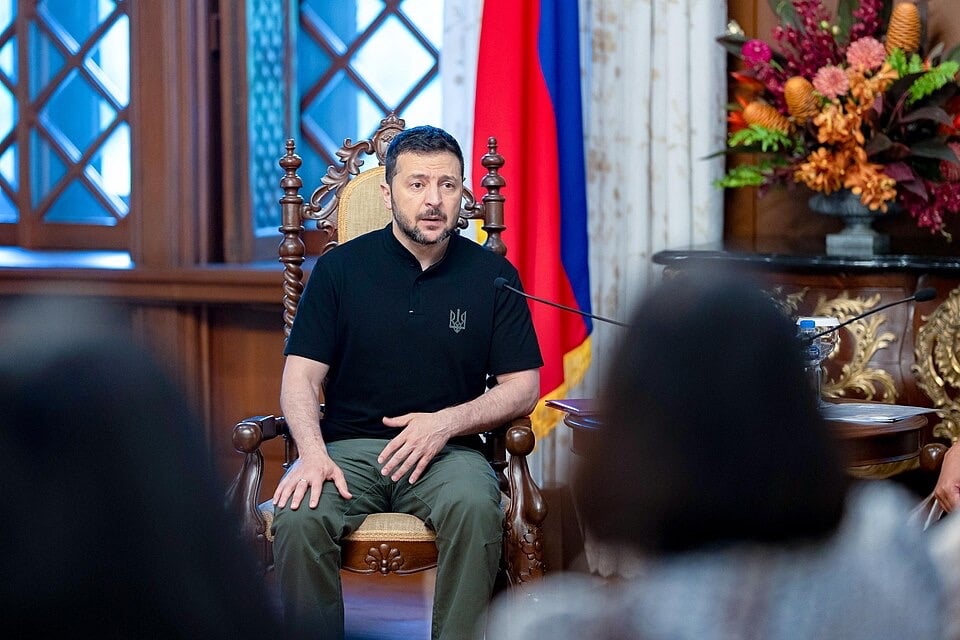
The Ukrainian president also said access to Starshield and US intelligence sharing has been fully restored, though progress on Patriot missiles is “moving very slowly”.
A meeting between Ukraine, Russia and the United States will take place next month, President Volodymyr Zelenskyy has said. The trilateral talks are understood to be planned for November, he wrote in a post on X on Sunday. He added that his military’s access to Starshield systems and US intelligence sharing had now been fully restored. However, he said progress on Ukraine receiving missiles for its Patriot air defence systems was “moving very slowly”.
Where and when
According to the research notes, Mr Zelenskyy named Abu Dhabi in the United Arab Emirates as the proposed venue in an address to the Hudson Institute on 23 October. Reuters subsequently reported that negotiating teams were aiming to meet in the first half of November. No exact date has been announced.
The talks are expected to begin at technical level, with each side sending negotiators to examine proposals before any move to national leaders. Mr Zelenskyy wants early progress to lead to a meeting involving himself, Vladimir Putin and Donald Trump, saying the most consequential questions would need decisions by leaders. That is an ambition, not a confirmed summit.
The notes say Mr Zelenskyy blamed Russia for the failure of a similar three-way meeting expected in October, saying Moscow gave another reason for not attending. That is his account, and the reason has not been independently established. The Kremlin has separately indicated it is willing to resume US-mediated talks in November, according to Reuters. That gives the meeting public backing in principle from both capitals, but not a guarantee.
The diplomacy so far
Trump’s envoy Steve Witkoff met Mr Zelenskyy in Oslo on 20 October, at talks also attended by Norwegian Prime Minister Jonas Gahr Store and Finnish President Alexander Stubb. He then met Mr Putin in St Petersburg on 21 October. Reuters reports that, afterwards, the Americans conveyed signs that Moscow would support renewed trilateral negotiations. On 23 October Mr Zelenskyy spoke to Mr Witkoff and Jared Kushner about those meetings and the November plans.
Mr Zelenskyy has listed an energy ceasefire as one possible objective, alongside a wider halt to fighting and humanitarian steps including prisoner exchanges. He has said Ukraine would need international funding to keep a substantial army for at least ten years after any settlement, as part of Kyiv’s push for security guarantees. He insists Europe must take part in the diplomatic process.
Other developments
- Oleshky ceasefire: Russia and Ukraine have agreed a temporary ceasefire in Oleshky, a Russian-occupied town in the Kherson region. It was announced on 23 October and is due to take effect at 4am local time on 27 October, according to Reuters. US First Lady Melania Trump helped broker it, both sides say, to allow aid deliveries, clear routes and evacuate civilians. The White House says only about 1,700 to 2,000 people remain, against around 24,000 before the full-scale invasion. It is a geographically limited humanitarian arrangement and not an end to hostilities.
- Prisoner exchange: Each side handed over 270 people on Friday 23 October, the first such exchange since August, Reuters reported. Mr Zelenskyy said some of the Ukrainians returned had been held in extremely difficult conditions since 2022.
- Starlink and Starshield: Ukraine’s defence ministry said connections had returned to normal speeds, with stable service at speeds above 400km/h. Restrictions imposed earlier in October had reportedly limited connectivity to about 160km/h. Hours after the announcement, Elon Musk alleged on X that Ukraine had breached the service’s terms by using Starlink for offensive drone strikes, and said a loophole was closed the previous week. These are his allegations and have not been independently established. Reuters reports that neither SpaceX nor the US government has publicly acknowledged responsibility for the earlier restrictions.
- Patriot missiles: Mr Zelenskyy said on 19 October that a shipment of interceptors already paid for by partners was awaiting approval from US Defence Secretary Pete Hegseth. They were being bought through NATO’s Prioritised Ukraine Requirements List. Ukraine offered to suspend attacks on Russian oil refineries for 30 days if Washington supplied Patriot interceptors, which he presented as a possible swap and not an agreed ceasefire. He also said that on three occasions last week Ukraine did not receive the usual warning information from partners about Russian attacks.
- Sanctions: On 24 October Mr Zelenskyy enacted sanctions on 51 individuals and 44 companies linked to Russian ballistic missile production, covering suppliers for Iskander, Kalibr, Kh-101 and Kinzhal missiles. A separate package targeted 32 individuals and 35 companies connected to industrial equipment, electronics and components used in Russian weapons.
