



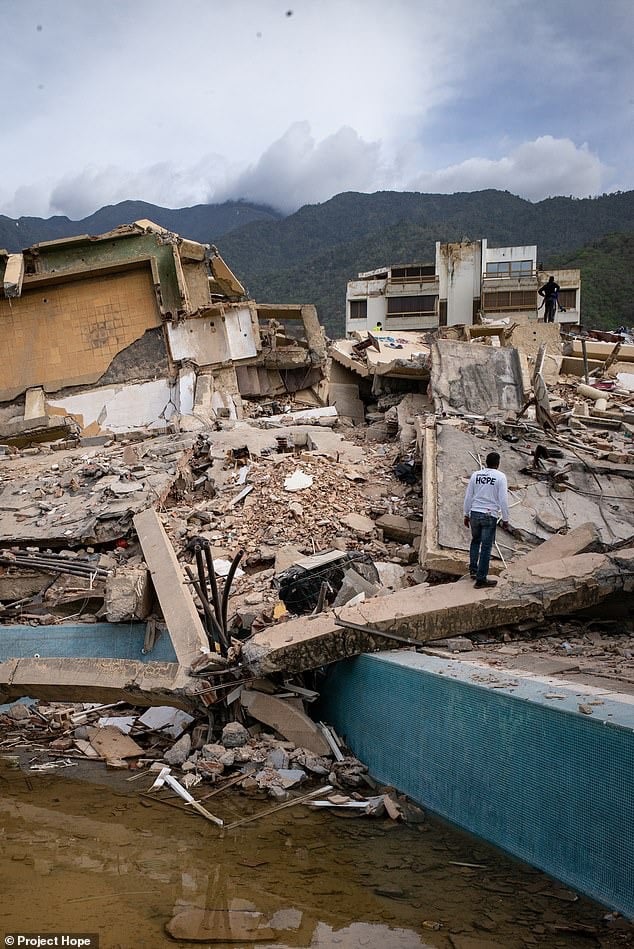
Hope of finding the tens of thousands of people still unaccounted for after Venezuela’s devastating earthquakes is all but gone, a senior charity official has warned, as the country transitions from rescue operations to the grim work of body recovery more than a week after the disaster.
Edward de Burgh, a senior global security officer for the nonprofit Project HOPE, which has been distributing supplies and providing emergency treatment in the affected region, told the Daily Mail that survival for those still under the rubble was now biologically implausible. “Just on our ability to survive as a human being without water in a very harsh environment, we’re getting to the point now where those miraculous cases will exist, but realistically speaking, biologically speaking, it’s not likely that people can survive much longer, if they are indeed at all alive at the moment,” he said.
The confirmed death toll stands at almost 2,300 following the back-to-back 7.2 and 7.5-magnitude earthquakes that struck last week, but with around 40,000 people still unaccounted for, the true scale of the catastrophe is expected to be significantly worse. De Burgh was unsparing in his assessment. “If you look at the number of disappeared, the people they can’t contact, and do the simple maths, then yes, you’re probably looking at a significant rising number of deaths.”
One remarkable rescue provided a fleeting moment of relief on Tuesday night, when 43-year-old Hernan Gil was pulled alive from the rubble in Playa Grande in the Catia La Mar neighbourhood in a dramatic operation involving teams from seven countries. But such moments are now vanishingly rare. The critical 72-hour survival window passed days ago, and international rescue teams are beginning to withdraw.
“In the first few days everyone has hope, solidarity kicks in and people are desperately trying to find loved ones,” de Burgh said. “You’ve got very professional teams working with dogs and sensors and drones and then you’ve got community teams working with hand tools to try and do their best. That’s kind of slowing down now and people are starting to realize that time is not their friend anymore. A lot of the international teams are now leaving, and we’re officially sort of moving into the recovery stage.”
The human reality of that transition is playing out across the ruins of La Guaira, once a festive seaside resort that was the hardest-hit region in the disaster. Entire neighbourhoods have been flattened, with eight-storey buildings reduced to six-metre mounds of twisted concrete and debris. A makeshift morgue has been established on the docks, where families wait on plastic chairs to formally identify their dead.
Owuar Herrera spent a week searching before the bodies of his ten-year-old granddaughter Dasleidy Herrera and her grandmother Mildred Moreno, 50, were recovered. “After a week of work, we found them today. They were embracing,” he said. Carlos Velazquez had been at the rubble of a ten-storey building every day since the earthquakes struck, searching for his 26-year-old son Dennis. “I’ve been here since day one. Even if I have to pull him out with my own fingernails, my son will rest in a proper cemetery,” he said, his eyes filled with grief but determination. His son’s body was recovered shortly afterwards. Crane operator Manuel Alejos, who had already recovered seven bodies, described the work of breaking through the debris slab by slab. “Their families need the bodies to say their goodbyes,” he said.
The local golf course has been converted into an emergency camp, with rows of camp beds housing some of the estimated 15,000 people whose homes no longer exist. Many others have been forced to sleep in the streets.
De Burgh described the broader human catastrophe now unfolding as communities begin to comprehend the full scale of what has been lost. “This pressure builds up as people are desperate dealing with the loss of people, loss of loved ones, and literally having nothing. Their homes now have gone, and whatever they had in them is not retrievable in many cases. It’s the period where you have to start living with the aftermath of it, which can be exceedingly incapacitating for people.”
Disease now represents one of the most pressing concerns for aid agencies moving into what de Burgh described as the secondary phase of the disaster. Collapsed buildings may have ruptured sewage systems and contaminated water supplies, while hospitals in the region, though still operating, are “very much overstretched.” Project HOPE has begun shifting its focus toward supporting clinics and hospitals, with emergency medical teams supplementing local health services. De Burgh warned that the challenges ahead would unfold over months rather than weeks. “In the next few weeks, we’ve got the concern of public health and then how do we get people back into housing? How do we remove all this destruction so we can build again? And that does take months.”
