



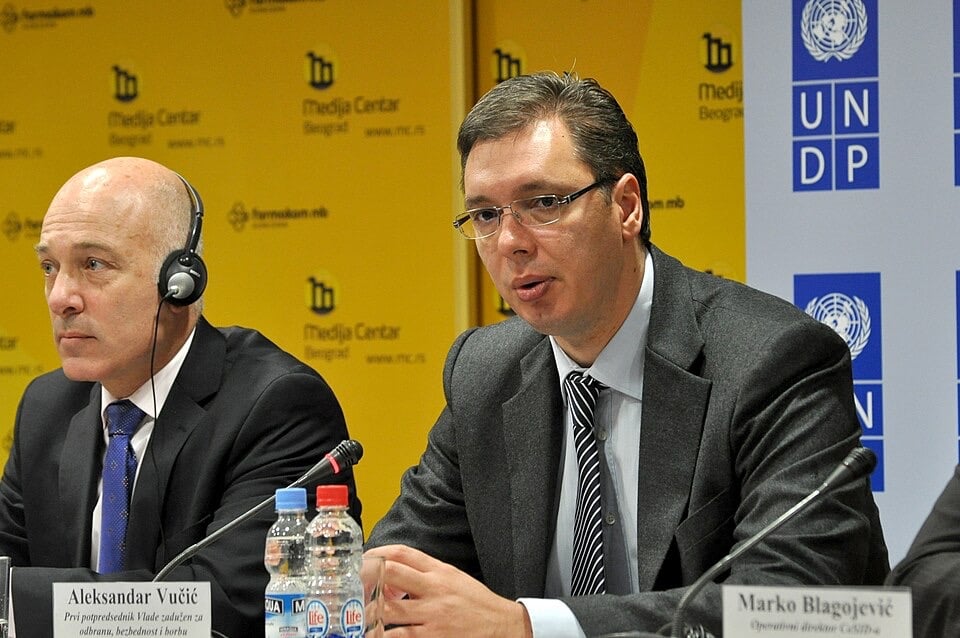
The longtime leader said “it is clear that we lost” after a high-turnout vote. Seat and vote figures so far are projections, not certified results.
Aleksandar Vucic, Serbia’s longtime leader, has conceded defeat to a student-led movement in Sunday’s parliamentary election, ending more than a decade of rule by his Serbian Progressive Party (SNS). “Based on a stratified sample, it is clear that we lost these elections,” he told supporters at SNS headquarters in Belgrade. Pre-election polls had suggested a tight race with the newly formed Students’ List. Celebrations broke out in the capital as soon as he conceded, with car horns sounding and crowds gathering near the Election Commission’s headquarters.
The projected result
At his election-night news conference, Mr Vucic gave figures from his party’s own sample. They have not been certified.
- Seats: He projected 135 to 140 of the 250 seats for the Students’ List and about 105 for his coalition. A majority needs 126. National minority parties could also win seats, including the Alliance of Vojvodina Hungarians and Albanian or Bosniak lists, and the final allocation is uncertain.
- Votes: He said the Students’ List received about 2.2 million votes and his coalition about 1.72 million, a gap of roughly 480,000, according to RTS.
An election-night projection by Ipsos/CeSID, reported by The Guardian, broadly agrees. It gives the Students’ List 52% of the vote and 138 seats, against 39.3% and 104 seats for Mr Vucic’s coalition. That is a lead of 12.7 percentage points. Neither set of figures is the Republic Electoral Commission’s certified count, which must be completed, with objections addressed, before seats are confirmed. Eighteen lists were approved, and only a few are expected to win seats. The new parliament must then take the constitutional steps to form a government.
A high turnout
According to the monitoring group CRTA, turnout reached 41.1% by 1pm, against 26.6% at the same stage in the December 2023 parliamentary election. Serbia’s Statistics Office director, Branko Josipovic, said 64.89% of voters had cast ballots by 6pm, two hours before polls closed. CRTA’s own figure at 7pm was 67.8%, which it said approached the historic record. Polling stations closed at 8pm local time, though people already queuing could still vote. Mr Vucic conceded at about 9.30pm.
After voting at a kindergarten on the outskirts of Belgrade, he said: “We will heed the democratic will of the citizens. You can win or lose an election. Either way, we will act responsibly.”
Concerns over the conduct of the vote
CRTA reported serious procedural problems at the polling stations it monitored:
- ballot photography at 48% of stations, including 79% in Belgrade and 58% in Vojvodina, which observers say can undermine ballot secrecy and enable pressure on voters
- ultraviolet verification lamps not used at 30% of stations, and voting without valid identification at 8%
- obstruction or pressure involving voters, polling board members and observers at 29% by late afternoon
CRTA also filed a police complaint in Veternik over alleged vote-buying and “carousel voting”. The research notes describe the latter as suspected manipulation of ballot papers to verify or control votes. No conviction has been established, and CRTA’s observations do not show how many votes were affected. The group deployed more than 2,000 observers across a representative sample of 500 polling stations.
Violent incidents were reported in Belgrade, Pancevo, Vranje and Novi Sad, and CRTA documented rising tension outside polling stations in the afternoon. No final tally of injuries or arrests has been established. AP reported that riot police blocked access to the area around the commission’s headquarters, and armoured police vehicles were seen near a Belgrade park occupied by Mr Vucic’s supporters. CRTA programme director Rasa Nedeljkov said he had never known citizens prevented from reaching the commission to file complaints in a Serbian election. According to The Guardian, he also said European Parliament observers needed police protection while moving around Belgrade. International observers are expected to give their preliminary assessment on Monday.
Mr Vucic used his speech to accuse independent Serbian media and foreign interests of influencing the election, referring to European countries and parts of the American political establishment, according to AP. He also said his coalition did well among Serbian voters in neighbouring countries and Kosovo, which is part of his own assessment and not a substitute for official data. No verified evidence shows that foreign interference decided the result.
Who leads the winning list
Cardiologist Ilija Srdanovic heads the Students’ List but is neither the movement’s leader nor its designated candidate for prime minister. After voting in Novi Sad, he said: “I hope that today will pass in a democratic atmosphere, in peace, and that we will legitimately elect a new government in Serbia.”
According to the research notes, citing Poland’s Centre for Eastern Studies, the movement picked its 250 candidates through university-based student assemblies. They include doctors, university lecturers, artists, farmers, athletes and civic activists. Its programme proposes a specialised prosecution police force, confiscation of illegally acquired assets, free school textbooks and cuts to medicine prices. It has discussed a government of experts, but no cabinet or timetable has been confirmed. These are proposals, not enacted measures.
How the movement began
The result follows almost two years of protests after a station canopy collapsed in Novi Sad in 2024, killing 16 people. The disaster stirred anger over alleged corruption, poor construction standards and a lack of accountability for public infrastructure projects. The authorities reject the allegations. University students began with blockades and marches, and were joined by teachers, farmers and others, making it Serbia’s largest movement since the fall of Slobodan Milosevic in 2000.
SNS won parliamentary elections in 2012 and has dominated Serbian politics since. Mr Vucic became prime minister in 2014 and president in 2017. After calling a snap election last month, he stepped down as president to run for prime minister. His second presidential term was due to end in May 2027, and the constitution bars a third. Critics accuse him of concentrating power, undermining independent media and weakening democratic institutions. He and his party deny this.
Serbia is a candidate for EU membership, though its accession has been hampered by concerns over democratic standards and the rule of law. Mr Vucic has kept close ties with Russia and refused to join Western sanctions over its invasion of Ukraine. The vote comes six months after Peter Magyar’s victory in Hungary over Mr Vucic’s ally Viktor Orban.
