



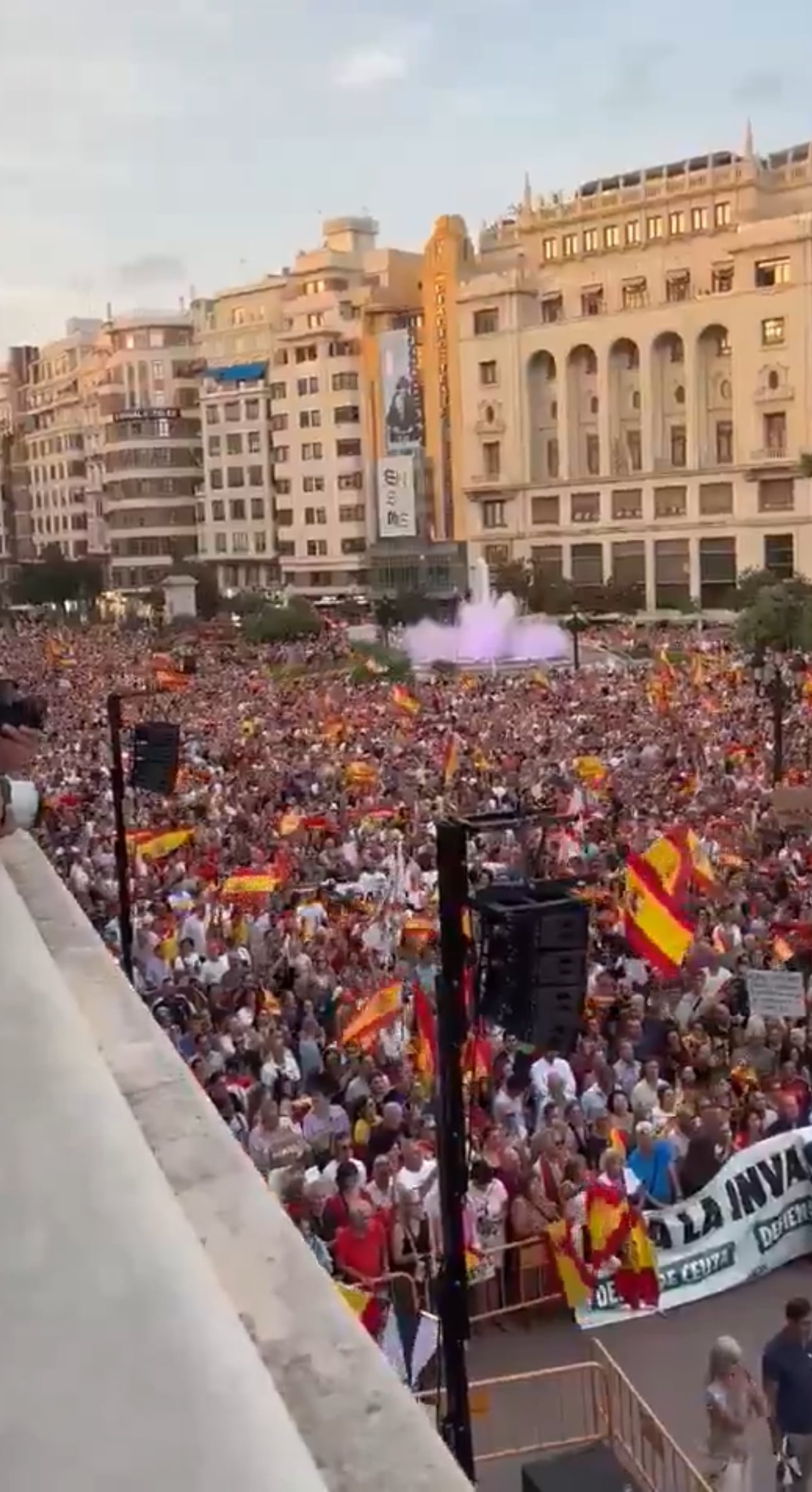
Spain braces for nationwide demonstrations “in solidarity” with Ceuta on Wednesday evening, as residents of the North African territory appeal for calm and a leaked police intelligence report alleging Moroccan involvement in July’s mass migrant crossing triggers a fresh dispute within the Spanish government.
People living in Ceuta have appealed for calm ahead of nationwide protests planned across Spain on Wednesday evening, held “in solidarity” with the Spanish territory in North Africa. The demonstrations, due to take place in major cities including Madrid, coincide with Ceuta Day, a holiday marking the territory, and come nearly five weeks after around 72,000 migrants crossed into Ceuta from Morocco in late July, with scores dying during the crossing. While most have since returned home, around 10,000 remain stranded in makeshift camps or on the streets of the enclave.
Local tensions boiling over
The continued presence of migrants in Ceuta has triggered near-daily protests by local residents against the Spanish government’s handling of the crisis, with demonstrators calling for migrants to either be returned to their countries of origin or redistributed across mainland Spain.
Ceuta resident Lola described a sense of mounting frustration among locals: “The government has failed to act in a critical situation. It’s spiralling out of control. We’re tired, just like those who came are getting tired, and tensions are rising. There’s a point where this will become a powder keg.”
Recent protests have already featured sporadic attacks against a makeshift migrant camp at El Trampolín beach, alongside the arrest of Moroccan citizens accused of throwing stones and bottles at army patrols. Francisco García Segado, who heads the residents’ association FPAV Ceuta, said organisers of Wednesday’s demonstration wanted proceedings to be “clean, free, without disrespecting anyone,” and were working to keep far-right activists out of the protest amid concerns that groups from mainland Spain could stoke violence. He added: “What we want is tranquillity… to go back to normal. Going back to normal means everyone being sent back where they came from.”
Disputed intelligence report on Morocco’s role
A significant new development has emerged concerning Morocco’s possible involvement in the July influx. A Spanish National Police intelligence report submitted to the Audiencia Nacional reportedly alleges that Moroccan gendarmes actively guided migrants toward designated crossing points, with plain-clothes individuals monitoring and directing the flow of people. The report reportedly characterises the operation as having been planned specifically to overwhelm Spain’s border-control capacity.
However, a direct dispute has since emerged within the Spanish government over the report’s status. Police Director-General Francisco Pardo told Interior Minister Fernando Grande-Marlaska that no police report officially attributes the planning or execution of the crossing to Moroccan security forces, explaining that investigators had been instructed by the presiding judge not to share the report with their superiors, meaning senior police officials had not previously seen its contents. Marlaska has since demanded a personal explanation from Pardo, writing to ask when police had obtained the information and whether the claims about Moroccan involvement were accurate, stressing that the details would be important for shaping the government’s response to the crisis.
According to the reported intelligence assessment, the crossing unfolded in three distinct waves: an initial group made up mostly of young Moroccan men equipped with wetsuits and floats; a second wave involving families, women and children; and a later wave again dominated by young men. Investigators reportedly interpreted these shifting demographic patterns as evidence that the influx had been deliberately structured. The assessment found no known organised criminal trafficking network behind the operation, pointing instead to extensive mobilisation via social media, including messages encouraging people to travel to the border and claims suggesting it was effectively open.
Morocco’s alleged role remains unresolved rather than proven. While the reported assessment carries weight because it was submitted directly to a judge, the Police Director-General maintains there is no formal police report attributing blame to Moroccan security forces, leaving the government internally divided over how to characterise events ahead of a key parliamentary appearance.
Government response and figures
Spain’s government has released more precise official figures on the crisis: 3,519 migrants voluntarily returned to Morocco between 10 and 31 August, while a further 214 were formally expelled. Officials have identified 1,612 minors among those involved, though they say the true number still requiring identification remains unknown.
Around 800 migrants were moved on 1 September into two newly designated, cordoned-off accommodation areas, as the government shifts away from previously used sites such as sports centres and a former military hospital, adding new locations including areas within the port, land belonging to the Ministry of Housing, and the K-8 barracks. Authorities have also deployed 50 additional National Police officers specifically to reinforce asylum processing, alongside 11 additional civil servants.
Spain has announced a €309 million emergency package for Ceuta, of which €90 million is earmarked for security, €118 million for migrant accommodation and basic care, and €63 million allocated specifically to policies concerning minors. Shelter capacity in the territory has increased from around 500 places to more than 3,400, alongside the deployment of more than 1,600 police officers.
Nationwide scale of the demonstrations
Wednesday’s protests are considerably broader than a single Madrid gathering. The Spanish Federation of Municipalities and Provinces (FEMP) has called for demonstrations at 8pm outside town halls across the country, potentially involving Spain’s entire network of more than 8,000 municipalities. In Madrid, opposition leaders Alberto Núñez Feijóo of the People’s Party (PP) and Santiago Abascal of Vox are expected to attend the main gathering at Cibeles.
Separate demonstrations are also planned in Madrid, including a “Por Ceuta” gathering outside Congress and an anti-racism demonstration in Callao, alongside a gathering outside the European Parliament in Brussels. FEMP president María José García-Pelayo has insisted the demonstrations are not intended to be political, calling instead for unity and peaceful expression, and stating that their purpose is to support Ceuta, condemn deaths and sexual violence linked to the crisis, and demand a return to normality.
A politically charged dispute
Wednesday’s nationwide protests were called by the FEMP, an organisation dominated by the opposition PP, and Spain’s left-wing government has distanced itself from the demonstrations, accusing the right of exploiting the crisis for political gain. Territorial policy minister Ángel Víctor Torres told radio station RNE: “This is not about defending Ceuta and the Ceutans, it is about attacking the government.”
A separate manifesto from the citizens’ initiative “Por Ceuta,” which calls for respect for the human rights of both residents and migrants, the orderly return of those with no right to remain, and increased security reinforcements, has attracted nearly 65,000 signatures. Left-wing groups and unions have organised counter-protests in several cities, including Madrid, to condemn what they describe as “racist and Islamophobic persecutions and attacks” against migrants in Ceuta.
Negotiations between local and central government over how to handle the crisis remain deadlocked, with PP politicians, in some cases working alongside the far-right Vox party, calling for all those remaining in Ceuta, including minors, to be deported. Regional groups and political leaders have said more needs to be done to keep both citizens and migrants safe as the crisis continues.
Prime Minister Pedro Sánchez is due to appear before Spain’s Congress on 3 September to explain the government’s handling of the crisis, following appearances by eight senior ministers already made before Parliament. The disputed police intelligence report on Morocco’s alleged role is expected to feature prominently in that parliamentary confrontation, given the stark disagreement between government ministers and senior police officials over its findings.
