



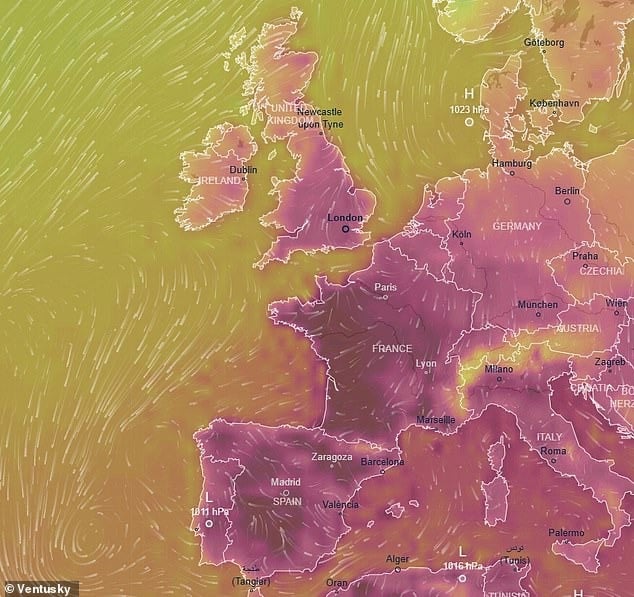
France has shut down a nuclear reactor near Toulouse after cooling water drawn from a nearby river became too warm to use safely, as a catastrophic “heat dome” baking western Europe has killed dozens of people in swimming accidents, left two toddlers dead in a car, and pushed temperatures toward 46C in parts of the continent.
The Golfech nuclear plant, cooled by the Garonne river, was taken offline after the water exceeded the safe temperature threshold of 28C. The shutdown adds an energy crisis dimension to a public health emergency that French Prime Minister Sébastien Lecornu said has claimed 40 lives through drowning since 18 June alone, as people desperately sought relief from the heat in unsupervised lakes and rivers. Among those who drowned over the weekend was a 13-year-old girl.
The heat dome, driven by a mass of hot Saharan air funnelled northward by a powerful high-pressure system known as the African anticyclone, is trapping hot air across western and central Europe and building temperatures day upon day. Weather authorities in France have put 49 of the country’s 96 mainland departments on red alert, up from 35 over the weekend. Forecasters have warned the conditions could rival the catastrophic 2003 heatwave that killed nearly 15,000 people in France.
The toll is already rising across the continent. In Germany, five people died in swimming accidents over the weekend, including two men aged 20 and 22 who drowned in Bavarian lakes and a 79-year-old woman who died in the Baltic Sea, with further fatalities in Brandenburg and North Rhine-Westphalia. In Spain, nearly the entire country is under heat alerts, with red warnings issued for areas around Cordoba, Bilbao and parts of Cantabria, where temperatures of up to 40C in the shade have been recorded in regions unaccustomed to such extremes. Fifteen Italian cities are on red alert, with a sixteenth expected to join the list on Wednesday. Greece saw wildfires break out on the island of Syros and near the northern town of Maroneia over the weekend, with four firefighting aircraft deployed and evacuation notices issued.
The human cost of the heat is already becoming vivid in individual tragedies. Two children aged two and four were found dead in a car in Carpentras in southern France, with the heatwave described by prosecutor Helene Mourges as “the leading line of inquiry” into their deaths. In Barcelona, 76-year-old Jose Farre told reporters he had been forced to do his shopping in the early morning hours to avoid the worst of the heat. “I have a heart condition, I’m diabetic and I feel it a lot,” he said. “We’ve gained several degrees between my youth and today. But what bothers you the most is the humidity.”
Paris authorities warned residents to avoid travel, with Valerie Pecresse, head of the Ile-de-France region, telling journalists that “the transport network comes under severe strain in periods of extreme heat” and that railways “cannot withstand temperatures above 50 degrees.” Belgium’s national rail company SNCB cancelled some rush hour trains to reduce the risk of breakdowns blocking tracks, as Belgian forecasters warned the country could experience its “hottest ever recorded” temperatures this week.
In the UK, where around 3,000 lightning strikes hit London in just two hours overnight and violent thunderstorms swept across southern England bringing flash flooding, power cuts and travel chaos, the extreme weather is expected to give way to record-breaking heat later in the week. Liz Bentley, chief executive of the Royal Meteorological Society, predicted the UK’s June temperature records would be “annihilated.” “The coming week will bring an unprecedented heatwave with temperatures likely to reach 38-39 degrees Celsius,” she said. “This will lead to two consecutive months, May and June, in which the UK temperature records have been annihilated by well over 2C.” The Met Office has now issued its highest level of heat warning for parts of central and southern England for Wednesday and Thursday, saying it was “now likely” the existing June record of 35.6C, set in Southampton in 1976, would be broken.
Akshay Deoras, a senior researcher at the University of Reading’s National Centre for Atmospheric Science, said the science behind the pattern was unambiguous. “Human-driven climate change has provided the springboard for this event, loading the atmosphere with extra heat and making extreme temperatures far more intense than they would have been in the past,” he said. The UN has warned that the next five years are likely to see further shattered heat records.
