



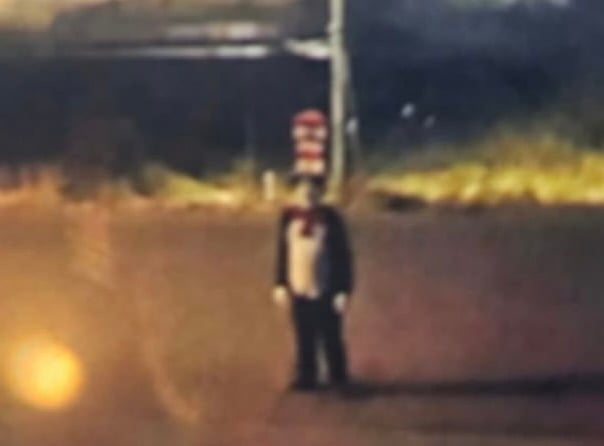
Canadian police are hunting a suspect dressed as the Cat in the Hat after the figure allegedly chased a teenage girl through a West Kelowna neighbourhood last month, in an incident distinct from a separate viral online trend involving AI-generated sightings of the Dr Seuss character that has caused disruption at schools across the UK, Ireland and the US.
Police in Canada are searching for an unidentified suspect who allegedly chased a teenage girl through an Okanagan neighbourhood while dressed as the Cat in the Hat. The West Kelowna Royal Canadian Mounted Police (RCMP) confirmed the incident took place around 9pm on 24 August, near the 2000 block of Shamrock Drive, according to Global News. A chilling photograph shows the suspect standing on a darkened street in a full costume, complete with the character’s unmistakable red-and-white striped hat and gloves.
What happened during the chase
The teenage girl, whose identity has not been released, told investigators she was walking near Shamrock Drive when she was suddenly chased by the costumed figure. The character, first introduced in the 1957 Dr Seuss book and later portrayed by Mike Myers in the 2003 live-action film, has become the centre of a wider wave of unsettling public sightings in recent months. The girl escaped unharmed and made it home safely, though police have described the incident as a “concerning prank.”
Corporal Devon Gerrits, addressing the incident in a statement, said: “Regardless of whether the individual intended the behavior as a joke, following a young person and causing them to fear for their safety is extremely concerning.” He clarified that while wearing a costume in public is entirely legal, following someone in a manner that causes them to fear for their safety could cross into criminal behaviour. “People should understand that behavior intended as a prank can have serious consequences when it causes another person to reasonably fear for their safety,” he added.
The police investigation
West Kelowna RCMP has opened a formal investigation under file number 2026-54880, and are actively working to identify the individual involved, rather than treating the incident as simply another online “sighting.” The incident occurred near the intersection of Shamrock Drive and the Old Okanagan Highway at approximately 9pm on 24 August, and police are specifically appealing to residents who may have doorbell camera or dashcam footage from that time to come forward.
RCMP have said that criminal harassment is only one of several possible offences under consideration; depending on what investigators establish, other potential charges could include assault, uttering threats, or intimidation. Importantly, police have not linked the suspect to the wider social media Cat in the Hat trend, and there is currently no publicly available evidence establishing any such connection. This distinction matters significantly, since much of the viral material circulating in the UK and Ireland has since been shown to be fabricated or AI-generated.
Authorities have urged parents to advise children who believe they are being followed to head to a safe, populated location, contact a trusted adult, and call 911 if they are in immediate danger.
A wider viral trend causing alarm
The Canadian incident comes amid a broader wave of Cat in the Hat encounters reported at schools across the UK, Ireland and the US, which has sparked fear among children, parents and staff. The phenomenon has been dubbed a viral trend, with people sharing photographs of life-sized versions of the Dr Seuss character standing motionless outside windows.
The trend appears to have originated in late June 2026, when a TikTok video combining footage of Mike Myers as the Cat in the Hat from the 2003 film with an unsettling soundtrack and caption began circulating. That original video was subsequently deleted, but reportedly accumulated more than 4.4 million views within around a week. The trend intensified further after the actual costume worn by Myers in the film was put up for auction, with photographs of the costume helping fuel the online horror narrative; one post showing the original costume reportedly attracted more than 14 million views.
Real-world disruption in US schools
In the United States, the trend has escalated from unsettling social media posts into genuine school security incidents. In Kentucky, threatening posts connected to the trend reportedly included students’ first names alongside specific locations, accompanied by messages such as “you’re next” and warnings not to leave windows open. Several Kentucky school districts responded by cancelling activities, moving classes online, or increasing security while authorities investigated the threats. A juvenile has since been arrested in Kentucky in connection with one of the incidents linked to the trend.
Police in the UK and Ireland debunk fake sightings
Police forces across Britain and Ireland have repeatedly moved to debunk supposed sightings of the character. Wexford Gardaí specifically reassured residents that the character had not actually been appearing in local neighbourhoods, describing the phenomenon as an AI-generated prompt rather than a genuine occurrence. South Yorkshire Police similarly had to address a fake police statement circulating online, which falsely claimed officers were investigating Cat in the Hat sightings in the area. Some of the social media accounts spreading these supposed sightings were found to be newly created, making it difficult for investigators to establish who was actually behind the posts.
A hidden safeguarding risk
Beyond the immediate fear generated by the trend, UK safeguarding experts have raised a further concern: children publicly naming their schools, towns or neighbourhoods in comments beneath the viral videos. Safeguarding guidance warns that strangers could potentially combine these seemingly harmless comments with other publicly available information to work out where a child lives, studies or spends time. Experts have also cautioned that accounts exploiting the Cat in the Hat trend could use the viral content as a way of drawing children towards profiles containing unrelated or age-inappropriate material.
