


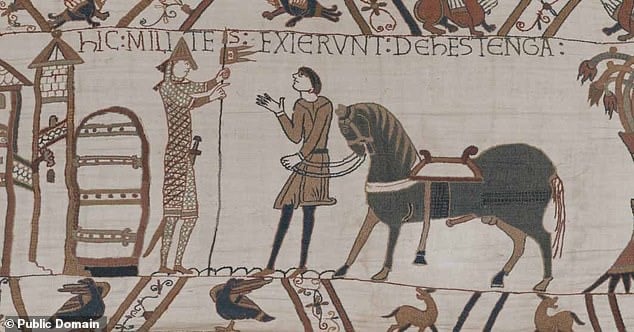
The Bayeux Tapestry has gone on display at the British Museum for the first time since it was created nearly a millennium ago, reigniting a scholarly dispute over exactly how many penises are woven into the famous depiction of the Battle of Hastings.
The Bayeux Tapestry has arrived in Britain for the first time in almost 1,000 years, going on display at the British Museum following a landmark cultural agreement between Britain and France. The 70-metre embroidered artwork, which depicts Norman king William the Conqueror’s 1066 victory over Saxon King Harold, was transported into the museum overnight as part of a high-security, high-tech operation. Alongside renewed public fascination with the medieval masterpiece, its arrival has revived a long-running academic disagreement among historians over the precise number of penises depicted across the artwork.
Not Actually a Tapestry
Despite its name, the Bayeux Tapestry is not technically a tapestry at all. It is an embroidered linen cloth, decorated using coloured wool thread and several distinct embroidery techniques, rather than woven on a loom in the traditional sense. It is widely regarded as one of the most significant surviving works of medieval art, and is on loan from France’s Musée de la Tapisserie de Bayeux while its permanent home in Normandy undergoes extensive conservation and renovation work. At the British Museum, it is being housed in a specially designed, climate-controlled gallery, with tightly managed temperature, humidity and light levels to protect the fragile embroidery.
The Original Count: 93
The debate over the tapestry’s more risqué imagery was sparked by Professor George Garnett, an Oxford University expert in medieval history, who has claimed to be the first person to formally tally the number of penises depicted in the artwork. Speaking at a conference, Garnett said the tapestry contains 93 penises in total, with the largest belonging to the horse ridden by William the Conqueror.
Writing about his findings for the BBC’s History Extra website, Garnett explained his motivation for the count. “The Bayeux Tapestry can arouse obsessiveness of many kinds in modern historians,” he wrote. “One type involves tallying the number of images. There are, we are told, 626 humans, 190 horses, 35 dogs, 37 trees, 32 ships, 33 buildings, etc., in the tapestry. To the best of my knowledge, no-one has yet tallied the number of penises. By my calculations there are 93 penises in what survives of the original tapestry.” Garnett has argued the imagery is far from incidental, suggesting the male anatomy featured throughout the piece “alert viewers to themes of betrayal and deceit central to the tapestry’s account of the Norman invasion of England.”
A Disputed 94th Addition
Garnett’s tally has since been challenged. Dr Christopher Monk, a medieval scholar and specialist in Anglo-Saxon nudity, argued last year that a 94th penis had been overlooked, pointing to a contested image of a running man depicted wearing a tunic. While the vast majority of genital imagery in the tapestry is attached to naked figures, this particular case remains disputed precisely because the figure is clothed.
Speaking on the History Extra podcast, Monk was unequivocal in his assessment. “I am in no doubt that the appendage is a depiction of male genitalia – the missed penis, shall we say?” he said. “The detail is surprisingly anatomically fulsome.”
Garnett, however, has stood by his original interpretation, maintaining that the image in question depicts a weapon rather than anatomy. “It’s quite clear to me that what is being depicted in that instance is the scabbard of his sword or dagger because right at its end is a yellow blob, which I take to be probably a depiction of brass,” he said.
A Wider Story of Craftsmanship and Mystery
Beyond the ongoing dispute over its more unusual details, the British Museum exhibition explores the broader history of the tapestry, including the events leading up to the Battle of Hastings, the craftsmanship behind its creation, and the symbolism embedded throughout its imagery, much of which continues to raise unanswered questions for historians nearly a thousand years after it was made.
