



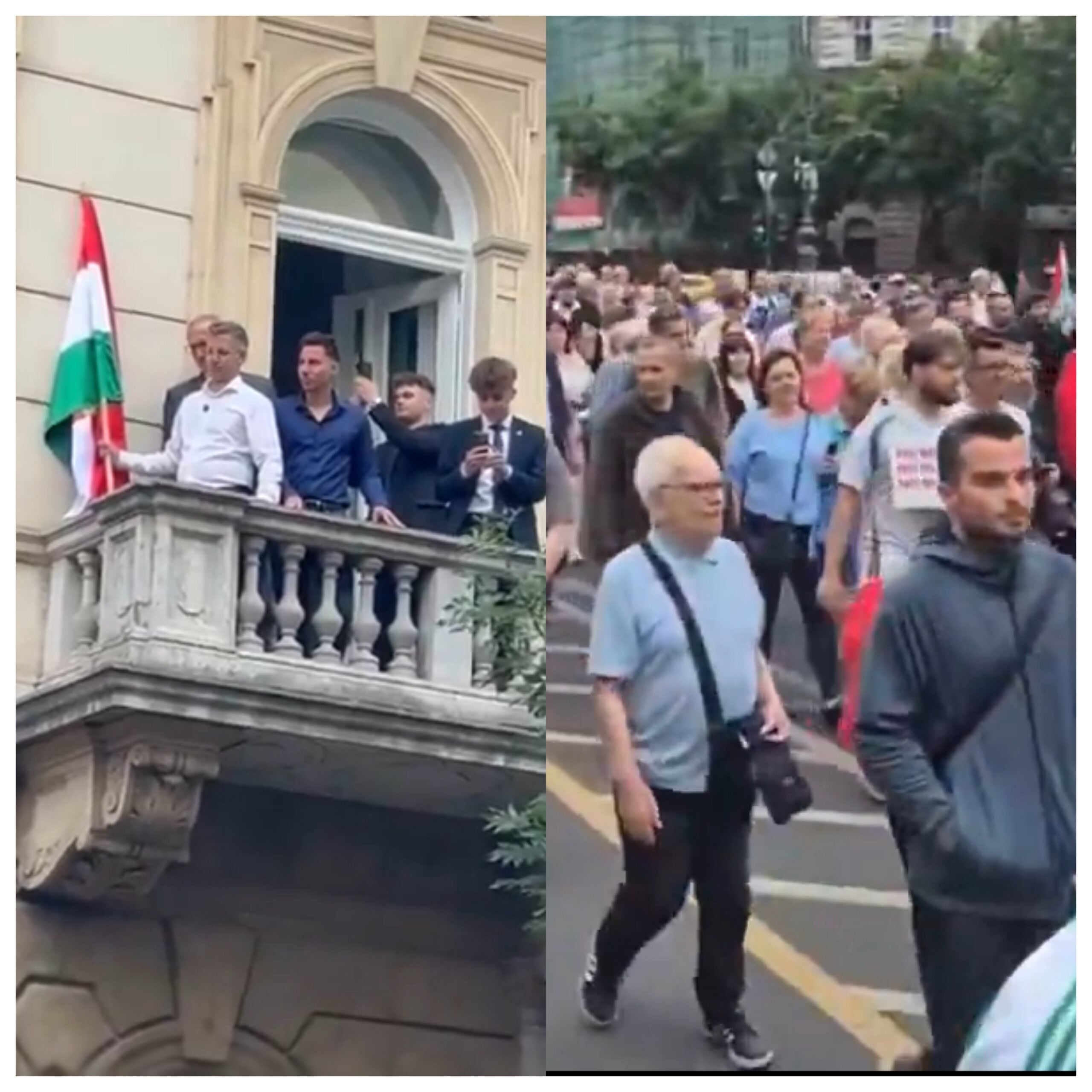
Tens of thousands of Hungarians marched through central Budapest on Thursday in one of the largest anti-migration protests since the country’s change of government, chanting “Traitor!” at their new Prime Minister as he appeared on a balcony to wave at the crowds below — an extraordinary scene that laid bare the deep divisions still fracturing Hungarian society just weeks into Péter Magyar’s premiership.
The demonstration, supported by backers of former Prime Minister Viktor Orbán’s Fidesz party and the Our Homeland Movement, proceeded from Kodály körönd toward Kossuth Square near Parliament. Protesters carried Hungarian flags and signs reading “NO MIGRATION,” their anger directed at what many see as Magyar’s willingness to soften Hungary’s hardline stance under pressure from Brussels, ahead of the European Union’s Migration and Asylum Pact taking effect on 12 June.
The defining moment came as the march passed the headquarters of Magyar’s Tisza Party. The Prime Minister stepped onto the balcony in a white shirt, smiling, waving, applauding the crowd and holding a Hungarian flag alongside an EU flag as members of his team stood alongside him filming the scene. The response from the street was immediate and unmistakable. Demonstrators raised fists, phones and flags while chanting “Áruló!” — Traitor — in thunderous unison, along with “Betrayal!” and “Shame on you!” Some could be heard calling out “Viktor! Viktor!” in reference to Orbán, whose 16-year rule Magyar’s party ended in a landslide election victory in April 2026. Video footage of the balcony confrontation spread rapidly across social media. No comment from Magyar’s office on the incident had been issued at the time of publication.
The protest draws on a deep well of Hungarian public sentiment. In a 2016 referendum on EU migrant quotas, more than 3.3 million Hungarians voted against mandatory migrant relocation — 98.36 per cent of valid ballots. The vote was ultimately invalid due to turnout falling below the required 50 per cent threshold, but Orbán’s government treated it as an unambiguous expression of the national will, and that sentiment has clearly not dissipated under the new administration.
Magyar has positioned himself as pro-EU while maintaining a publicly hardline stance on immigration. But signals that his government may accept limited aspects of the EU pact — in order to avoid financial penalties and unlock Brussels funding — have triggered exactly the backlash on display in Budapest on Thursday. The protest underscores a fundamental tension at the heart of his early premiership: a governing coalition that won power on a pro-European platform now faces a significant portion of the population that views any compromise with Brussels on migration as a betrayal of the Hungarian national interest.
