



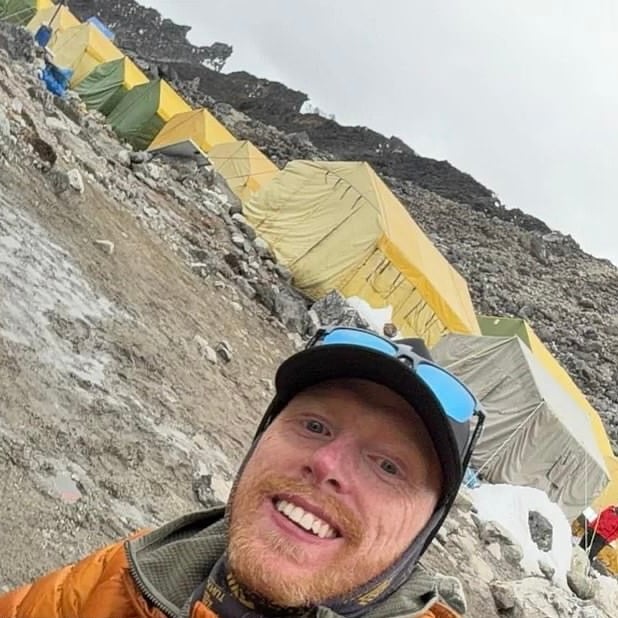
A deaf BBC presenter who summited Mount Everest was left stranded alone in the mountain’s lethal “death zone” for up to three hours after losing contact with his Sherpa guide during the descent — surviving the ordeal by thinking of his children before being reunited with his guide lower down the mountain.
Michael Woods, 36, a British Sign Language presenter from Liverpool, reached the summit of the world’s highest peak on Thursday as part of a charity climb for the National Deaf Children’s Society. But during his descent near the Hillary Step, at nearly 29,000 feet above sea level, he became separated from his Sherpa in one of the most dangerous stretches of high-altitude mountaineering.
Woods described the experience on social media after safely returning from the expedition. “I was up near the Hillary Step for around two to three hours, completely alone with nobody around me,” he wrote. “In that moment, my kids came into my mind, and I fought my way back down to stay alive.” The Hillary Step sits within the death zone — the altitude above 26,000 feet where oxygen levels are critically low and the human body begins to deteriorate rapidly, making every moment of delay potentially fatal.
Initial reports suggested Woods had required a rescue at the summit, a characterisation he was quick to correct. “A lot of the news got it wrong. I was not rescued. My guide Sherpa came back up to meet me around halfway, approximately 8,400 metres, to support me on my descent back to Camp Four,” he wrote. Lakpa Sherpa, managing director of 8K Expeditions, which organised the climb, confirmed that members of the expedition team assisted Woods and another climber in descending safely.
Woods had been candid about the scale of the challenge in the days before his summit push, posting from Camp Four that he was about to face “the hardest part” of his life. “It’s crazy to think after more than ten years of dreaming, training and working towards this moment, I’m finally here,” he wrote. “Whatever happens, I’m super proud of how far I’ve come.” He also spoke of battling illness and exhaustion during the climb. “There were moments during this expedition where I genuinely didn’t know if I could make it,” he said, “especially after being sick and struggling with energy, but somehow I found a way to keep fighting all the way to the top of the world.”
Following his descent, Woods reflected on what the achievement meant to him. “Standing on the summit of Mount Everest is something I’ll never ever forget. This is not just a summit for me. This is years of dreaming, sacrifice and proving to myself that anything is possible if you refuse to give up.” The Everest climb forms part of his broader goal to complete the Seven Summits challenge — scaling the highest peak on each of the world’s seven continents.
His ascent took place during what is shaping up to be the busiest season in Everest’s recorded history. A record 274 climbers reached the summit in a single day last Wednesday, according to Rishi Ram Bhandari of the Expedition Operators Association Nepal, surpassing the previous record of 223 set on Nepal’s southern route on 22 May 2019. This year’s season began later than usual due to concerns about a large serac — a block of glacial ice — hanging over the key summit route. Around 494 climbers and an equal number of Sherpa guides are expected to attempt the 29,032-foot peak before the season closes at the end of this month. Chinese authorities have closed the northern Tibetan route this year, concentrating all traffic on the Nepalese side.
Thousands of climbers have reached Everest’s summit since Edmund Hillary and Tenzing Norgay first stood on its peak on 29 May 1953.
