



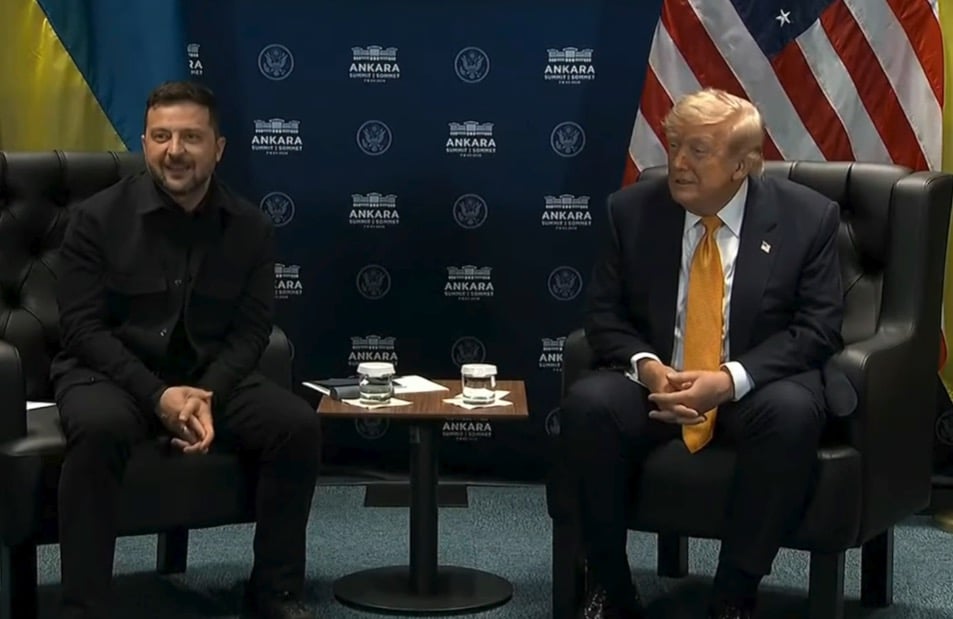
Volodymyr Zelensky joked he could not safely meet Vladimir Putin in Moscow due to Ukrainian drone strikes, during a strikingly warm exchange with Donald Trump at the NATO summit in Turkey that also saw the US president offer Kyiv a licence to manufacture Patriot air-defence missiles.
Donald Trump and Volodymyr Zelensky put on a display of warmth at Wednesday’s NATO summit in Turkey, a marked shift from their fractious history, as the US president floated giving Ukraine the right to manufacture its own Patriot interceptor missiles. Asked by Trump whether he would travel to Moscow to meet Vladimir Putin, a smirking Zelensky quipped: “It’s difficult, there are many Ukrainian drones there… it’s dangerous for me.” The lighthearted exchange came against the backdrop of Ukraine’s sustained drone campaign against Russian energy infrastructure, which has left Moscow and other cities grappling with a fuel crisis.
From White House Bust-Up to NATO Love-In
Wednesday’s cordial exchange stood in sharp contrast to the two leaders’ infamous clash at the White House in February 2025, when Trump repeatedly criticised Zelensky on live television, sending Washington-Kyiv relations to their lowest point. Eighteen months on, Trump’s tone toward Ukraine appears to have shifted considerably, with the summit itself, in his words, showing “a lot of love” and “a lot of unity” among NATO leaders. He described the gathering as a “great meeting.”
A Licence to Build Patriot Missiles
The centrepiece of Trump’s remarks was an offer to license Ukraine to produce Patriot air-defence missiles domestically, including the interceptor missiles themselves rather than just components of the wider system — a move that would mark a significant shift in US defence cooperation with Kyiv. “So one of the things we’re going to be talking about is we’re going to give a licence to you to make Patriots,” Trump told Zelensky. “That’s pretty cool, right. This way, you can’t complain that we’re not giving them enough.” Trump also indicated that Washington holds significant influence over US defence manufacturers and suggested his administration could encourage companies to help facilitate the licensing arrangement.
Patriot systems remain central to protecting Ukrainian infrastructure from Russian drone and missile attacks, with a single battery costing more than £750million to produce and individual missiles priced at around £370million — costs that domestic Ukrainian production could substantially reduce. Zelensky welcomed the proposal, thanking Trump and describing it as an important step, and said he wanted to discuss further details on strengthening Ukraine’s air defences during their meeting. The talks took place just hours after Russia launched another ballistic missile and drone attack on Ukraine, underscoring Kyiv’s continued push for additional Patriot systems.
Security Guarantees and a Possible Putin Meeting
Trump also assured Zelensky he would work on security guarantees for Ukraine, something the Ukrainian leader has described as a critical component of any eventual peace deal. Trump said he would be willing to close Ukrainian airspace if necessary for security purposes, and suggested that Putin’s conditions for ending the war had become less maximalist over the past year. He added that he hoped Putin and Zelensky could meet directly as soon as possible, expressing hope that such talks could help bring the war closer to a resolution.
While Trump said he believed both Russia and Ukraine wanted peace, he described both Putin and Zelensky as “difficult” negotiating partners. He also praised Ukraine’s rapid progress in drone production, suggesting the United States could benefit from closer cooperation with Kyiv’s defence industry. Trump went further still, suggesting he might visit Ukraine himself and calling Kyiv a “beautiful city,” though he joked his own security team might not welcome such a trip.
Europe Braces for a New Security Reality
Away from the warmth between Trump and Zelensky, the summit carried a more sobering message for European security, according to John Lough, a former NATO first permanent representative in Moscow. He told The Sun the gathering showed Europe was moving to strengthen its own defences without relying on US support as it once did. “The Europeans now understand that the US is no longer going to be guaranteeing their security as before and that they need to do something about it,” Lough said. “This is going to create a new reality for Russia. Europe is the new potential adversary.”
Lough said he expected the Kremlin to view the West’s renewed commitment to European defence as a genuine threat, and predicted a corresponding Russian military response. “They’re in the process of strengthening the defences of Kaliningrad Region, the exclave that borders Lithuania and Poland,” he said. “They fear it could be blockaded if there were a military confrontation with NATO. Over the coming years, they will reinforce their military presence in the north to counterbalance Finland and Sweden’s accession to NATO. They need to re-build their armies and take steps to increase the resilience of societies.”
