



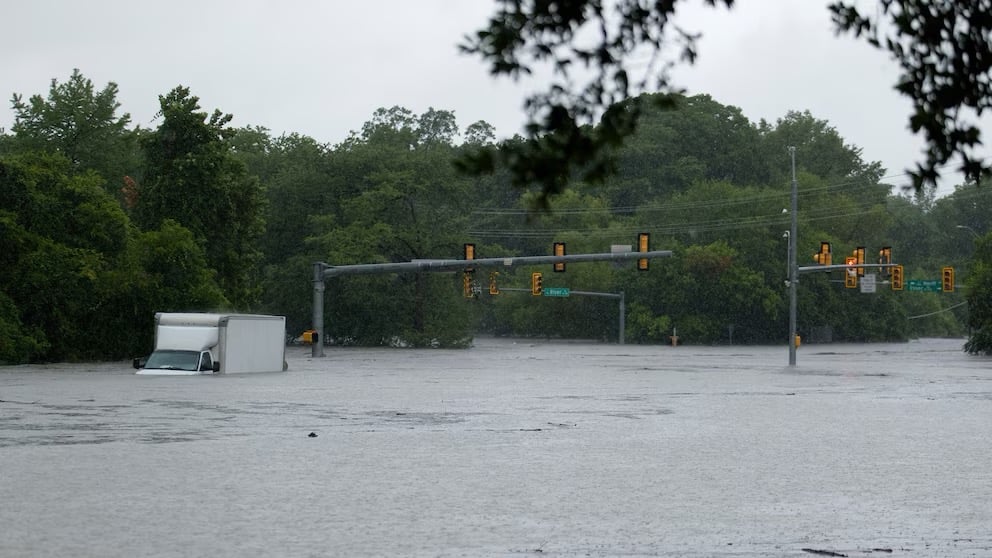
Torrential rain has triggered flash flood emergencies across Texas Hill Country, forcing evacuations and water rescues in Kerrville, Hunt, Uvalde and Knippa as rivers surged to dangerous levels overnight. Governor Greg Abbott has declared a state of disaster in 59 counties, warning that the storm could bring even heavier rainfall than the deadly floods that struck the region a year earlier.
As of Thursday morning, two flash flood emergencies remained active across the region, with authorities warning of life-threatening flooding and reports of water entering buildings in multiple communities. Kerrville, the town where the deadly Camp Mystic flooding occurred in July 2025, was among the areas affected, alongside Hunt, Uvalde and Knippa, where evacuations and water rescues were reported throughout the night.
Rivers rising at record speed
The scale of the flooding was evident in how quickly local waterways rose. The Guadalupe River at Hunt climbed from 9 to 19 feet between 3am and 4am local time, cutting off access to several roads and bridges in the process. Downstream, the river gauge at Center Point rose 32 feet in just four hours, with forecasters expecting it to reach a crest similar to the catastrophic flood recorded on 4 July 2025.
The National Weather Service escalated its flash flood emergency warning on Thursday, stating that a “large and deadly flood wave” had begun moving along the Guadalupe River around Kerrville, continuing downstream through Center Point and on towards Comfort, Waring, Sisterdale, Crown and Bergheim.
Bridge inspected amid safety fears
In Comfort, engineers were called in to assess the bridge carrying Highway 87 over the Guadalupe River, after concerns that the force of the floodwater may have compromised its structural integrity, Kendall County Judge Shane Stolarcyz told ABC News. Engineers ultimately concluded the bridge remained structurally sound for the time being, ABC News reported. Fast-moving water beneath the bridge could be seen carrying debris downstream, while 63 residents sought shelter with their pets at the town’s evacuation centre as the storm passed through. Authorities said the water had begun to recede by Thursday but cautioned that a second wave was possible later in the day, though not expected to reach the severity seen that morning.
Extreme rainfall totals across the region
Rainfall rates of 2 to 4 inches per hour were forecast for parts of the region, with the Uvalde area recording up to 20 inches of rain over the previous 48 hours, more than six months’ worth of rainfall for the area, including 8 inches that fell within just two hours. Boerne, located roughly 55 miles southeast of Camp Mystic, also came under a flash flood emergency warning from the National Weather Service on Wednesday afternoon, with residents urged to move to higher ground immediately. “This is a PARTICULARLY DANGEROUS SITUATION,” the NWS warning stated. “SEEK HIGHER GROUND NOW!” A rain gauge near Boerne recorded 3.5 inches of rainfall within a single hour on Wednesday morning, while Cibolo Creek rose 10 feet in just 90 minutes, reaching a record-high level of more than 22 feet.
Further south, a flash flood emergency was also issued for D’Hanis, roughly 60 miles southwest of Boerne, where between 4 and 10 inches of rain fell according to the NWS. Local officials urged residents in flood-prone areas near the rapidly rising Seco Creek to relocate to higher ground without delay.
State response mobilised across dozens of agencies
Speaking at a press conference on Wednesday, Governor Abbott confirmed disaster declarations had been made for 59 counties, with further counties possibly to be added as conditions evolve. He said more than 75 people had already been rescued, and warned that rainfall from the storm could ultimately exceed 30 inches, roughly 10 inches more than was recorded during the previous year’s deadly floods. “We are dealing with and responding to a flood that is likely going to break records,” Abbott said. “There are over 1,300 state personnel from more than 30 agencies that are already activated. More than 800 vehicles, more than 75 boats, and 20 aircraft have been deployed. Our primary focus right now and throughout the remainder of this torrential rain is saving lives.”
Communities cut off as rescues continue
In Boerne, emergency crews responded to dozens of water rescue calls, with more than 50 people seeking refuge at an emergency shelter after floodwaters isolated entire neighbourhoods. In Uvalde, officials reported that parts of the city had become completely cut off by rising water, with rescue operations continuing as roads remained submerged. Despite the scale of the flooding, authorities said no fatalities had been confirmed as of Thursday morning, even amid widespread evacuations and numerous water rescues across the region.
What’s driving the flooding
Meteorologists attributed the flooding to days of repeated thunderstorms falling on already saturated ground, rather than a single storm system, resulting in exceptional runoff across Texas Hill Country, an area often referred to as “Flash Flood Alley.” More than six million people across central and south Texas remained under flood watches, with forecasters warning that further heavy rain could trigger additional dangerous flash flooding in the days ahead.
