



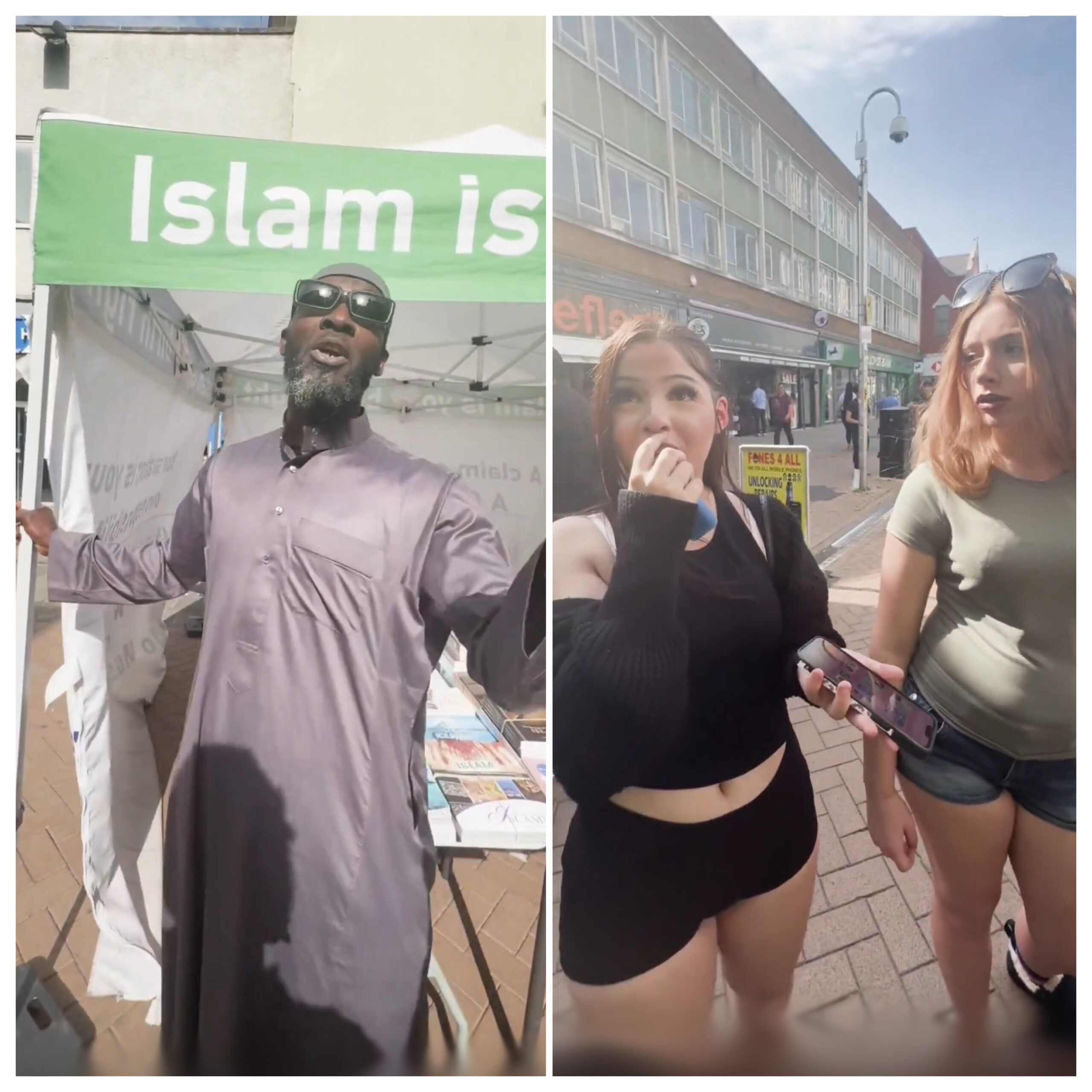
Two young women have confronted a street preacher in Croydon, south London, after alleging he had told them they deserved to be raped because of their clothing — claims the preacher emphatically denied before security officers intervened and escorted the women away.
The video, shared widely on X on Sunday 24 May, shows the two women — one wearing shorts, one a crop top — approaching a robed preacher and his security team beside a stall bearing the banner “Islam is your birthright.” The women insist the alleged comment was directed at them, or at girls dressed similarly, earlier in the day. The preacher, who appears to be of African origin and is wearing sunglasses, repeatedly denies the accusation, calls the women liars and demands that police be called. SIA-approved security officers linked to a Croydon-based operation then step in and escort the women from the scene. No police are seen attending during the footage.
No independent verification of the alleged original remark has emerged, and no police report has been confirmed. The clip is edited and contains no audio of any earlier exchange between the parties. Whether what was allegedly said constituted a direct statement, a clumsy invocation of religious modesty concepts, a misunderstanding or a fabrication cannot be established from the footage alone.
The video has nonetheless attracted significant attention online, prompting widespread calls for the preacher’s deportation and reigniting a long-running debate about what many viewers describe as a double standard in the policing of public religious expression in Britain. Critics have repeatedly pointed to cases in which Christian street preachers have faced arrest for quoting scripture or expressing views on sexuality, while arguing that comparable or more provocative statements from other religious groups have drawn less intervention from authorities — an inconsistency that policing bodies have been challenged to explain on numerous occasions.
The incident occurred in a borough that has itself been at the centre of previous controversies involving street dawah activity and public order. Views linking women’s dress to sexual violence exist within some conservative religious traditions. However, mainstream Islamic scholarship widely and explicitly condemns rape as a grave sin and rejects victim-blaming in unambiguous terms.
No statement from the Metropolitan Police had been issued at the time of publication.
