



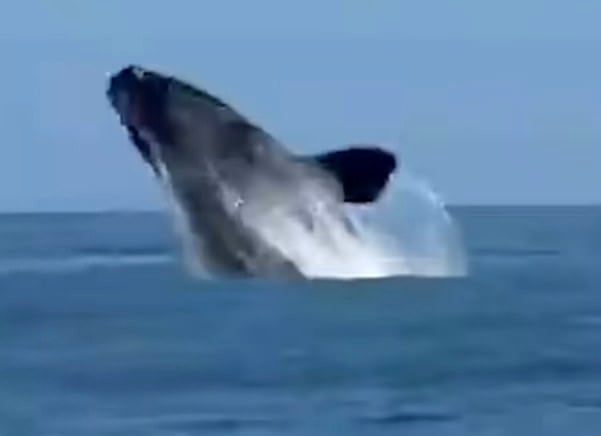
A researcher says he saw the critically endangered animal breach 10 to 15 times off the Outer Banks, calling it the most incredible moment of his career.
A rare North Atlantic right whale has been seen repeatedly leaping clear of the water off North Carolina’s Outer Banks, according to a marine researcher who witnessed it. John Felter, a research operations technician at the Coastal Studies Institute in Wanchese, was on a boat with five others on 30 October, the day before Halloween, when the whale appeared. He told WAVY-TV 10 that seeing it breach was “akin to seeing a unicorn”. The species is among the most endangered large whales in the world.
“Absolutely the most incredible thing”
Mr Felter said he heard the captain shout “Whale!”, but by the time he turned to the front of the boat he saw only a large splash and feared he had missed it. He said capturing the moment would have been career-defining, given how rare the species is.
“Seeing one playing, like leaping fully out of the water, breaching 10 to 15 times, that’s akin to seeing a unicorn,” he said. “It was just absolutely the most incredible thing I’ve seen in my career for sure.”
Why the species is so rare
According to NOAA Fisheries, about 384 North Atlantic right whales, within a range of 375 to 394, were alive two years ago. “They are the most critically endangered whale in the world,” Mr Felter said. “There’s less than 400 of them that we know of, and only 70 that we know of are breeding females.”
NOAA Fisheries says researchers use specialised electronic equipment to find whales and study their behaviour, migration routes, dive depths and habitat. Mr Felter’s crew had learned that a whale had been spotted near the Chesapeake Bay, which was unusual, as whales are not typically tracked and tagged in the way sharks are.
Individual whales can be identified harmlessly from photos, videos and surveys because of unique skin growths on their heads called callosities, he explained. “We suspect that it’s the whale known as Calvin, because she’s a breeding female, and she was seen most recently near the Chesapeake Bay and headed south,” he said.
Protecting the whales from ships
Right whales swim slowly near the surface and have no dorsal fin, which makes them notoriously hard for ships to spot. To prevent collisions, captains usually reduce speed by 10 knots in designated seasonal zones and keep a 500-yard buffer around any right whale, five times the distance required for other large whale species.
Mr Felter urged boat operators to “be responsible and vigilant when operating in areas where any protected species may be nearby”. He said a collision with a speedboat could be just as lethal as one with a 100-foot shipping tanker. Whales, he added, are “blissfully unaware of what humans have delineated as shipping lanes”.
