



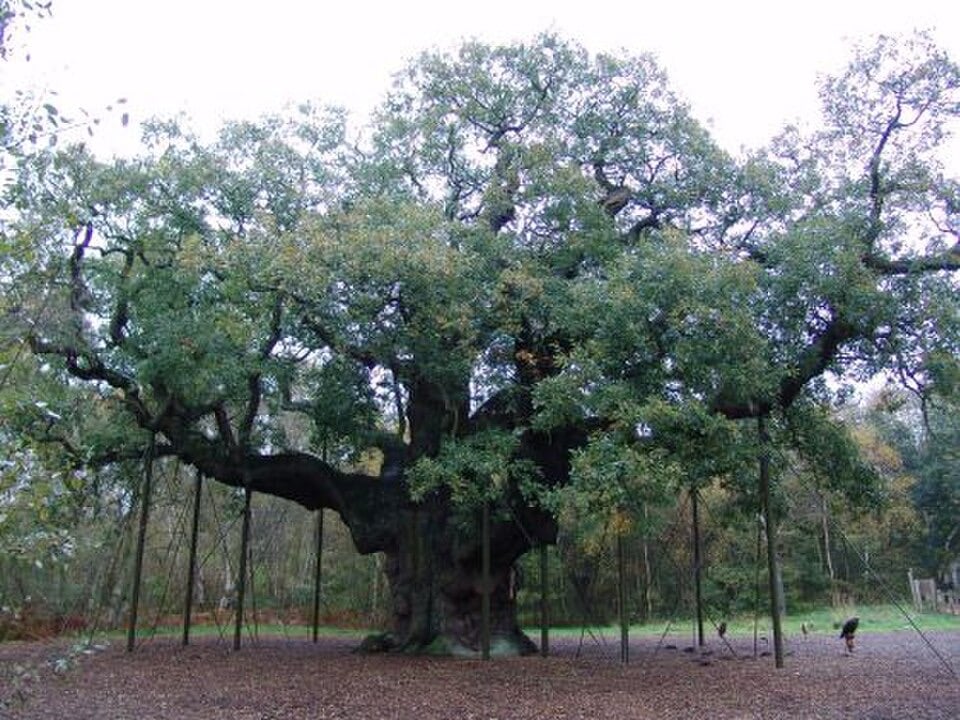
The ancient oak tree said to have sheltered Robin Hood and his Merry Men in Sherwood Forest appears to have died after failing to produce a single leaf for the first time in living memory, marking a heartbreaking milestone for what is widely regarded as the UK’s most famous tree.
The Major Oak, which has stood in Nottinghamshire’s Sherwood Forest for more than 1,000 years, has not budded this spring — an ominous sign for a tree that conservationists say has been in decline for years. The Royal Society for the Protection of Birds confirmed the tree’s deterioration, saying attempts to protect it appear to have fallen short of reversing a long-term decline driven by a combination of factors including the sheer weight of its own fame.
Despite being roped off to protect its root system, the Major Oak draws up to 350,000 visitors a year, and soil testing around the tree has revealed ground compacted to the consistency of concrete in some areas. This means rainfall can no longer penetrate the soil around the roots effectively. The situation has been compounded by increasingly frequent heatwaves and droughts, alongside the natural challenges of extreme old age.
The tree first became widely known after featuring in Major Hayman Rooke’s book in 1790, and is steeped in legend as the hiding place of Robin Hood and his band when fleeing the Sheriff of Nottingham. It is among the largest oak trees in the UK and has inspired centuries of stories, poetry and artwork.
Hollie Drake of RSPB Sherwood Forest said the tree’s legacy would endure despite its apparent death. “We know the Major Oak will have a lasting legacy, first and foremost because it is so inextricably linked to Robin Hood,” she said. “But beyond its cultural heritage, the Major Oak will continue to provide important habitat for wildlife, reminding us why these remarkable trees are so important. The invaluable knowledge gleaned from taking care of this beloved tree will inform best practices in how we look after ancient oak trees going forwards, not just here but around the world.”
Dame Judi Dench, who has long championed the cause of ancient trees, paid tribute to the Major Oak. “The Major Oak has provided inspiration for countless stories, poems, paintings and people for more than a thousand years — all the while itself teeming with life and providing a home to an enormous range of wildlife,” she said. “Ancient trees like this one have put air in our lungs and serenity in our hearts for centuries.”
Conservation groups are using the tree’s apparent death to call for stronger legal protections for ancient woodland across the UK. Ed Pyne, Senior Conservation Adviser at the Woodland Trust, said: “The Major Oak was the very first tree recorded on our Ancient Tree Inventory, but recording trees alone will not halt their catastrophic decline. We urgently need stronger legal protections for our ancient woods and trees, as well as more investment in their active care.”
The tree will nonetheless live on in a different form. Acorns, cuttings and saplings taken from the Major Oak have been planted across the world, ensuring its genetic heritage endures long after the original has fallen silent.
