



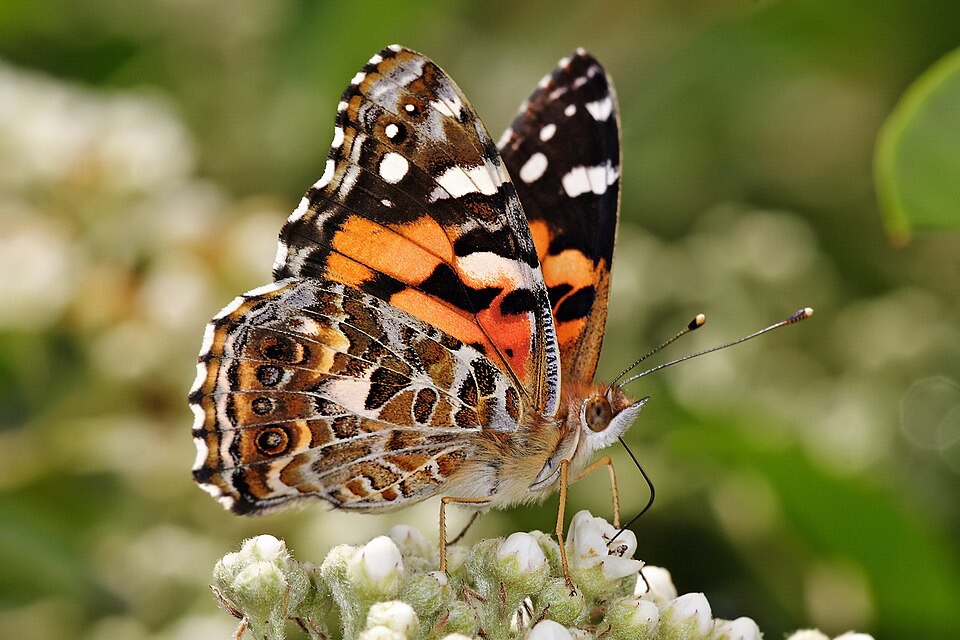
Painted lady butterflies have begun arriving in unusually large numbers and earlier than usual this year, raising hopes among naturalists for one of the spectacular “painted lady summers” that occur only occasionally when conditions align for a mass migration from North Africa.
The first sighting in Weardale came in mid-May, after tantalising reports of early arrivals in Wales and Cumbria had circulated on social media from mid-April onwards. Since then, the orange, black-tipped, white-spotted butterflies have appeared in striking numbers, basking on footpaths baked hard by recent heatwave conditions and nectaring on dandelions in groups rather than as isolated individuals — a pattern observers say they cannot recall seeing so early in the season.
The painted lady’s migration is one of the most remarkable in the natural world. Some of the earliest arrivals are believed to fly directly from Morocco on southerly winds, an extraordinary marathon for an insect, while most travel in relays, crossing the Mediterranean to breed in France and Spain before continuing northwards. Because the butterfly’s life cycle from egg to adult takes only around six weeks, numbers multiply exponentially as successive generations push further north, building into a rolling, multigenerational wave that can break across British shores from midsummer onwards.
Such mass arrivals are the stuff of legend among lepidopterists. A particularly memorable invasion occurred in 1996, when hundreds of painted ladies were seen settling in flowery clifftop grassland along the coast near Whitby, with that migration reaching as far as Orkney and Shetland. The most recent comparable mass migration occurred in 2009, as reported by the Guardian at the time, though the scale and frequency of these events depend heavily on favourable winds and settled weather.
What happens to this year’s arrivals remains an open question. There is time for two further generations to be produced before autumn frosts set in, with caterpillars feeding on thistles. Until 2012, it was assumed that all painted ladies in Britain perished during the wet, cold winter months. That year, researchers at the University of York discovered that the species undertakes a previously unknown autumn reverse migration, flying back towards Africa at altitudes too high for ground-based observers to detect.
There is, however, another possibility worth considering as Britain’s climate continues to warm: how long before some painted ladies are able to overwinter successfully in the milder counties of southern England? For now, much of the butterfly’s appeal lies precisely in the epic nature of its journey — a journey that begins, for at least some individuals, in Morocco. Whether that same flutter of excitement at a first sighting would survive if the journey instead began somewhere closer to home, in the Mendips rather than Marrakech, is something every butterfly-watcher might quietly wonder.
