



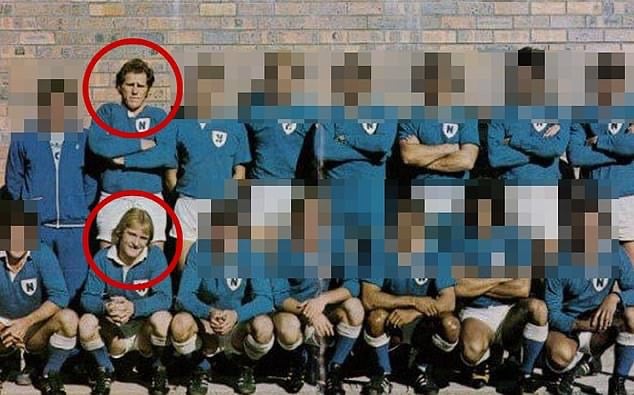
In the history of Australian rugby league, no single dressing room has produced a more extraordinary catalogue of crime than the 1975 Newtown Jets — a team whose roster included a man who would become one of Queensland’s most notorious armed robbers, another who rotted in a Bangkok prison for drug smuggling, and a third whose wife’s disappearance became one of Australia’s most gripping murder cases.
The Jets, a foundation club of the NRL who had just rebranded from the Bluebags two years earlier, fielded a competitive side in 1975. What nobody could have known at the time was that three of the men lacing up their boots in that dressing room would go on to make national headlines for reasons that had nothing to do with football.
Garry Sullivan: The Test Forward Who Turned Robber
If any single story captures the duality of the Jets’ infamous squad, it is Garry Sullivan’s. On the field, he was everything a club could want — a tough lock forward from Kurri Kurri who earned selection for the Australian Kangaroos after just six first-grade appearances and went on to play seven Tests, represent New South Wales and feature in Australia’s victorious 1970 World Cup campaign before appearing in the 1972 World Cup final against Great Britain.
By the mid-1970s, Sullivan was one of the hardest forwards in the game. What followed would make his football career almost a footnote.
A decade after wearing the green and gold, Sullivan was carrying out armed robberies. Between 1985 and 1991, he and his stepfather Bill Orchard targeted banks and armoured cash vehicles across Queensland, stealing more than $3 million in what reports at the time described as six of the biggest robberies in Queensland history. The motive was gambling. When police caught up with them in 1991, both were convicted and sentenced to 20 years. Sullivan served around two years before escaping from Borallon Correctional Centre in 1993 and spending over three decades in hiding, including two decades on the Gold Coast.
Even that was not the end. In May 2026, at the age of 78, Sullivan was arrested on the Gold Coast after Victoria Police reopened their investigation into the armed robbery of an Armaguard cash collection at Chadstone Shopping Centre in Melbourne in 1994. Police allege he was the masked gunman who shot three men before escaping with cash. Prosecutors intend to rely on recordings obtained through a secret listening device and telephone intercepts. Sullivan has been charged with armed robbery, intentionally causing injury, theft and firearms offences. The allegations remain before the courts and are unproven. His lawyer has told the court he is in poor health, suffering from coronary artery disease, mouth cancer and coeliac disease.
Paul Hayward: The Footballer Who Died in the Shadow of Bangkok
Paul Hayward’s story is one of pure tragedy. The tough five-eighth was one of Newtown’s most popular figures in the 1970s — a talented footballer who also boxed professionally and was known as a fearless competitor seemingly destined for many more years in the game.
In October 1978, Hayward was arrested in Bangkok after Thai authorities discovered 8.4 kilograms of heroin in his possession. His football career ended instantly. He was sentenced to 20 years in Thailand’s notorious Bang Kwang prison, feared around the world for its brutal conditions.
More than six years into his sentence, an Australian journalist who visited him found a man trying desperately to stay positive amid overcrowded cells, disease, poverty and crushing isolation. “I blame myself, I got myself into this,” Hayward said from behind prison walls. While inside, he missed watching his children grow up. His youngest daughter was born after his arrest and he never met her. Both of his parents died while he was incarcerated. He later contracted HIV after using a contaminated syringe in prison.
A royal pardon came in 1989 after more than a decade behind bars. Freedom brought no redemption. Unable to rebuild his life after returning to Sydney, Hayward struggled to reconnect with family, friends and ordinary existence. The years inside had left wounds that never healed. In May 1992, just three years after his release, he died from a heroin overdose. He was 38 years old.
Chris Dawson: The Teacher’s Pet and Australia’s Most Infamous Murder
If Sullivan became notorious for armed robbery and Hayward for tragedy, Chris Dawson became the face of one of the most enduring murder mysteries in Australian history.
The former Jets forward spent five seasons with Newtown after switching from rugby union, including as part of the 1973 championship-winning side. He later built a career as a physical education teacher on Sydney’s northern beaches and appeared, for years, to be living a quietly respectable suburban life.
Then his wife Lynette vanished.
The 33-year-old mother of two disappeared from the couple’s Bayview home in January 1982 and was never seen again. Dawson claimed she had walked out on the family and joined a commune. Police accepted the explanation. Just days after Lynette’s disappearance, Dawson moved a teenage student and family babysitter — with whom he had been conducting a sexual relationship while she was his pupil — into the matrimonial home. Suspicion lingered for decades but the case went nowhere.
Everything changed in 2018 when the true-crime podcast The Teacher’s Pet reignited worldwide interest in the case. Months later, Dawson was charged with murder. In 2022, Supreme Court Justice Ian Harrison found him guilty, ruling that Dawson had killed Lynette to remove what he described as an obstacle to a new life with the teenager he had become obsessed with. Justice Harrison said Dawson treated his wife as “completely dispensable” and murdered her for the “selfish and cynical purpose” of pursuing his desired future. Lynette’s body has never been found.
Dawson was sentenced to 24 years with a non-parole period of 18 years. In 2023 he was further convicted of unlawful sexual activity with the teenage student. His appeal against the murder conviction was dismissed in 2024. Now 77, he is unlikely ever to walk free — his non-parole period expires in 2041, when he will be in his nineties, and New South Wales’ no-body, no-parole laws present a further hurdle to any future release.
Three players. Three catastrophic afterlives. One dressing room that no sport has ever matched for sheer criminal notoriety.
